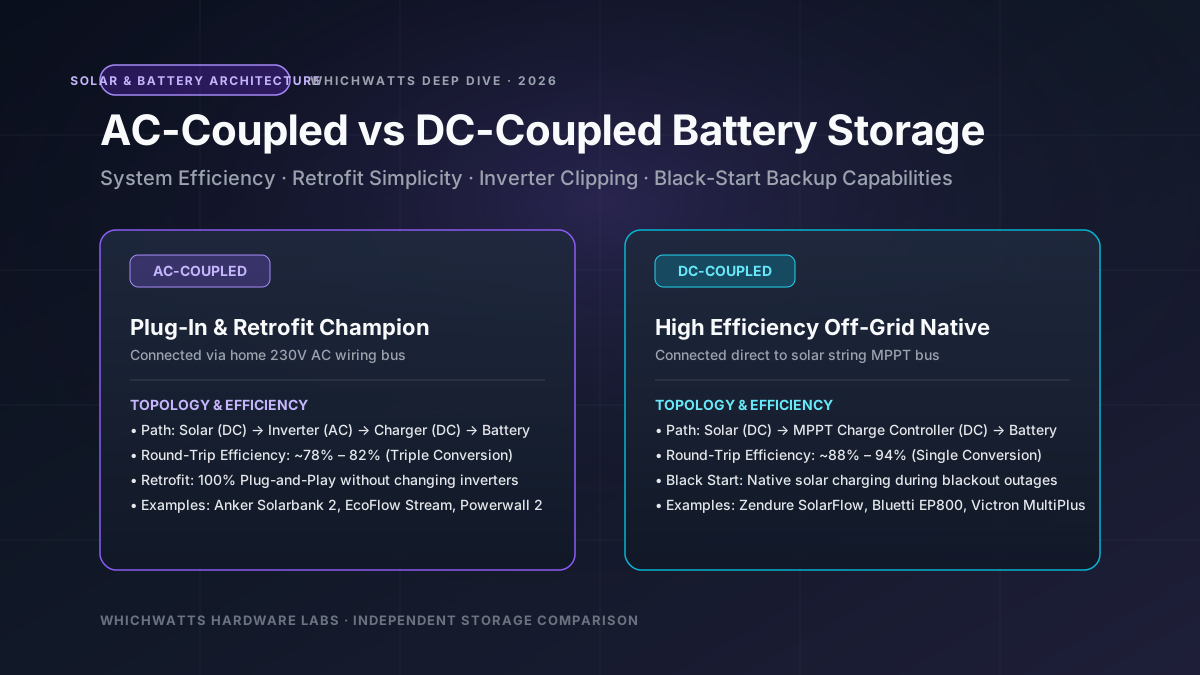
Direct answer: Understand the fundamental differences between AC-coupled and DC-coupled battery storage systems, including round-trip efficiency, inverter conversion losses, retrofit simplicity, and blackout islanding backup.
Editorial note: WhichWatts is an independent comparison site. Prices, availability, specifications, and retailer promotions change frequently. Check the live product table and retailer page before buying.
AC-Coupled vs DC-Coupled Battery Storage: Efficiency, Retrofitting & Backup Comparison
As solar self-consumption surges and time-of-use smart tariffs become the gold standard for household energy savings, adding battery storage has evolved from an enthusiast niche into an essential home upgrade. Whether you are installing an 800W balcony solar system or expanding a 4kW rooftop array, you must answer one fundamental architectural question:
Should you choose an AC-coupled or a DC-coupled battery storage system?
This decision determines your system's lifetime electrical efficiency, how easily it retrofits into your existing wiring, how much it costs upfront, and crucially, whether your home can keep running when a winter power cut knocks out the public grid.
This guide provides an engineering-grade breakdown of AC-coupled versus DC-coupled architectures, comparing round-trip efficiency losses, installation complexity, microinverter compatibility, off-grid islanding capabilities, and leading commercial hardware in 2026.
1. DC-COUPLED SYSTEM (Single Conversion Path):
[Solar PV Array (DC)] ──> [MPPT Charge Controller] ──> [Battery Storage (DC)]
                                     │
                             Single DC-to-AC Inverter
                                     │
                                     ▼
                           [AC Household Loads]

2. AC-COUPLED SYSTEM (Triple Conversion Path):
[Solar PV Array (DC)] ──> [Solar Inverter (AC)] ──> [230V AC Home Bus]
                                                           │
                                             Bi-Directional Battery Inverter
                                                    (AC ──> DC ──> AC)
                                                           │
                                                           ▼
                                                 [Battery Storage (DC)]
1. System Architecture: How Energy Flows
The core difference between the two systems lies in where the battery connects to your home's electrical circuits:
The DC-Coupled Architecture
In a DC-coupled system, both your solar panels and your battery bank share a common Direct Current (DC) busbar. Solar energy generated by your photovoltaic cells flows through a Maximum Power Point Tracking (MPPT) charge controller directly into the battery cells—DC to DC, with no conversion to alternating current required.
Only when your household appliances call for power does the system’s hybrid inverter convert stored DC energy into 230V AC mains electricity.
The AC-Coupled Architecture
In an AC-coupled system, the solar panels and the battery operate on completely separate circuits linked by your home’s existing 230V Alternating Current (AC) wiring:
- Solar panels feed direct current into a dedicated solar inverter or microinverter, converting DC into 230V AC.
- If household appliances are not running, that surplus AC power travels through your home's wiring to an AC-coupled battery storage unit (such as an Anker Solix Solarbank 2 E1600 Pro, an EcoFlow PowerStream battery setup, or a Tesla Powerwall 2).
- The battery's internal bi-directional inverter rectifies that 230V AC electricity back into DC to charge the battery cells.
- Later that evening, when your lights and fridge demand power, the battery inverts that stored DC back into 230V AC for a second time.
2. The Efficiency Showdown: The Triple Conversion Penalty
Every time electrical energy changes form—from Direct Current (DC) to Alternating Current (AC) or vice-versa—solid-state transistors, transformers, and inductor coils generate waste heat. In modern electronics, each conversion step carries a 3% to 7% energy tax.
Here is how that conversion penalty compounds across each architecture:
| Energy Flow Stage | DC-Coupled System Path | AC-Coupled System Path |
|---|---|---|
| Solar Generation to Battery Storage | Solar (DC) → MPPT Controller → Battery (DC) • Efficiency: 97% |
Solar (DC) → Microinverter (AC) → Battery Charger (DC) • Efficiency: 96% × 93% = ~89.3% |
| Battery Storage to Home Appliances | Battery (DC) → Hybrid Inverter → 230V AC Loads • Efficiency: 95% |
Battery (DC) → Battery Inverter → 230V AC Loads • Efficiency: 93% to 94% |
| Total Solar-to-Battery-to-Load Round-Trip Efficiency (RTE) | 89% to 94% Net RTE | 78% to 83% Net RTE |
What Does an 11% Efficiency Gap Mean in Pounds and Pence?
Assume an 800W plug-in solar kit or rooftop system cycles 1,200 kWh through battery storage every year over a 10-year period (12,000 kWh lifetime throughput):
- DC-Coupled System (92% RTE): Delivers 11,040 kWh of usable household energy.
- AC-Coupled System (81% RTE): Delivers 9,720 kWh of usable household energy.
- Lost Energy: 1,320 kWh wasted as invisible heat.
- At an average electricity price of £0.26 per kWh, that 11% round-trip penalty costs approximately £343 in lost savings over the battery's operational lifetime.
3. Retrofitting & Installation Flexibility: Why AC-Coupled Dominates
If DC-coupling is noticeably more efficient, why are AC-coupled systems dominating the 2026 consumer retrofit and balcony solar markets?
The answer comes down to installation simplicity, modularity, and zero disruption:
Existing Rooftop / Balcony Panels
          │
  Existing Solar Inverter (Unchanged)
          │
  Home Consumer Unit / Wall Socket ◄─── PLUG IN ANY AC-COUPLED BATTERY
- No Inverter Replacement Required: If you already have a working solar array with string inverters or microinverters (Hoymiles, Enphase, SolarEdge), adding a DC-coupled battery forces you to scrap your existing inverter and install an expensive hybrid inverter. An AC-coupled battery simply connects into an existing subpanel or domestic wall socket.
- Freedom of Physical Location: A DC-coupled battery must be installed adjacent to the high-voltage DC solar cable entry point. An AC-coupled battery can sit in a detached garage, basement, or utility room—wherever standard AC wiring is accessible.
- Multi-Source Charging & Grid Arbitrage: AC-coupled batteries excel at charging from any AC source. If you subscribe to dynamic time-of-use tariffs (like Octopus Agile or Octopus Flux), an AC-coupled battery charges from the grid at 3:00 AM for pennies per kWh with identical efficiency, regardless of whether you have solar panels at all.
4. Black-Start & Outage Islanding: Who Wins in a Blackout?
A critical consideration during winter power cuts is whether your battery can keep your home running when the grid fails:
Standard AC-Coupled Limitations:
Under safety regulations (such as G98/G99 in the UK and IEEE 1547 in the US), grid-tied inverters must feature mandatory anti-islanding protection. When mains electricity cuts out, standard AC microinverters and solar inverters must shut down within 500 milliseconds to avoid electrocuting utility repair crews.
Because a standard AC-coupled battery relies on grid AC frequency (50 Hz / 60 Hz) to synchronize, most basic AC-coupled storage systems turn off entirely during a power cut. Even if your battery is at 100% capacity and bright sun is shining on your panels, you sit in the dark.
The Modern Exception: Premium modern AC-coupled home systems (such as the Tesla Powerwall 3 or GivEnergy All-In-One with Gateway) incorporate automatic physical isolation switches that island your home from the street grid, creating a localized 50Hz microgrid that keeps solar inverters running.
The DC-Coupled Off-Grid Native Advantage:
DC-coupled systems with hybrid inverters inherently support true Black Start and Solar Islanding:
- If the grid dies for four consecutive days, your solar panels continue to charge your DC battery bank every morning via the internal MPPT controller, completely independent of the public electrical grid.
- Dedicated EPS (Emergency Power Supply) backup ports supply continuous pure sine wave AC to critical home circuits.
5. Technical Comparison Matrix (2026)
| Feature / Criteria | DC-Coupled Battery Storage | AC-Coupled Battery Storage | Winner |
|---|---|---|---|
| Round-Trip Efficiency | 89% to 94% (Single conversion) | 78% to 83% (Triple conversion) | 🏆 DC-Coupled (+10% more usable energy) |
| Retrofit Simplicity | Complex (Requires replacing solar inverter) | 100% Plug-and-Play into existing wiring | 🏆 AC-Coupled |
| Balcony Solar Compatibility | Ideal for standalone DC power station kits | Ideal for all-in-one smart microinverter kits | 🤝 Tie (Use-case dependent) |
| Off-Grid Solar Recharging in Blackouts | Native black-start capability via solar MPPT | Requires expensive automatic transfer gateway | 🏆 DC-Coupled |
| Off-Peak Tariff Arbitrage (Grid-to-Battery) | Requires AC rectification stage | Direct AC charging from home mains | 🏆 AC-Coupled |
| Cable Voltage & Safety | High-Voltage DC strings (up to 500V DC) | Standard 230V AC building wiring | 🏆 AC-Coupled (Standardized domestic safety) |
| Average Upfront System Cost (Installed) | Higher initial capital for complete setup | Lower entry barrier for existing solar owners | 🏆 AC-Coupled |
6. Leading Hardware Systems in 2026
Best AC-Coupled Systems:
- Anker Solix Solarbank 2 E1600 Pro: The undisputed benchmark for plug-in balcony storage. Features an integrated 800W microinverter, 4 independent MPPT solar trackers (up to 2,400W PV input), 1.6kWh to 9.6kWh modular LFP storage, and direct 230V AC grid synchronization.
- EcoFlow PowerStream Ecosystem: Blends portable DELTA series power stations with a grid-tied microinverter, routing daytime solar to household baseload while dumping excess into portable batteries for evening use.
- GivEnergy All-In-One (Home Scale): 13.5kWh usable LiFePO4 battery paired with a 6kW bi-directional AC-coupled inverter, offering 100% whole-home backup switchover within 20 milliseconds.
Best DC-Coupled Systems:
- Zendure SolarFlow Hyper 2000: Innovative bi-directional DC-coupled balcony hub with integrated ZenLink local communication, connecting high-yield DC solar panels directly to AB2000 LFP battery packs before inverting to AC.
- Bluetti EP800 Home ESS: Modular 7.6kW / 9.9kWh to 19.8kWh DC-coupled hybrid storage platform engineered for off-grid homesteads and whole-home blackout resilience with zero conversion losses.
Buying Verdict: Which Should You Choose?
- Choose AC-Coupled If: You already own rooftop or balcony solar panels and want to add battery storage without touching your existing microinverter, or you primarily want to exploit cheap off-peak smart tariffs (like Octopus Agile or Economy 7) to store cheap night energy for daytime use.
- Choose DC-Coupled If: You are installing a brand-new solar and battery setup from scratch, you want maximum round-trip efficiency from your solar harvest, or you live in an area prone to extended, multi-day winter blackouts where off-grid solar black-start recharging is a vital survival feature.
Helpful Next Steps & Tools
- Model your solar harvest and storage capacity on our Solar Calculator.
- Calculate device runtimes with our Power Station Sizing Calculator.
- Review current battery storage pricing and £/Wh metrics in our Live Price Comparison Table.
- Explore our curated rankings in Best Portable Power Stations with Solar Charging.
FAQ
What is the main difference between AC-coupled and DC-coupled batteries?
In a DC-coupled system, solar panels feed electricity directly into the battery via a DC charge controller without any alternating current conversion. In an AC-coupled system, solar energy is first converted into 230V AC by a solar inverter, and the AC-coupled battery must invert that power back into DC to store it, resulting in slightly higher conversion losses.
Why do AC-coupled batteries lose more energy?
AC-coupled systems suffer from a "triple conversion penalty": Solar Direct Current (DC) is converted to Alternating Current (AC) by the microinverter, then converted back from AC to DC to charge the battery cells, and finally inverted from DC back to AC to power household appliances. Each conversion stage loses roughly 3% to 7% of energy as heat, lowering overall round-trip efficiency to around 78%–83% compared to 89%–94% for DC-coupled systems.
Can an AC-coupled battery charge from solar panels during a power outage?
Only if the system includes a certified automated islanding gateway or dedicated Emergency Power Supply (EPS) socket. Standard grid-tied AC microinverters immediately disconnect when the mains grid fails to comply with anti-islanding safety regulations. Unless an isolation gateway simulates a local 50Hz AC grid, the solar panels cannot generate power and the AC-coupled battery cannot recharge from the sun during an outage.
Which battery system is better for smart off-peak tariffs like Octopus Agile?
AC-coupled batteries are outstanding for smart tariff arbitrage. Because they connect directly to your home's 230V AC wiring, they can charge at high speed from cheap off-peak overnight grid electricity and discharge during peak morning and evening pricing hours, delivering substantial bill savings even during sunless winter months.