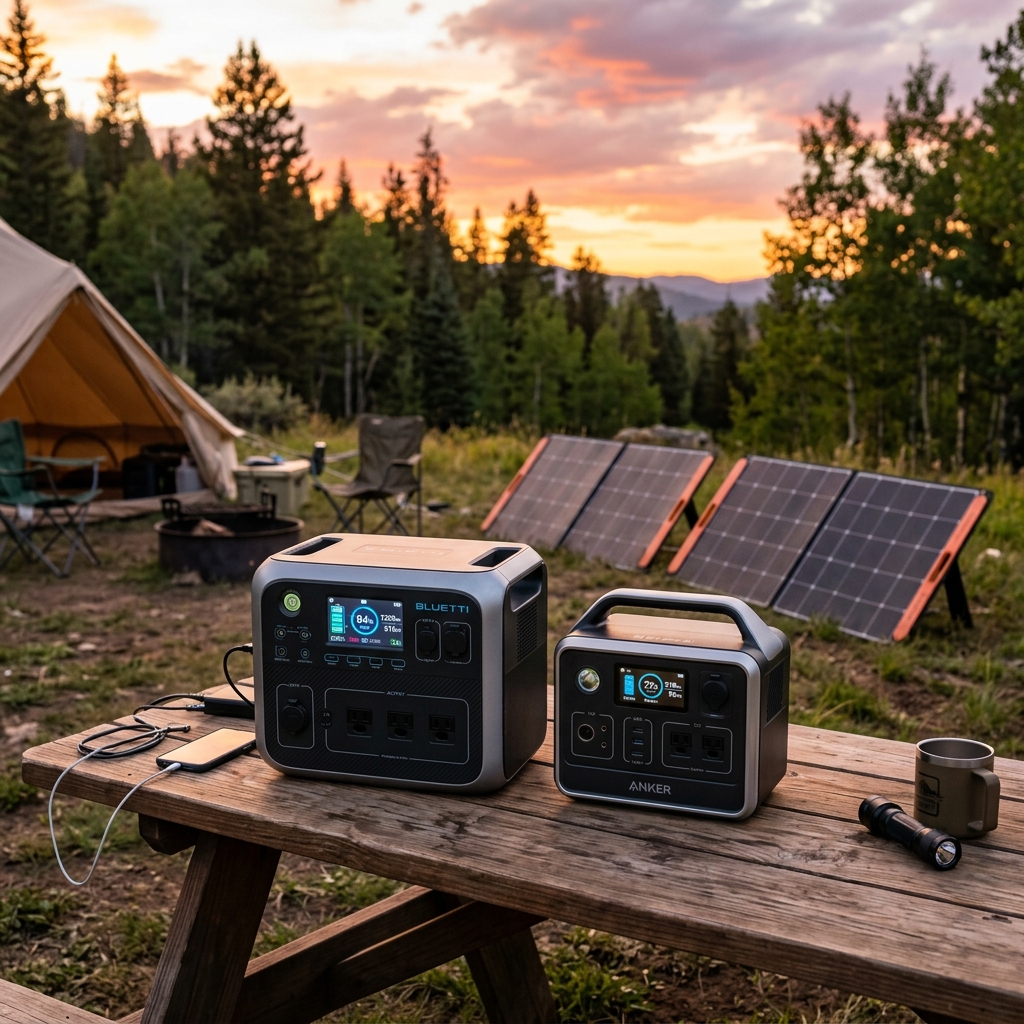
Direct answer: Fact-checked 2026 buying guide comparing capacity, LiFePO4 battery chemistry, cost per watt-hour ($/Wh), solar input, and real use cases for EcoFlow, Jackery, Anker, and Bluetti.
The best portable power station depends entirely on your use case: the EcoFlow River 2 Pro suits most people balancing capacity and portability, the Jackery Explorer 1000 v2 wins for off-grid camping, and the Anker Solix C1000 offers the lowest cost per watt-hour for budget-conscious buyers. But "best" is only useful if it matches your needs, not the reviewer's.
Most portable power station buying guides list products without explaining why you'd choose one over another. This guide shows you how to decide based on real power math, battery chemistry, and true value.
→ Compare Live Prices & $/Wh across 16 Manufacturers
→ Take the Interactive Power Station Recommender Quiz
What Makes a Portable Power Station Actually Useful
A portable power station is a rechargeable battery pack equipped with AC outlets, USB ports, and a built-in inverter. You charge it at home via a wall outlet or off-grid using solar panels, then use it to power phones, laptops, CPAP machines, camping gear, or home appliances during outages.
Unlike gas generators, they are completely silent, produce zero toxic emissions, and require no fuel or maintenance. Unlike a basic phone power bank, they output pure sine wave AC electricity just like your home sockets. Most units hold enough energy for 1–3 days of light use or 4–8 hours of heavy appliance loads.
The golden rule: Capacity matters far more than brand hype. A 256Wh station (Jackery Explorer 300) runs a 40W laptop for ~6 hours. A 2048Wh station (Jackery 2000 v2) runs that same laptop for over 45 hours. You must know what you actually intend to power.
The Portable Power Station Buying Guide: Capacity vs. Portability vs. Price
1. Capacity Tiers: Match It to Your Real Use Case
- 256Wh – 512Wh (7 – 14 lbs): Phones, tablets, drones, and laptops. Ideal for weekend day trips, outdoor photography, or emergency backup for single devices.
- 700Wh – 1500Wh (17 – 30 lbs): Laptops, mini-fridges, CPAP machines, and TV/Wi-Fi setups. Ideal for car camping, tailgating, or partial home backup during blackout events.
- 2000Wh+ (40 – 100+ lbs): Full-sized refrigerators, power tools, microwaves, and medical devices. Ideal for off-grid RVing, job sites, or multi-day home backup.
How to calculate your needs:
Wattage of Device (W)×Hours of Use=Watt-Hours (Wh) Needed.
Example: A 60W CPAP machine run for 8 hours requires 480Wh. Factoring in ~15–20% inverter efficiency loss, you would want a station rated for at least 600Wh.
2. Cost Per Watt-Hour ($/Wh): The Metric Most Reviews Skip
To evaluate true value across different brands, divide the retail price by the capacity in watt-hours:
$$\text{Cost per Watt-Hour} = \frac{\text{Price ($)}}{\text{Capacity (Wh)}}$$
- Budget & Sales: $\approx $0.45 – $0.65\text{ / Wh}$
- Standard & Mid-Tier: $\approx $0.65 – $0.85\text{ / Wh}$
- Premium & Flagships: $\approx $0.85 – $1.15\text{ / Wh}$
If two units cost the same, but unit A has 1056Wh and unit B has 768Wh, unit A offers significantly better raw value per dollar. Don't overpay for brand prestige when raw capacity is identical.
→ View Current Best Value Power Stations Sorted by $/Wh
3. Battery Chemistry: LiFePO4 vs. Ternary Lithium (NMC)
Most modern power stations use LiFePO4 (Lithium Iron Phosphate). Older or ultra-budget units use NMC / Ternary Lithium.
| Feature | LiFePO4 (LFP) | Ternary Lithium (NMC) |
|---|---|---|
| Lifespan (to 80% capacity) | 3,000 – 4,000+ Cycles (10+ Years) | 500 – 1,000 Cycles (2–4 Years) |
| Safety & Thermal Stability | Extremely High | Moderate |
| Weight per Wh | Slightly Heavier | Slightly Lighter |
Rule of thumb: Only buy LiFePO4 for any station you plan to own for more than 2 years. A $1,500 station with a 3,000-cycle lifespan costs far less per year than a $1,200 station that degrades after 500 cycles.
The Best Portable Power Stations by Real Use Case
Best for Most People: EcoFlow River 2 Pro
- Specs: 768Wh capacity | 17.2 lbs | 800W AC Output (1600W X-Boost) | 100W USB-C | 70-min AC Fast Charge
- Price Range: ~$450 – $600
- Why it wins: Excellent balance of capacity and weight. Recharges 0–100% in just 70 minutes. Perfect for camping, roadside emergencies, and light home backup without lugging a 30-lb box.
Best for Off-Grid Camping: Jackery Explorer 1000 v2
- Specs: 1070Wh capacity | 23.8 lbs | 1500W AC Output | LiFePO4 (4,000+ cycles) | 1-Hour Emergency Charge
- Price Range: ~$650 – $850
- Why it wins: Compact body with folding handle. Jackery's v2 lineup fixed the slow charging of older models while keeping their renowned durability and solar pairing reliability.
Best Value Per Watt-Hour: Anker Solix C1000
- Specs: 1056Wh capacity | 28.4 lbs | 1800W AC Output (2400W SurgePad) | 600W Solar Input | 58-min AC Fast Charge
- Price Range: ~$550 – $750
- Why it wins: Offers one of the lowest $/Wh ratios in the 1kWh class. Includes a fast 600W solar input controller, quiet fan profile, expandable battery port, and true 20ms UPS capability.
Best for Ultra-Portability: Jackery Explorer 300 / 300 Plus
- Specs: 293Wh (Standard) / 288Wh (Plus) | 7.1 lbs (Standard) / 10.4 lbs (Plus) | Dual 300W AC Outlets
- Price Range: ~$180 – $260
- Why it wins: Easy grab-and-go size for weekend trips, tailgating, and charging laptops/drones away from grid power. (Note: For airline carry-on under 100Wh, look at mini power banks like the Jackery Explorer 100 Plus at 2.1 lbs).
Best Budget Mid-Capacity: Bluetti EB70S
- Specs: 716Wh capacity | 21.4 lbs | 800W AC Output (1400W Surge) | Dual 100W USB-C Ports
- Price Range: ~$400 – $500
- Why it wins: Solid LiFePO4 capacity under $500. Good for pass-through charging and small appliances. (If you require automated uninterruptible home backup under 20ms switch time, step up to the Bluetti AC180 or Anker C1000).
Key Takeaways
- Capacity in Watt-Hours (Wh) matters more than brand power. Match Wh capacity to what you will actually run.
- Calculate Cost per Watt-Hour ($/Wh) to fairly compare sales across different capacity tiers.
- Insist on LiFePO4 chemistry for 3,000+ cycle longevity (10+ year lifespan).
- Solar input capability (in Watts) dictates off-grid recharge speed; a 1000Wh station needs 400W–600W solar input to charge in a single sunny day.
- Don't buy a massive 2000Wh+ station unless you need to power high-draw appliances like refrigerators or AC units; weight scales dramatically above 1500Wh.
FAQ
Can I use a portable power station as a UPS (Uninterruptible Power Supply)?
Some models support true UPS functionality with a <20ms transfer time (e.g., Anker Solix C1000, EcoFlow Delta 2, Bluetti AC180), which keeps desktop PCs and Wi-Fi routers running during power flickers. Basic pass-through models take longer to switch and may cause sensitive electronics to reset.
Should I buy solar panels with my power station?
Only if you intend to recharge off-grid or prepare for extended power outages. Wall charging is faster, 100% efficient, and free of weatherproof constraints. Solar panels add $150–$500+ to your setup cost and are best added when outdoor usage demands it.
How long will a portable power station last?
With LiFePO4 chemistry, expect 8 to 10+ years of regular use before capacity drops to 80%. With older ternary lithium (NMC) chemistry, expect 3 to 5 years. To maximize lifespan, avoid storing units at 0% or 100% charge for prolonged periods in extreme heat.
→ Explore All Portable Power Station Deals & Dynamic Comparison Tools