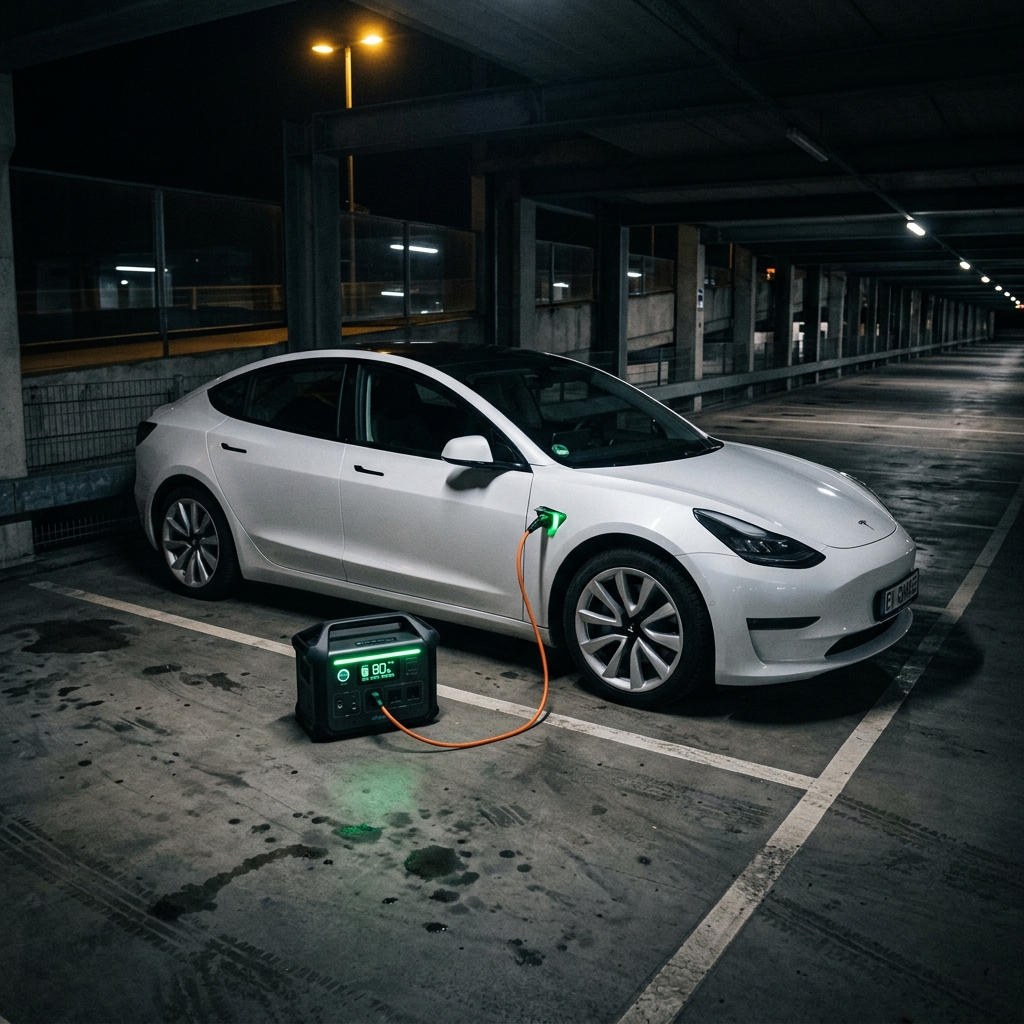
Direct answer: Discover whether you can charge an electric car from a portable power station in an emergency, why neutral-ground bonding is required, real miles added, and efficiency losses.
Editorial note: WhichWatts is an independent comparison site. Prices, availability, specifications, and retailer promotions change frequently. Check the live product table and retailer page before buying.
Can You Charge an EV with a Portable Power Station? Emergency Range, Ground Bonding & Real-World Limits
The idea of carrying a portable power station in the boot of your electric vehicle as an "emergency jerry can of electricity" is one of the most appealing concepts in modern motoring. Running out of charge miles away from a motorway service station or rapid DC charger is every EV driver's worst scenario.
However, connecting an electric car to a portable battery station is not as simple as plugging in a toaster. EV onboard chargers enforce strict grounding safety checks, draw sustained high currents that can overheat portable inverters, and suffer notable double-conversion efficiency penalties.
This technical guide breaks down the physics, electrical safety requirements, grounding workarounds, and real-world range calculations so you know exactly what to expect before relying on a portable battery station for roadside EV rescue in 2026.
┌─────────────────────────┐         ┌─────────────────────────┐         ┌─────────────────────────┐
│  Portable Power Station │ ──────> │   N-G Bonding Adapter   │ ──────> │   EV Level 1 Charger    │ ──────> [ EV Port ]
│ (2,048Wh LFP / 2,400W)  │         │ (Resolves Open Ground)  │         │ (Granny Cable @ 8A-10A) │
└─────────────────────────┘         └─────────────────────────┘         └─────────────────────────┘
The Floating Ground Problem: Why Your EV Refuses to Charge
When you plug an EV's Level 1 "granny charger" (such as a Tesla Mobile Connector, BMW Flexible Fast Charger, or aftermarket Type 2 / J1772 cable) into a domestic wall socket, the car's Electric Vehicle Supply Equipment (EVSE) performs an automated safety hand-shake:
- It verifies supply voltage and frequency (230V / 50Hz in the UK/Europe, 120V / 60Hz in the US).
- It measures the resistance between Neutral and Earth (Ground). In household electrical panels, neutral and earth are bonded together at the main intake (TN-C-S / PME or TN-S earthing).
- If the EVSE detects continuous continuity to ground, it closes its internal contactor and begins delivering AC current.
The Power Station Dilemma
Almost all portable power stations use a floating neutral inverter architecture. The AC output sockets have Live and Neutral, but the Earth pin is unbonded (it floats with no reference to neutral). This design is standard and safe for standalone isolated appliances like laptops, fridges, or power tools.
However, when an EV charger detects this floating ground, its internal monitoring circuit triggers an immediate fault:
- Tesla: Rapidly flashes red "Ground Fault / Check Power Source".
- Kia / Hyundai: EVSE screen displays "Error / Ground Missing".
- Volkswagen / MG: Flashes yellow/red fault LED and refuses to close the high-voltage contactors.
The Solution: A Neutral-Ground Bonding (NGB) Plug
To allow the EVSE to pass its safety self-check, you must provide a reference between Neutral and Earth. This is achieved using a Neutral-Ground Bonding (NGB) adapter plug:
- An NGB plug is an enclosed dummy plug with a low-resistance internal connection bridging the Earth pin to the Neutral pin.
- When inserted into one of the power station's AC sockets, it creates a bonded reference across all parallel AC outlets on the unit.
- The EV charging brick reads a verified ground path and immediately authorizes the charge cycle.
Safety Warning: Only use an NGB plug on a standalone, isolated portable power station. Never connect an NGB plug into a household mains wall circuit, as doing so violates electrical building regulations and can cause dangerous circulating neutral currents.
The Double-Conversion Efficiency Penalty
One of the biggest surprises for motorists is that a 2,000Wh (2kWh) power station does not deposit 2kWh of energy into your vehicle's traction battery. Electric vehicle AC charging involves a two-stage power conversion process, each with inherent thermal and parasitic losses:
- Power Station Inverter Loss (DC to AC): The power station's internal battery is low-voltage DC (typically 48V–51.2V in modern LiFePO4 units). The internal inverter steps this up to 230V/120V AC with an efficiency of 88% to 92%.
- EV Onboard Charger (OBC) Loss (AC to DC): The car's onboard charger converts that incoming AC power back into high-voltage DC (400V to 800V) to feed the vehicle's traction pack. EV onboard chargers are engineered for optimal efficiency at 7kW to 22kW. When throttled down to a trickle Level 1 rate of 1.5kW to 2.3kW, their efficiency drops drastically to 75% to 82%.
- Vehicle Wake Parasitics: While charging, the electric car's thermal management system, coolant pumps, computer processors, and instrument cluster remain active, consuming 200W to 350W continuously just to stay awake.
The Math: Net Delivered Energy
Let's calculate the net traction energy delivered by a 2,048Wh power station (such as an EcoFlow DELTA 2 Max or Bluetti AC200L):
- Nominal Stored Capacity: 2,048 Wh
- Usable Inverter Depth of Discharge (90%): 1,843 Wh AC available
- EV Onboard Rectification & Parasitic Efficiency (~78%): 1,843 Wh × 0.78 = ~1,437 Wh
- Net Energy Delivered to Traction Pack:
1.44 kWh (70% total system round-trip efficiency)
Nearly 30% of the portable battery's stored energy is dissipated as heat in the inverter, onboard charger, and vehicle computers.
How Many Miles Does a Power Station Add?
The table below calculates the realistic emergency miles added by common power station capacities across popular electric vehicles, assuming an average mild-weather driving efficiency of 3.5 to 4.0 miles per kWh:
| Power Station Capacity | Usable Stored Energy | Net Energy to EV Battery | Range Added (Tesla Model 3 / MG4 @ 4.0 mi/kWh) | Range Added (Ioniq 5 / EV6 / ID.4 @ 3.3 mi/kWh) | Time Required to Transfer Energy |
|---|---|---|---|---|---|
| 1,024 Wh (e.g. Delta 3 / C1000) | ~920 Wh | ~710 Wh (0.71 kWh) | 2.8 miles | 2.3 miles | ~25 minutes |
| 2,048 Wh (e.g. Delta 2 Max / AC200L) | ~1,843 Wh | ~1,440 Wh (1.44 kWh) | 5.8 miles | 4.8 miles | ~50 minutes |
| 3,840 Wh (e.g. Anker F3800 / Delta Pro) | ~3,450 Wh | ~2,700 Wh (2.70 kWh) | 10.8 miles | 8.9 miles | ~85 minutes |
| 6,144 Wh (2kWh Base + 2x Add-on Battery) | ~5,500 Wh | ~4,300 Wh (4.30 kWh) | 17.2 miles | 14.2 miles | ~2.5 hours |
The Verdict on Emergency Range
A standard 2kWh portable power station adds roughly 5 miles of emergency limp range.
In most populated regions, 5 miles is enough to get off a dangerous motorway hard shoulder, limp down a slip road to a service plaza, or reach a public 50kW+ rapid charger. However, it will not fully recharge your vehicle, and carrying 20kg to 35kg of battery in your boot on everyday journeys reduces your car's normal driving efficiency.
Continuous Amperage Limits: Why You Must Throttle Current
Most domestic 3-pin granny cables default to drawing 10 Amps (2,300W in the UK) or 12 Amps (1,440W in the US).
While high-end 2kWh power stations boast continuous AC ratings of 2,400W, running an inverter at 95% of its rated limit continuously for an hour inside a warm car boot can trigger high-temperature protection codes or drain the battery faster than expected.
Best Practice Current Settings:
- Reduce Charging Amperage in Vehicle Settings: In Tesla, Hyundai, Kia, and BMW companion apps or in-car infotainment screens, dial down the AC charging current from "Maximum" (16A/13A) to 8A or 10A.
- At 8A (230V): The car draws approximately 1,840W. This sits comfortably in the optimal 75% load band of a 2,400W inverter, keeping internal cooling fans quiet and operating temperatures manageable.
- Keep the Power Station Well-Ventilated: Never operate a portable power station inside an enclosed, sealed vehicle boot while charging. Place the station outside on dry pavement or leave the boot lid open to ensure unobstructed fan airflow.
Portable Power Station vs Petrol Generator vs Roadside Assistance
| Feature / Scenario | Portable Power Station (2kWh) | Compact Inverter Petrol Generator (2kW) | Breakdown Service (RAC / AA / AAA) |
|---|---|---|---|
| Initial Cost | £900 – £1,400 | £450 – £800 | £100 – £220 / year membership |
| Fuel / Maintenance | Zero fuel, zero oil changes | Petrol required, carburetor maintenance | None |
| Noise & Emissions | Silent, zero local emissions | Noisy (60–72 dB), toxic exhaust fumes | Diesel recovery truck |
| Readiness | Holds 80% charge for 6+ months | Fuel spoils after 3–6 months if untreated | 45–90 min average response time |
| Range Added per Hour | ~5 miles (fixed by battery capacity) | ~7 miles (runs until fuel tank empty) | Towed directly to rapid DC charger |
| Secondary Uses | Home blackout backup, camping, power tools | Outdoor worksites, emergency fuel backup | Roadside breakdown assistance only |
Recommended Systems for Vehicle Backup
If you want a portable power station that can double as an emergency EV range booster and a whole-home blackout backup system, shortlist models that deliver at least 2,400W of continuous pure sine wave output and support high solar input:
- EcoFlow DELTA 2 Max (2,048Wh LFP): 2,400W AC continuous (4,800W surge), fast 80-minute AC recharge, expandable up to 6,144Wh with modular packs.
- Bluetti AC200L (2,048Wh LFP): 2,400W continuous output, exceptional 3,600W Power Lifting mode, durable LiFePO4 cells rated for 3,500+ cycles.
- Anker Solix F2000 / F3800: Rugged pull-handle wheels for easy trunk maneuvering, up to 3,840Wh base capacity with high continuous AC output.
Helpful Next Steps & Tools
- Calculate your device runtime and watt-hour consumption on our Power Station Calculator.
- Compare current battery capacities, warranties, and cost-per-watt-hour in our Live Price Comparison Table.
- Explore high-capacity models in our Best 2kWh Power Stations curated ranking.
FAQ
Can a portable power station charge a Tesla or other EV?
Yes. A portable power station with a pure sine wave inverter and at least 1,800W continuous AC output can charge a Tesla, Kia, Hyundai, or any other EV via a Level 1 charging cable. However, you will need a neutral-ground bonding adapter so the car's charger recognizes a valid ground path.
How many miles of range will a 2kWh power station give an electric car?
After factoring in inverter losses (DC to AC) and vehicle onboard charger rectification losses (AC to DC), a 2,048Wh battery delivers approximately 1.44 kWh of net energy to the vehicle's traction pack. At typical driving efficiencies of 3.5 to 4.0 miles per kWh, this provides between 4.5 and 6 miles of emergency driving range.
Why does my EV charger flash a red ground fault error on a power station?
Portable power stations utilize a floating neutral inverter output for electrical safety, meaning there is no physical bond between the Neutral and Earth pins. EV charging cables monitor this connection and abort charging if ground is not detected. Inserting a Neutral-Ground Bonding (NGB) plug into a spare AC socket on the power station resolves the error.
Can emergency EV charging damage my portable power station?
No, provided you do not exceed the station's continuous wattage limit. To prevent the inverter from overheating during sustained Level 1 charging, reduce the car's AC charging current in your vehicle settings to 8A or 10A (around 1,800W) and ensure the power station's cooling vents remain completely unobstructed.