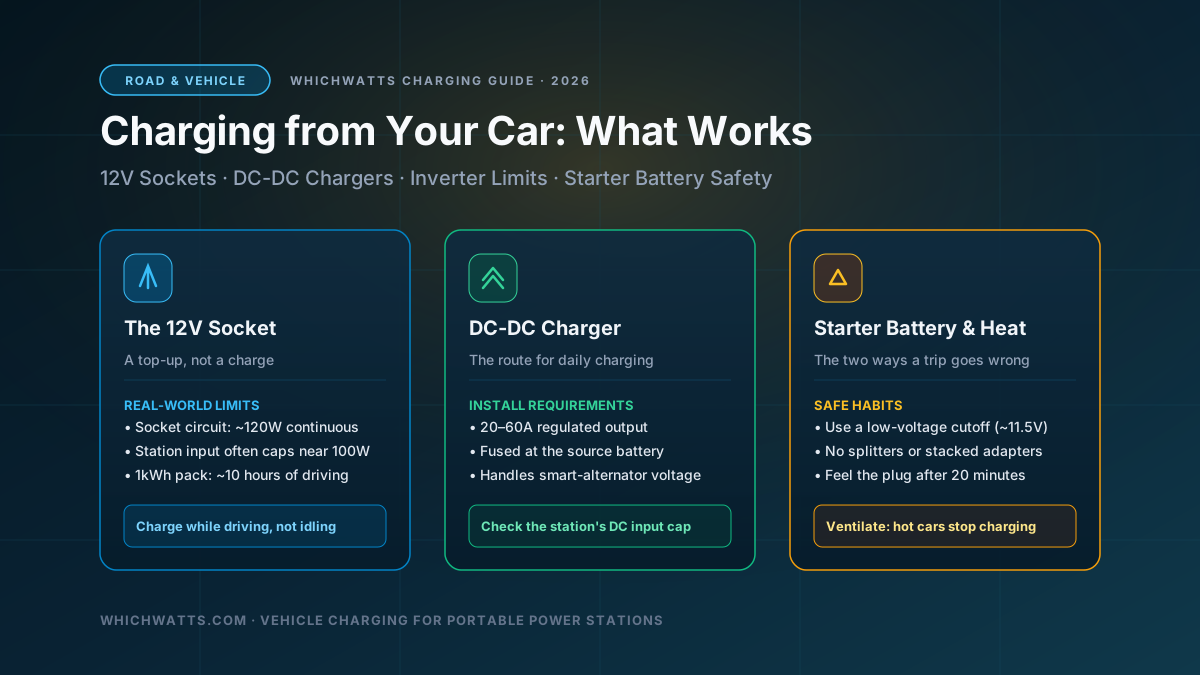
Direct answer: A car 12V socket usually supplies only 100-150 W, so a 1 kWh station needs most of a day to fill; a hardwired DC-DC charger is the faster route, and an AC charger run from a small car inverter is the least efficient. Here is how each option behaves and how to avoid flattening the starter battery.
Editorial note: WhichWatts is an independent comparison site. Prices, availability, specifications, and retailer promotions change frequently. Check the live product table and retailer page before buying.
Charging a Portable Power Station from Your Car: 12V Sockets, DC-DC, and What Actually Works
Charging from a vehicle is one of the most misunderstood parts of portable power. A car's 12 V socket feels like an unlimited supply, and a road trip feels like hours of free charging. In practice the accessory socket is a small, fused circuit: it will charge a station, slowly, and it will do so while asking the starter battery to keep up.
This guide covers the four realistic routes - the 12 V accessory socket, a hardwired DC-DC charger, the car's own AC inverter, and USB-C - with the arithmetic for each, plus the safety details that decide whether the setup is a convenience or a flat battery in a car park.
The short answer
A 12 V socket is a top-up, not a charge. Expect roughly 100-150 W through it, which means a 1,000 Wh station needs somewhere between eight and twelve hours of driving or idling. For anything beyond a small station, a fused DC-DC charger wired to the vehicle's electrical system is the only route that makes sense.
Route 1: the 12 V accessory socket
This is the cable that comes in the box, or the one sold alongside the station: a plug for the cigarette-style socket at one end and a DC input connector at the other.
Where the ceiling comes from. Two limits stack. The vehicle's socket circuit is usually fused at 15 A and often rated for around 120 W continuous, because the plug itself gets hot at sustained current. The station's DC input is the second limit, and many models cap it near 100 W, with a handful accepting 200 W or more. The lower of the two wins.
| Station capacity | Rough time on a 120 W socket | With charger and battery losses |
|---|---|---|
| 500 Wh | 4.2 hours | around 5 hours |
| 1,000 Wh | 8.3 hours | around 10 hours |
| 2,000 Wh | 16.7 hours | around 20 hours |
Losses are real: a DC-DC converter inside the car cable typically runs at 85-90% efficiency, and the battery absorbs less than it receives, so add 15-25% to the theoretical time.
Engine on or off? Most sockets are switched with the ignition, and some cut out when the engine stops. With the engine running, system voltage sits around 13.8-14.4 V instead of 12.0-12.6 V, so a charger that draws a fixed current delivers more watts. Idling to charge is expensive, though: a petrol engine at idle burns roughly half a litre to a litre an hour, which makes the electricity far more costly than mains power. Charge while driving, not while parked.
The starter battery risk. Leaving a station charging on a live socket with the engine off for a long afternoon pulls the battery down, and a modern car with a small battery and a lot of electronics can be hard to start well before it feels flat. Better car chargers include a low-voltage cutoff that stops drawing around 11.5-12 V. Do not assume yours does; check, and carry a jump pack if you plan to leave it connected.
Heat and plugs. A cigarette plug carrying 10 A continuously gets warm, and cheap plugs, splitters and multi-sockets get warmer. Use the cable that came with the station, avoid daisy-chaining adapters, keep the plug out of direct sun, and feel it after twenty minutes. A plug that is hot enough to be uncomfortable is drawing more than it should.
Route 2: a hardwired DC-DC charger
For vans, overlanding and anyone charging daily, this is the real answer. A DC-DC charger takes power from the vehicle's electrical system and delivers a regulated output to the station, typically somewhere between 20 A and 60 A, or roughly 250-750 W.
It also removes most of the guesswork: many units sense the alternator, isolate the starter battery, and compensate for the variable voltage of a smart alternator, which drops output when the vehicle thinks its battery is full. That behaviour is exactly why a plain voltage-sensing relay performs badly on a modern vehicle.
What it requires:
- Cable sized for the current and fused at the source, close to the battery.
- An ignition or alternator signal, depending on the unit, so it does not run the starter battery down when parked.
- A professional installation if you are not confident working on vehicle electrics. This is a permanent high-current circuit, not an accessory.
- A station that can accept the current. The charger may be able to deliver 500 W while the station's DC input accepts 200 W, in which case you have bought headroom you cannot use. Check both figures.
Route 3: the car's built-in AC socket
Some cars, particularly larger SUVs and EVs, include a mains socket rated at 100-400 W. Running the station's AC charger from it works, but it converts DC to AC and back to DC again, so it loses more than a direct DC connection and is usually slower than the 12 V route unless the car's socket is unusually capable.
Two cautions. First, confirm the socket's continuous rating rather than its peak, because a charger draws steadily for hours. Second, avoid pairing a station with a cheap aftermarket inverter: modified sine wave output is a poor input for a charger, and derating or refused charging is a common result.
Route 4: USB-C and EV power outlets
A car's USB-C port at 100-140 W is genuinely useful for a small station on a day trip, and it avoids the socket and wiring questions entirely. On an electric vehicle, a vehicle-to-load outlet can supply far more, but that is a different exercise with its own trade-offs, covered in our V2L versus portable power station comparison.
Safety and good habits
- Ventilate. Charging in a closed car on a sunny day cooks both the charger and the battery; most stations derate or refuse to charge when hot.
- Secure the cable. Route it so it cannot chafe on a seat rail or be pulled by a closing door.
- Fuse at the source for any hardwired installation, and never run an unfused lead straight from the battery terminals.
- Never back-feed a socket. A cable with a plug at both ends is not a charging solution.
- Check the joint temperature after the first half hour of any new setup, and again on a hot day.
- Do not leave a cheap charger unattended overnight in a vehicle you are sleeping in.
FAQ
Can I charge a power station from my car while driving?
Yes, and it is the best time to do it: the alternator is already running, the socket is live, and no fuel is being burned specifically to charge. Expect the rate to be limited by the station's DC input, often around 100 W.
Will charging from my car drain the starter battery?
It can. With the engine off, the socket draws from the same battery that starts the car. Use a charger with a low-voltage cutoff, charge with the engine running, or fit a DC-DC charger that isolates the starter battery.
How long does a 1,000 Wh station take to charge from a car?
Roughly eight to twelve hours on a 12 V socket at 100-120 W once losses are counted. A 500 W DC-DC installation cuts that to a couple of hours, if the station's input accepts the current.
Can I use a 12 V splitter to charge two devices at once?
The socket's fuse sets the total. Splitting it between a station and a fridge usually means both charge slowly and the plug runs hot. Give the station the socket on its own.
Is a car's 12 V socket the same as a DC-DC charger?
No. The socket is a fused accessory circuit with a voltage that sags and rises with the vehicle. A DC-DC charger is a regulated converter wired to the electrical system, and it controls current rather than accepting whatever the socket provides.
Bottom line
Decide what the car is for: top-ups on the move, or a genuine charging system. For the first, use the supplied cable and a low-voltage cutoff; for the second, price a fused DC-DC installation and check the station's DC input limit before buying. Size the station to the trip with the power station sizing calculator, then compare DC input ratings and cost per watt-hour in the price comparison table.