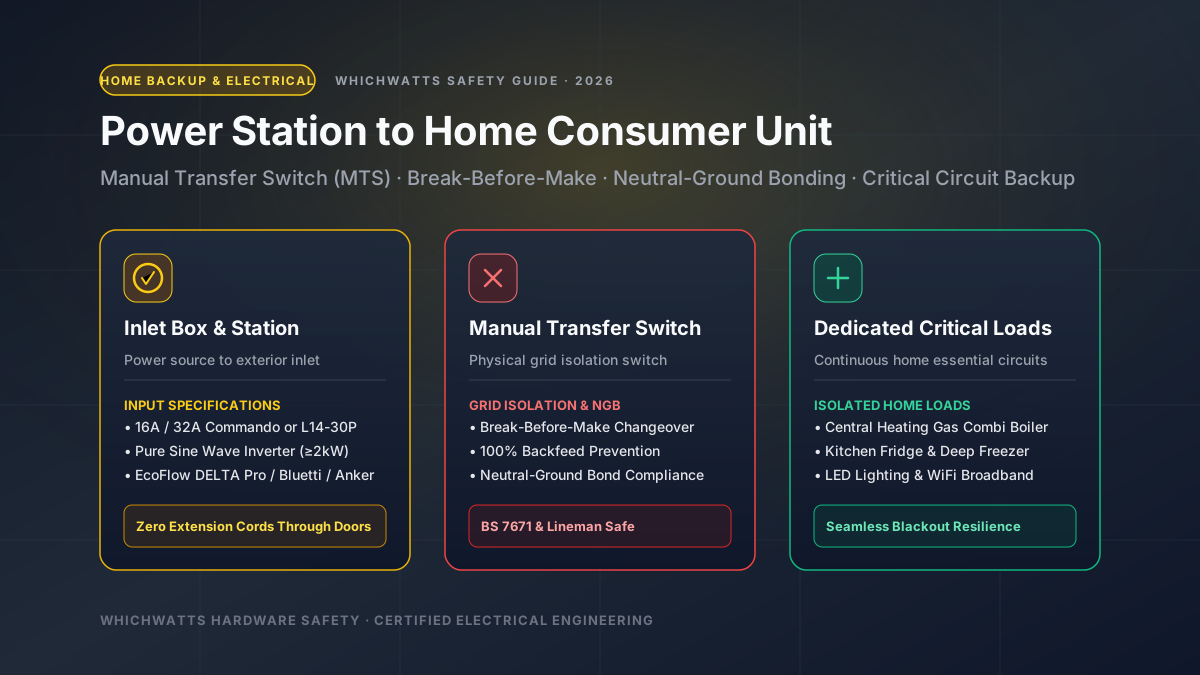
Direct answer: A safe, code-compliant guide to connecting a high-capacity portable power station to your home consumer unit using a manual transfer switch, avoiding dangerous backfeeding, and mastering neutral-ground bonding.
Editorial note: WhichWatts is an independent comparison site. Prices, availability, specifications, and retailer promotions change frequently. Check the live product table and retailer page before buying.
How to Connect a Portable Power Station to Your Home Consumer Unit: Manual Transfer Switch Guide
When severe winter gales, substation floods, or localized grid failures knock out mains electricity, a high-capacity portable power station (such as an EcoFlow DELTA Pro 3, Bluetti AC500, or Anker SOLIX F3800) is an invaluable emergency lifeline. Delivering between 2,000Wh and 6,000Wh of clean LiFePO4 battery power with zero exhaust fumes or engine roar, these units operate safely indoors where petrol generators cannot.
However, during a prolonged blackout, the reality of running loose extension cords through doors and windows quickly reveals its drawbacks:
- Open patio doors or cracked windows leak expensive home heat into freezing sub-zero weather.
- Extension cords create severe trip hazards in pitch-dark hallways.
- Most importantly, you cannot plug hardwired home appliances—such as your gas combi central heating boiler pump, wired LED ceiling lights, hardwired fridge circuits, or home security alarms—into a standalone extension cord.
The ultimate solution is connecting your portable power station directly to your home's main Consumer Unit (Distribution Board) via a professionally installed Manual Transfer Switch (MTS).
This electrical engineering and safety guide explains how to install a code-compliant transfer switch, why illegal "suicide cables" pose lethal risks to grid workers, how to solve the floating-neutral bonding dilemma, and how to safely power critical household circuits during a blackout.
                                  [Grid Mains Meter]
                                          │
                                          ▼
                               ┌─────────────────────┐
                               │  UTILITY MAIN ISOL  │
                               └──────────┬──────────┘
                                          │
[Portable Power Station]                  │ (Position 1: Grid Normal)
   (Pure Sine Wave AC)                    │
          │                               ▼
          ▼                     ┌─────────────────────┐
[Exterior Inlet Box] ──────────>│ MANUAL TRANSFER     │
 (16A/32A Commando)             │ SWITCH (Changeover) │
   (Position 2: Battery Backup) └──────────┬──────────┘
                                          │
                                          ▼
                                ┌─────────────────────┐
                                │ CONSUMER UNIT       │
                                │ (Critical Circuits) │
                                └──────────┬──────────┘
                                           │
         ┌───────────────────┬─────────────┴───────┬──────────────────┐
         ▼                   ▼                     ▼                  ▼
[Combi Boiler Pump]   [Kitchen Fridge]     [WiFi Router & NAS]  [LED Lighting]
1. The Lethal Trap: Why "Suicide Cables" Are Illegal and Deadly
Before examining certified transfer switches, we must address the single most dangerous DIY electrical shortcut: the Male-to-Male "Suicide Cable".
Every winter, ill-informed homeowners take a heavy extension cord, cut off the female socket, wire on a second male plug, connect one end into a portable battery station or generator, and jam the other end into a standard domestic wall socket.
This practice is called uncontrolled backfeeding, and it is strictly illegal under the UK Electrical Safety Regulations (BS 7671) and US National Electrical Code (NEC Article 702):
Why Backfeeding Is Lethal:
- Electrocution of Utility Linemen: If your main breaker is not physically isolated, current from your power station flows backwards through your domestic consumer unit, through your home meter, and out into the street transformer. The transformer steps that 230V electricity back up to 11,000 Volts, energizing downed utility lines that electrical linemen are actively handling.
- Instant Fire & Explosion Upon Grid Restoration: When mains grid electricity unexpectedly restores, the utility grid and your portable battery inverter will be out of phase. Thousands of amperes of short-circuit fault current will smash into your power station's inverter transistors, causing an immediate high-energy explosion, violent fire, and destruction of your battery.
- Exposed Live Male Pins: If one end of a suicide cable is plugged into an active power station and the other end pulls loose, you have two bare metal brass prongs carrying 230 Volts of lethal AC electricity exposed on your living room floor.
Never, under any circumstances, use a male-to-male plug. A certified transfer switch exists specifically to make backfeeding physically impossible.
2. Certified Switching Solutions: Manual Transfer Switches vs Interlock Kits
To connect an auxiliary power source to a building safely, regulations require a Break-Before-Make physical disconnection mechanism:
| Transfer Mechanism | Working Principle | Best Suited For | Typical UK / US Hardware |
|---|---|---|---|
| Manual Transfer Switch (MTS / Changeover Switch) | A dedicated heavy-duty rotary switch with three positions: Position 1 (Grid Mains) ── 0 (OFF / Disconnect) ── Position 2 (Power Station). | Standard UK consumer units; switching either the entire board or an isolated critical subpanel. | Garo 63A Double Pole Changeover, Hager SF219G, Reliance Controls 6-Circuit. |
| Critical Loads Subpanel | A secondary miniature consumer unit containing only 4 to 8 essential circuit breakers, fed exclusively by the changeover switch. | Sizing battery backup strictly to essential devices (boiler, fridge, lights) without overloading the inverter. | 4-way to 8-way metal clad consumer unit with dedicated 30mA RCD protection. |
| Mechanical Breaker Interlock Plate | A sliding metal or anodized aluminum plate installed on the consumer unit cover that physically blocks the generator breaker from switching ON unless the main grid breaker is OFF. | Common in US electrical panels; rare in UK split-load consumer units. | Generator Interlock Kit (panel-brand specific: Square D, Siemens, Eaton). |
The Critical Loads Strategy: Why You Shouldn't Back Up the Entire House
A typical 2kWh to 3kWh portable power station has a continuous inverter limit between 2,400W and 3,600W.
If you attempt to power your home's entire consumer unit through an automatic switch without isolating heavy circuits:
- An electric kettle draws 3,000W.
- An electric oven or induction hob draws 4,000W to 7,400W.
- An electric shower draws 8,500W to 10,500W.
If someone accidentally switches on an electric kettle or shower while the power station is engaged, the inverter will instantly trip on overload.
By routing only Critical Essential Circuits through your transfer switch, your battery operates comfortably within its continuous power envelope:
| Essential Circuit | Typical Continuous Draw | Surge Demand | 24-Hour Energy Budget |
|---|---|---|---|
| Gas Combi Boiler (Circulation pump & electronics) | 90W – 140W | 250W (Motor start) | ~1,200 Wh (cycling 50% duty) |
| Kitchen Fridge / Deep Freezer | 60W – 110W | 600W – 900W (Compressor startup) | ~700 Wh to 1,000 Wh |
| Ground Floor LED Lighting (6–10 bulbs) | 40W – 60W | 60W | ~300 Wh (evening hours) |
| Fibre Broadband ONT, Router & Home Office PC | 50W – 150W | 150W | ~1,200 Wh |
| Total Combined Continuous Load | ~240W to 460W | ~1,400W Surge Headroom | ~3,400 Wh / Day |
A single 3.6kWh battery (such as an EcoFlow DELTA Pro 3 or Anker F3800) can keep this entire core setup operating for 20 to 24 continuous hours without solar top-up.
3. The Neutral-Ground Bonding (NGB) Dilemma: Why RCDs Trip
The most complex technical issue when connecting a portable power station to a residential electrical panel is Neutral-Ground Bonding (NGB).
Floating Neutral vs Bonded Neutral:
- Residential Mains Wiring (TN-C-S / PME in the UK): The Neutral conductor is physically bonded to Earth at the street supply or service head. Your consumer unit's Residual Current Devices (RCDs / RCBOs) rely on this bond to detect current imbalances and trip instantly during a ground fault.
- Portable Power Stations: For safety during standalone outdoor use, virtually all portable power stations ship with a Floating Neutral (the AC socket’s neutral pin is completely isolated from the station's chassis earth ground).
What Happens When You Connect a Floating Neutral to Your Consumer Unit?
- RCDs Will Fail to Protect You: Because there is no low-resistance path between Neutral and Earth on a floating inverter, a short circuit between Live and an appliance's metal chassis will not return current to trip the RCD, leaving the appliance casing dangerously live.
- Nuisance Tripping: If the transfer switch does not switch the Neutral wire (single-pole switching), you create a parallel neutral return path through the utility company's neutral, causing upstream RCDs to trip violently.
The Code-Compliant Solution:
Under BS 7671 (Section 551) and NEC 250, when a portable generator or power station acts as a Separately Derived System, you must install a Double-Pole Transfer Switch (Switched Neutral):
- A double-pole switch breaks both the Live and the Neutral conductors simultaneously.
- When switched to battery backup, the consumer unit is 100% physically disconnected from the utility grid's Live and Neutral.
- The neutral bonding is maintained through a certified Neutral-Ground Bonding (NGB) plug or internal bond on the power station, anchored to your home's dedicated earth electrode rod.
4. Hardware Sizing: Pure Sine Waves & Inductive Motor Surge
Never connect a cheap modified-sine-wave or square-wave inverter to a domestic consumer unit:
- Pure Sine Wave Mandatory (THD < 3%): Sensitive electronics, modern gas boiler circuit boards, and brushless circulation pumps will burn out or emit loud buzzing hums on modified sine wave power.
- Inrush Current Headroom: Refrigerators, chest freezers, and central heating pumps utilize inductive electric motors. When an inductive compressor kicks on, it demands 3x to 5x its running wattage for 100 to 300 milliseconds. Shortlist power stations with substantial peak surge headroom (minimum 4,000W surge).
5. Recommended Transfer Switches & Compatible Power Stations
Leading Power Stations for Home Transfer Switch Integration (2026):
- EcoFlow DELTA Pro 3: 4,096Wh base LFP capacity, massive 4,000W continuous pure sine wave AC output (8,000W surge), dual 120V/240V split-phase capability, and dedicated 30A Commando/L14-30 output ports.
- Anker SOLIX F3800: 3,840Wh base capacity expandable to 26.9kWh, built-in 6,000W AC inverter with dual-voltage output, capable of running heavy 240V loads with integrated transfer switch compatibility.
- Bluetti AC500 + B300S System: 5,000W continuous pure sine wave inverter, up to 10,000W surge, paired with modular 3,072Wh LiFePO4 packs featuring internal heating pads for sub-zero garage storage.
Certified Manual Transfer Switches:
- Garo G632P 63A Double Pole Changeover Switch (UK / EU): High-reliability DIN-rail mountable changeover switch rated for 63A continuous current, designed to switch both Phase and Neutral with break-before-make safety.
- Hager SF219G Changeover Switch: Compact 2-pole modular switch fitting neatly inside standard UK metal clad consumer units.
- Reliance Controls 30A 6-Circuit Indoor Transfer Switch (US): Features dual wattmeters, 6 individual toggle changeover switches with circuit breakers, and integrated L14-30 generator inlet plug.
6. Step-by-Step Blackout Operation Procedure
Once an NICEIC-registered electrician (UK) or licensed master electrician (US) has installed your transfer switch and exterior inlet box, follow this safe sequence during a power cut:
When Mains Electricity Fails:
- Power Up the Power Station: Switch on your portable battery and ensure the AC output inverter toggle is active.
- Connect the Heavy-Duty Cable: Plug the 16A/32A Commando or L14-30 cable firmly into the power station's AC outlet, then connect and twist-lock the other end into your home's wall inlet box.
- Turn Heavy Breakers OFF: On your consumer unit, verify that non-essential heavy appliances (oven, kettle, dryer) are switched off.
- Throw the Changeover Switch: Rotate the manual transfer switch from Position 1 (Grid) through 0 (OFF) to Position 2 (Battery Backup).
- Verify Operation: Your boiler, lights, internet, and fridge will immediately illuminate and resume operation cleanly and silently.
When Mains Grid Electricity Is Restored:
- Check Street Lights / Grid Status: Verify that public mains electricity has stabilized.
- Rotate Switch Back to Grid: Move the transfer switch back from Position 2 through 0 to Position 1 (Grid).
- Power Down Battery: Disconnect the inlet cable, turn off the battery's AC inverter, and plug the power station into an AC outlet or solar array to recharge.
Helpful Next Steps & Tools
- Calculate your household essential circuit runtimes with our Power Station Sizing Calculator.
- Compare the latest expandable home backup systems in our Live Price Comparison Table.
- Explore whole-home battery rankings in our Best 2kWh–4kWh Power Stations buying guide.
- Review winter blackout preparation tactics in our Winter Power Cut Preparedness (2026) Guide.
FAQ
Is it legal to connect a portable power station to a home consumer unit in the UK?
Yes, provided it is installed by a qualified electrician in compliance with BS 7671 (IET Wiring Regulations, Section 551) and Part P of the Building Regulations. The installation requires a certified break-before-make manual transfer switch with switched neutral (double-pole) and an external commando inlet socket to prevent any backfeeding into the National Grid.
Can a portable power station run a gas central heating combi boiler?
Yes. A modern gas combi boiler requires very little electrical power—typically between 90W and 140W for the circulation pump, fan, and electronic ignition circuit board. However, the power station must output a pure sine wave (THD < 3%) and must be connected through an isolated, properly grounded circuit so the boiler’s electronic flame sensor detects a valid earth path.
Why do I need a double-pole (switched neutral) transfer switch?
A double-pole transfer switch disconnects both the Live and Neutral conductors simultaneously. In standard UK and European homes, if you only switch the Live wire, the power station remains connected to the utility company's shared Neutral, which can disable your consumer unit's RCD safety trip mechanisms or cause nuisance RCD tripping during battery operation.
How big of a power station do I need to back up critical home circuits?
For powering a gas combi boiler, kitchen refrigerator, internet router, and LED ceiling lighting, a power station with at least 2,000Wh of LiFePO4 battery capacity and a 2,000W to 2,400W pure sine wave inverter is recommended. This provides approximately 12 to 18 hours of continuous runtime before requiring solar or AC recharging. Expandable systems (such as the EcoFlow DELTA Pro or Anker F3800) can be scaled with extra battery modules for multi-day resilience.