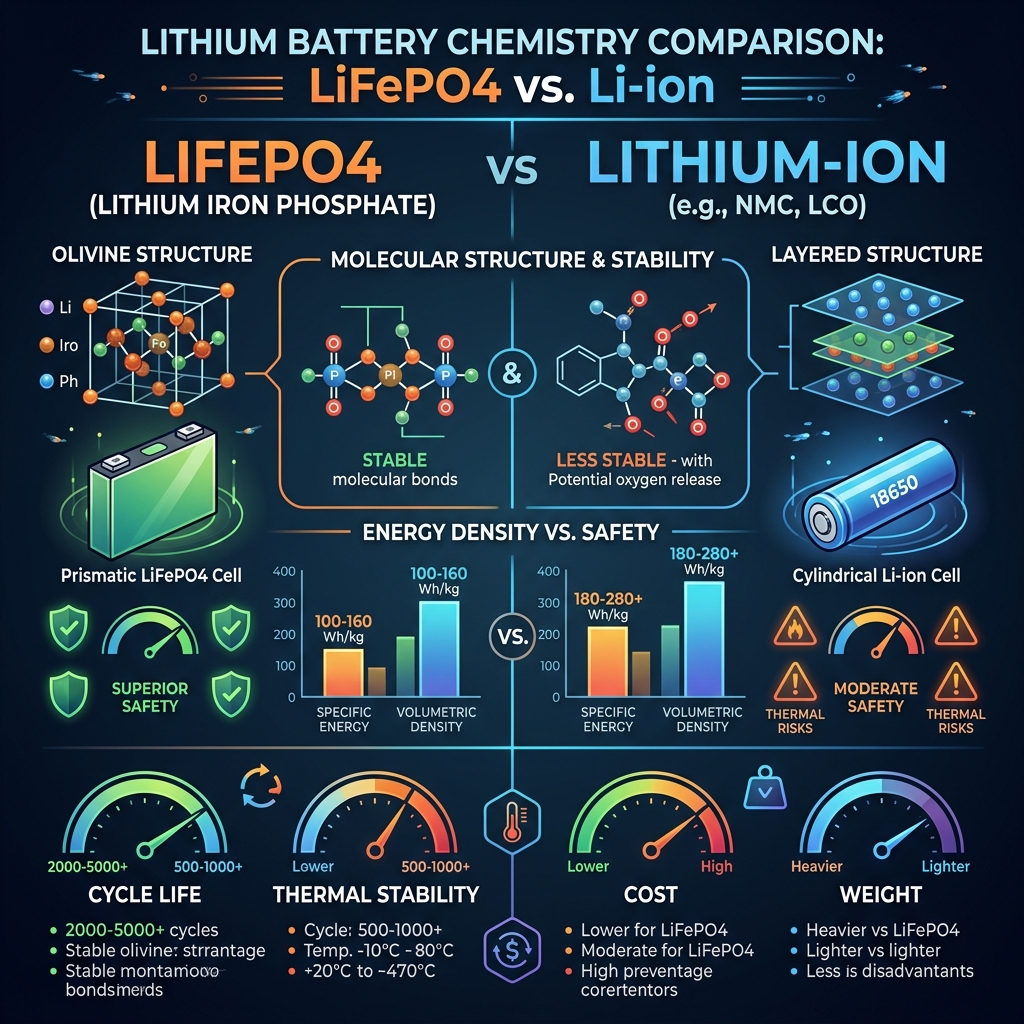
Direct answer: The battery inside your portable power station determines how long it lasts, how safe it is, and ultimately how much value you get from your investment. Two chemistries dominate the market: traditional lithium-ion and the newer LiFePO4 lithium iron phosphate. Understanding the differences helps you
The battery inside your portable power station determines how long it lasts, how safe it is, and ultimately how much value you get from your investment. Two chemistries dominate the market: traditional lithium-ion and the newer LiFePO4 (lithium iron phosphate). Understanding the differences helps you choose the right technology for your needs.
Battery Chemistry Explained Simply
Both battery types store energy chemically and release it as electricity, but they use different materials that dramatically affect performance and longevity.
Lithium-ion batteries (technically lithium nickel manganese cobalt oxide, or NMC) have powered laptops and smartphones for decades. They pack significant energy into compact, lightweight packages. These are the same cells used in electric vehicles and the first generation of portable power stations.
LiFePO4 batteries use iron phosphate instead of cobalt-based chemistry. This substitution creates batteries that are more stable, longer-lasting, and safer, though slightly heavier and bulkier for the same energy capacity.
Neither chemistry is inherently "better"—each excels in different scenarios depending on your priorities.
Side-by-Side Comparison
| Feature | LiFePO4 | Lithium-Ion (NMC) |
|---|---|---|
| Cycle Life | 3000-3500 cycles to 80% | 500-800 cycles to 80% |
| Calendar Lifespan | 10+ years | 3-5 years |
| Weight | Heavier (+30%) | Lighter |
| Energy Density | Lower (90-120 Wh/kg) | Higher (150-220 Wh/kg) |
| Safety Profile | Excellent (thermal stability) | Good (requires management) |
| Temperature Tolerance | -20°F to 140°F | 32°F to 113°F |
| Self-Discharge Rate | 2-3% per month | 3-5% per month |
| Environmental Impact | Lower (no cobalt) | Higher (cobalt mining) |
| Cost | Higher upfront | Lower upfront |
| Cost per Cycle | Much lower | Higher |
Cycle Life: The Game-Changing Difference
Cycle life is where LiFePO4 truly shines and often justifies its higher initial cost.
A battery cycle means one full discharge and recharge. If you use 50% of capacity and then recharge, that counts as half a cycle. Manufacturers rate batteries by how many cycles they provide before capacity drops to 80% of original—the threshold where performance becomes noticeably diminished.
LiFePO4 batteries deliver 3000-3500 cycles to 80% capacity. In practical terms, if you fully cycle your power station once per week, it will maintain strong performance for 8-10 years. Even daily users get 8-10 years before seeing significant degradation.
Lithium-ion batteries typically provide 500-800 cycles to 80% capacity. Weekly use means 2-3 years of optimal performance, while daily users might see degradation within a year or two.
This longevity difference compounds over time. A LiFePO4 unit might last three times longer than a lithium-ion equivalent, dramatically improving lifetime value even with a higher purchase price.
Weight and Portability Considerations
Energy density measures how much power packs into each pound of battery. Lithium-ion wins decisively here.
A 1000Wh lithium-ion power station typically weighs 20-25 pounds. An equivalent LiFePO4 unit weighs 28-32 pounds—roughly 30% heavier. For occasional use or stationary applications, this difference barely matters. For frequent transport, especially when carrying the unit significant distances, those extra pounds add up.
Backpackers and frequent travelers usually prefer lithium-ion for weight savings. Carrying a 20-pound unit versus a 28-pound unit makes a real difference after a mile on the trail or when loading and unloading from a vehicle multiple times per trip.
RV owners and home backup users rarely notice the weight difference since the unit stays relatively stationary. The longevity benefits of LiFePO4 outweigh the portability concerns.
Car campers fall somewhere in between—most can handle the extra weight for the long-term value, but weight-conscious buyers might opt for lithium-ion.
Safety Profile: Why LiFePO4 Wins
Both chemistries are generally safe when manufactured properly with appropriate battery management systems, but LiFePO4 has inherent safety advantages.
Thermal runaway is the technical term for battery fires. It occurs when a battery cell overheats, causing a chain reaction of more heating. Lithium-ion batteries can experience thermal runaway if damaged, overcharged, or subjected to extreme conditions. While rare in quality power stations with proper management systems, it's a theoretical risk.
LiFePO4 batteries have exceptional thermal stability. The phosphate chemical bonds are extremely strong and resist breaking down even at high temperatures. LiFePO4 batteries essentially won't catch fire or explode even in worst-case scenarios like puncture or severe overcharging.
For home backup power stored in garages that get very hot or very cold, this safety margin provides peace of mind. Families with children or those storing units in living spaces often prefer LiFePO4's proven safety record.
Temperature Performance
Operating temperature range affects where and when you can use your power station.
LiFePO4 batteries function across a wider temperature spectrum, roughly -20°F to 140°F. They maintain efficiency in cold better than lithium-ion, making them ideal for winter camping, cold storage areas, or vehicles parked in extreme climates. The chemistry remains stable in heat, so hot garages or summer RV storage doesn't accelerate degradation.
Lithium-ion batteries perform optimally between 32°F and 113°F. Below freezing, charging becomes problematic and capacity drops noticeably. Some units won't charge at all below 32°F. High heat (over 113°F) accelerates degradation, shortening the already limited cycle life.
Cold-weather campers, winter emergency backup users, and those in extreme climates benefit significantly from LiFePO4's temperature tolerance.
Cost Analysis: Initial Price vs Lifetime Value
LiFePO4 power stations typically cost 20-40% more upfront than comparable lithium-ion models. However, total cost of ownership tells a different story.
Initial purchase example:
- 2000Wh lithium-ion unit: $1500
- 2000Wh LiFePO4 unit: $1900
- Price premium: $400 (27% more)
Cost per cycle calculation:
- Lithium-ion: $1500 ÷ 600 cycles = $2.50 per cycle
- LiFePO4: $1900 ÷ 3000 cycles = $0.63 per cycle
Over the lifetime, the LiFePO4 unit costs 75% less per cycle despite the higher purchase price.
Real-world value over 10 years:
- Frequent user (3x/week, ~150 cycles/year): Lithium-ion requires replacement after 4 years, total cost $3000+. LiFePO4 lasts the full decade on one purchase: $1900.
- Occasional user (1x/month, ~12 cycles/year): Lithium-ion might last 8-10 years but will show noticeable degradation by year 5-6. LiFePO4 performs like new throughout.
For anyone planning to keep their power station more than 3-4 years, LiFePO4 typically offers better value.
When LiFePO4 Is Worth It
LiFePO4 makes the most sense for:
Daily or frequent users: If you use your power station for daily off-grid living, regular jobsite work, or frequent camping trips (weekly or more), LiFePO4 pays for itself within 2-3 years through extended longevity.
Hot climate storage: Garages in Arizona, Texas, or similar climates regularly exceed 120°F in summer. Lithium-ion batteries age faster in these conditions. LiFePO4 handles the heat without accelerated degradation.
Cold weather operation: Winter campers, ice fishing shelters, and emergency backup in cold climates benefit from LiFePO4's ability to charge and discharge effectively below freezing.
Long-term investment mindset: Buyers who view power stations as 10-year investments rather than disposable electronics should choose LiFePO4 for maximum lifetime value.
Safety-conscious users: Families storing units in living spaces, RV owners, or anyone prioritizing safety over absolute weight savings should consider LiFePO4's superior thermal stability.
Home backup systems: Emergency power systems might sit unused for months between outages. LiFePO4's lower self-discharge and longer calendar life means the unit remains ready when needed years down the line.
When Lithium-Ion Still Wins
Traditional lithium-ion remains the better choice for:
Backpacking and portability-critical uses: When every pound matters, lithium-ion's 30% weight advantage makes a tangible difference. Backpackers, motorcycle travelers, and those frequently carrying their unit long distances benefit from the reduced weight.
Budget-conscious buyers: If upfront cost is the primary concern and you need maximum capacity for minimum dollars right now, lithium-ion delivers more watt-hours per dollar initially.
Occasional users with short-term needs: Someone who only camps 2-3 times per year and might upgrade to a larger unit in 3-4 years won't fully realize LiFePO4's longevity advantage. The lithium-ion unit serves them adequately for less money.
Weight-sensitive vehicle setups: Boats, small RVs, and motorcycles with strict weight limits might need lithium-ion's compact profile to stay under maximum load ratings.
Technology enthusiasts who upgrade frequently: If you tend to upgrade electronics every 2-3 years to get the latest features, lithium-ion's shorter lifespan becomes irrelevant. You'll upgrade before cycle life becomes a factor.
Hybrid Approach: Some Manufacturers Offer Both
Several brands now offer both chemistries in their lineup, letting you choose based on your specific use case.
EcoFlow offers lithium-ion in their River series (lightweight, affordable) and LiFePO4 in newer DELTA models (longevity-focused).
Bluetti focuses primarily on LiFePO4 across most of their range but offers some lithium-ion in ultra-portable models where weight is critical.
Jackery traditionally used lithium-ion for portability but recently introduced LiFePO4 options in their Plus series models.
Anker takes a hybrid approach with LiFePO4 in their larger Solix series and lithium-ion in compact models.
This variety lets you match battery chemistry to your specific application rather than being locked into one technology across all products.
Top Picks for Each Battery Type
Best LiFePO4 Power Stations
Bluetti AC200MAX (2048Wh): The sweet spot for LiFePO4 technology with modular expansion, excellent build quality, and 3500+ cycle lifespan. Perfect for home backup and frequent users. Around $1800-1900.
EcoFlow DELTA 2 (1024Wh): Combines LiFePO4 longevity with EcoFlow's fast-charging technology. Great balance of portability and durability for regular camping use. Around $900-1100.
Jackery Explorer 2000 Plus (2042Wh): Reliable Jackery design with LiFePO4 chemistry and impressive expandability. Best for RV users wanting proven reliability with modern longevity. Around $1900-2000.
Best Lithium-Ion Power Stations
Jackery Explorer 1000 (1002Wh): The standard-bearer for portable lithium-ion units. Lightweight, reliable, and priced right for occasional users. Around $1000.
EcoFlow River 2 Pro (768Wh): Ultra-lightweight at 17 pounds with surprising output capacity. Ideal for backpackers needing serious power without weight penalty. Around $550-650.
Anker 521 (256Wh): Ultra-portable for minimalist adventures. Weighs just 8 pounds yet charges laptops and small appliances. Budget-friendly at $200-300.
Environmental Considerations
Battery choice has environmental implications worth considering.
LiFePO4 advantages: No cobalt mining (cobalt extraction causes significant environmental and human rights concerns), longer lifespan means fewer units produced per person over time, better recyclability with simpler chemistry.
Lithium-ion concerns: Cobalt mining in Congo has documented environmental damage and labor issues, shorter lifespan means more frequent replacement increasing e-waste, more complex chemistry makes recycling more difficult.
Neither technology is perfect environmentally, but LiFePO4's elimination of cobalt and extended lifespan reduce its overall impact significantly.
Making Your Decision
Choose your battery chemistry based on honest assessment of your usage patterns:
Ask yourself:
- How often will I actually use this? (Daily/weekly = LiFePO4, Monthly/occasionally = either works)
- How important is weight? (Critical = lithium-ion, Not a factor = LiFePO4)
- How long do I plan to keep it? (5+ years = LiFePO4, 2-3 years = lithium-ion)
- What's my climate? (Hot/cold extremes = LiFePO4, Mild = either works)
- How much does safety matter? (Critical priority = LiFePO4, Standard is fine = either works)
Most buyers find that LiFePO4 offers the best long-term value unless portability is the absolute highest priority. The technology has matured to where the benefits—safety, longevity, temperature tolerance—outweigh the weight penalty and higher initial cost for the majority of applications.
The good news is that both technologies will serve you well. Modern power stations use high-quality cells with excellent battery management systems regardless of chemistry. Your choice simply optimizes for your specific priorities and use patterns.
Ready to choose the perfect power station with the right battery chemistry for your needs? Browse our complete selection with filtering by battery type, capacity, and weight to find your ideal match.