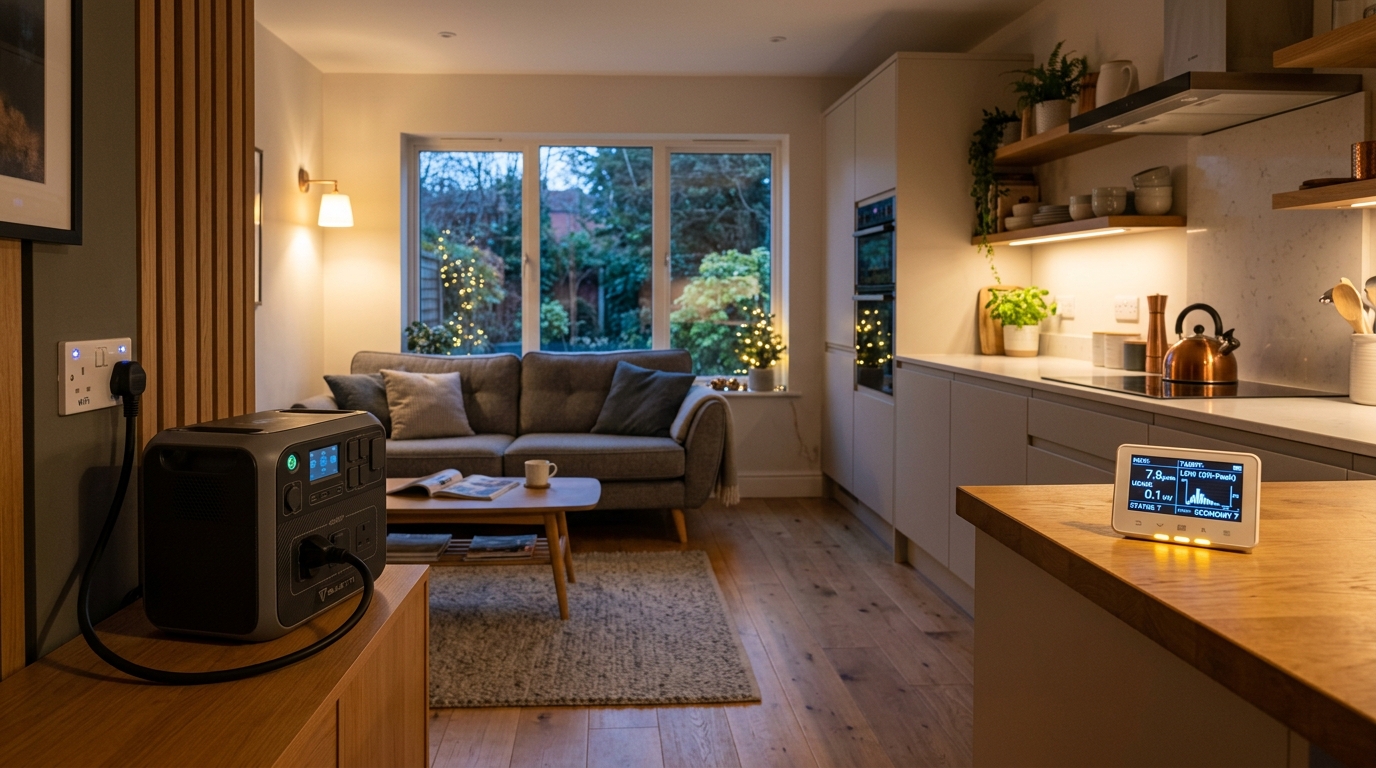
Direct answer: Beat the October 2026 energy price cap increase by using portable and plug-and-play battery storage to arbitrage cheap off-peak electricity into peak evening hours.
Editorial note: WhichWatts is an independent comparison site. Prices, availability, specifications, and retailer promotions change frequently. Check the live product table and retailer page before buying.
October 2026 Energy Price Cap Rise: How to Arbitrage Peak Tariffs with Home & Portable Battery Storage
As Ofgem adjusts the UK Energy Price Cap heading into autumn and winter 2026, household electricity bills face renewed upward pressure. Peak evening electricity rates—the hours between 4:00 PM and 7:00 PM when millions of households cook, heat, and power electronics—remain the most expensive unit rates of the entire day.
However, a growing number of UK households are adopting a smart strategy known as Peak Tariff Energy Arbitrage: charging a portable power station or plug-and-play battery storage unit with ultra-cheap overnight electricity (7p–9p/kWh) and discharging it to power high-draw household loads during the expensive peak rate window (28p–35p+/kWh).
This comprehensive guide breaks down the mathematics of battery arbitrage, calculates real-world payback periods, covers automated smart plug scheduling, and shows how you can save hundreds of pounds this winter without installing expensive, fixed home storage systems.
Understanding the October 2026 Price Cap & Time-of-Use Spreads
Under standard default tariffs, households pay a flat rate per kilowatt-hour throughout the day. However, dynamic and time-of-use (ToU) tariffs—such as Octopus Agile, Octopus Go, British Gas Electric Driver, and modern Economy 7—offer huge price differentials between night and day:
| Tariff Type | Overnight Off-Peak Window (00:00 – 05:00) | Daytime Standard Rate (07:00 – 16:00) | Peak Evening Window (16:00 – 19:00) | Spread per kWh |
|---|---|---|---|---|
| Standard Ofgem Variable Cap | ~24.5p / kWh | ~24.5p / kWh | ~24.5p / kWh | 0.0p |
| Smart EV / Overnight Tariff | 7.0p – 8.5p / kWh | ~25.0p / kWh | 32.0p – 38.0p / kWh | Up to 30.0p / kWh |
| Half-Hourly Dynamic (Agile) | 5.0p – 9.0p / kWh (sometimes negative) | ~22.0p / kWh | 35.0p – 45.0p / kWh | Up to 36.0p / kWh |
Every kilowatt-hour of energy shifted from the peak evening window to the overnight off-peak slot saves between 23p and 30p.
The Mathematics of Battery Arbitrage: ROI & Cycle Cost
A common question among cautious buyers is whether the electricity savings outweigh the physical wear and tear on the lithium battery cells.
Let's calculate the real-world economics of cycling a 2,048Wh (2kWh) LiFePO4 battery once per day:
1. Daily Electricity Shift
- Usable battery capacity (90% DoD): 1.84 kWh
- Round-trip AC charging & inverter efficiency (85%): 2.16 kWh drawn from grid
- Overnight charge cost (at 8p/kWh): £0.17
- Peak electricity value saved (at 34p/kWh): £0.63
- Net Daily Saving: £0.46 per day (£168 per year)
2. Battery Cycle Life & Degradation Cost
Modern LiFePO4 power stations are rated for 3,500 to 6,000 full charge cycles before reaching 80% original capacity.
- Purchase price of 2kWh unit (e.g. EcoFlow Delta 2 Max / Bluetti AC200L): ~£1,050
- Total lifetime energy throughput (4,000 cycles × 1.84 kWh): 7,360 kWh
- Capital Cost per Cycled kWh: ~£0.14 per kWh
- If the price spread between night and peak is 25p–30p, the arbitrage spread exceeds the combined electricity and cycle amortisation cost, delivering clean positive return while preserving emergency blackout protection for free.
Step-by-Step: Setting Up Automated Battery Arbitrage
You do not need an electrician or building permission to run peak tariff arbitrage with a portable power station. Here is the recommended automated workflow:
[Grid Wall Socket] ──> [Smart Wi-Fi Plug] ──> [Power Station AC Input]
                                                     │
                                                     ▼
                                      [Power Station AC Outlets]
                                                     │
                                ┌────────────────────┴────────────────────┐
                                ▼                                         ▼
                     [Home Office / Desk]                       [Kitchen / TV Lounge]
Step 1: Schedule the AC Input with a Smart Plug
Fit a heavy-duty 13A Wi-Fi smart plug (e.g., Tapo P110, Meross, or Shelly Plus) between your mains wall socket and the power station's AC power cable. Set the plug's timer to switch ON only during your off-peak window (e.g., 00:30 to 04:30 AM).
Step 2: Connect Daytime & Peak Evening Appliances
Plug your regular evening appliances into the battery's AC sockets or run an extension lead to high-draw entertainment, work, or cooking hubs:
- Desktop computer workstations, monitors, and networking gear (200W–400W).
- Living room entertainment systems, TV, consoles, audio amplifiers (150W–300W).
- Refrigerator and upright freezer (100W continuous average).
- Slow cookers, multicookers, or air fryers used during dinner prep (800W–1,500W).
Step 3: Enable EPS / Pass-Through Mode
Most modern power stations (EcoFlow Delta series, Bluetti AC series, Anker Solix) feature automatic AC pass-through. When mains power is active during the cheap night window, the unit powers your loads directly from the grid while charging the internal battery. Once the smart plug cuts grid power at 05:00 AM, the station switches to internal battery power seamlessly in under 20 milliseconds.
Top Battery Systems for Energy Arbitrage
| Model | Usable Capacity | AC Output | AC Fast Charge Time | Cycle Life (to 80%) | Warranty | Direct Review / Price |
|---|---|---|---|---|---|---|
| EcoFlow DELTA 2 Max | 2,048 Wh | 2,400 W (4,800W Surge) | 80 mins | 3,000+ cycles | 5 Years | Compare EcoFlow |
| Anker Solix C1000 | 1,056 Wh | 1,800 W (2,400W Surge) | 58 mins | 3,000+ cycles | 5 Years | Compare Anker |
| Bluetti AC200L | 2,048 Wh | 2,400 W (3,600W Lift) | 90 mins | 3,500+ cycles | 5 Years | Compare Bluetti |
| EcoFlow DELTA 3 Plus | 1,024 Wh | 1,800 W (3,600W Surge) | 56 mins | 4,000+ cycles | 5 Years | Compare EcoFlow |
Combining Off-Peak Arbitrage with Balcony Solar
During the darker winter months, solar generation drops significantly. However, combining a plug-in balcony solar kit (generating 0.5–1.5 kWh on bright winter days) with overnight grid arbitrage ensures your battery starts every single morning at 100% state of charge.
You use overnight 8p power for the bulk of charging, top up for free from whatever midday solar is available, and discharge 100% of your energy during the expensive 4:00 PM – 7:00 PM peak.
Helpful Next Steps & Tools
- Compare real-time pricing and cost-per-watt-hour in our Live Price Comparison Table.
- Model your daily household watt-hour consumption with the Power Station Calculator.
- Review our full guide to Best Plug-In Solar Kits in the UK.
FAQ
Is it legal to charge a battery off-peak and use it during peak hours in the UK?
Yes, absolutely. You are fully entitled to draw electricity from your domestic supply during off-peak hours and store it for your own household consumption. No permits, DNO approvals, or building certifications are required for portable plug-and-play battery storage.
How much money can I realistically save each month with a 2kWh battery?
With an average spread of 25p/kWh between overnight off-peak rates (8p) and peak evening rates (33p), cycling a 2kWh unit daily saves approximately £14 to £18 per month (£168 to £216 per year). Savings increase if you also shift daytime home office or cooking loads.
Can battery arbitrage damage my portable power station?
No. Modern LiFePO4 (lithium iron phosphate) battery cells are engineered for daily cycling and typically retain 80% of their original capacity after 3,000 to 5,000 full discharge cycles—equivalent to 8 to 13 years of daily usage.
Do I need an electrician to set up peak tariff arbitrage?
No. You simply plug the power station into a standard 13A UK mains wall socket via a digital timer or smart plug, and plug your appliances into the power station's AC sockets.