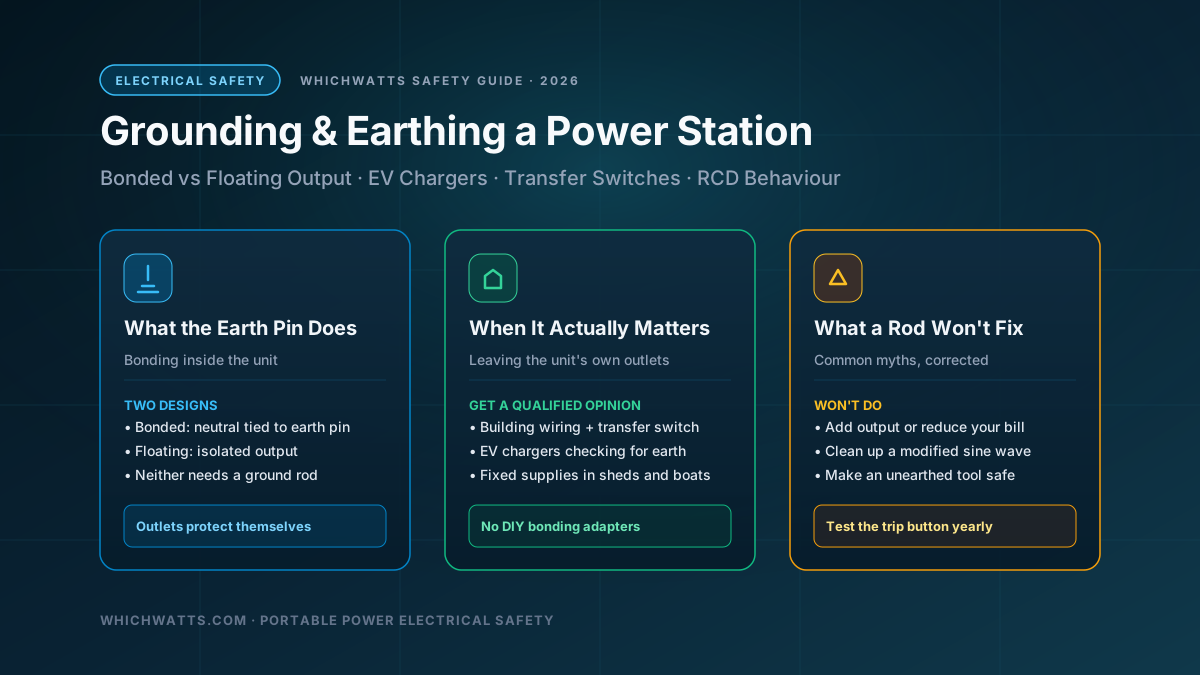
Direct answer: A plug-in power station with a built-in inverter normally provides the safety earth its own outlets need, so it does not require a ground rod for ordinary use. Earthing questions only become real when the station is connected to a building, a vehicle circuit or an EV charger, and those cases need the manufacturer instructions or an electrician.
Editorial note: WhichWatts is an independent comparison site. Prices, availability, specifications, and retailer promotions change frequently. Check the live product table and retailer page before buying.
Grounding and Earthing a Portable Power Station: What Is Actually Required
Grounding is one of the few topics where a confident internet answer can make a safe product unsafe. The question usually arrives in one of three forms: does my power station need to be earthed, why will my EV charger not work from it, and can I wire it into my house. Each has a different answer, and only the first is simple.
This guide explains what the earth pin on a power station actually connects to, when the question becomes a real installation issue, and which fixes are legitimate rather than improvised.
The short answer
A portable power station that plugs into a wall to charge and supplies appliances through its own outlets does not need a ground rod. Its outlets are protected by the unit's own electronics, and the earth pin on those outlets connects to a bonding point inside the station, not to the soil. What it does not do is earth your building, your vehicle or an EV charging cable, and it should not be asked to.
What the earth pin actually does
Inside a station there is an inverter producing mains voltage from a battery. Safety in that arrangement depends on two things: a path for fault current that does not go through a person, and a device that notices the fault and disconnects quickly.
How manufacturers arrange this varies, and the variation is the source of most confusion:
- Bonded output. Many consumer stations connect the output neutral to the earth pin internally. A socket tester plugged into one will usually report correct wiring, and a fault inside an appliance trips the station's protection.
- Floating output. Some units leave the output isolated from earth entirely. Appliances still work, because the two live conductors are all they need, but a socket tester may report a missing earth and some external equipment will refuse to run.
Neither design is a defect. They are different choices with different consequences when you attach something else to the station.
When the question becomes real
Connecting to a building
Feeding household circuits from a power station requires a transfer switch or an interlock installed by a licensed electrician, never a cable with plugs at both ends. Once the station is part of the building's wiring, the neutral-to-earth bonding arrangement has to be consistent with the rest of the installation: an extra bond can cause protective devices to trip, and a missing one can leave circuits without a fault path.
This is where portable units and fixed generators genuinely differ, and it is not a decision to make from a forum post. Tell the electrician the exact model, show them the manual, and let them specify the connection. If they decline the job, that is information.
Charging an electric vehicle
An EV charging cable is not a passive lead. Before it will deliver power it checks the supply, including whether an earth path exists. A station with a floating output can fail that check, and the cable will refuse to charge rather than risk an unsafe connection.
Legitimate routes are an EV-rated station, a charging lead the manufacturer supports, or a neutral-earth bonding adapter that the station's own manual explicitly authorises. Making your own bonding plug is not a legitimate route: it defeats a safety check the charger is performing for a reason. Our EV emergency charging guide covers the wider picture.
Vehicles, boats and sheds
A 12 V circuit in a vehicle uses the chassis as its return path, and that is unrelated to mains earthing. Do not use a vehicle chassis, a water pipe or a metal frame as a substitute for a proper earth, and do not rely on a station to earth a shed's wiring. A fixed supply in an outbuilding is an electrician's job.
Heating controls and sensitive equipment
Some gas boiler controls and older electronic appliances expect a particular earth reference. A power station can run them, but if the appliance refuses to start or keeps locking out, the issue is compatibility rather than a missing rod. Follow the appliance manufacturer's guidance, and do not improvise a connection to make a safety device behave differently.
What a ground rod will not do
- It will not increase output, runtime or efficiency.
- It will not silence inverter noise or clean up a modified sine wave output.
- It will not protect a portable setup from a lightning strike.
- It will not make an unearthed appliance safe, because safety comes from the fault path and the disconnecting device, not from soil contact.
- It will not reliably provide a low-resistance earth in dry or rocky ground. Verifying one needs an instrument, not a visual check.
Protective devices deserve a test
Most stations include residual-current or ground-fault protection on their outlets, often with a test button. Press it before you rely on it, and press it again after the station has been stored for a season. Two protective devices in series - a station's own protection feeding an appliance with its own GFCI plug, for example - can behave unexpectedly, and testing is the only way to know what happens in your setup.
A practical checklist
- Read the manual's section on earthing and on external connections before attaching anything.
- Use the station's own outlets for appliances. That is the arrangement it was certified for.
- Do not add a ground rod to a portable setup unless the manufacturer or a qualified electrician tells you to.
- Involve an electrician before any connection to fixed wiring, and have them approve the transfer arrangement.
- Never build a bonding adapter yourself; use only one the manufacturer supplies or specifies.
- Test the station's protective device regularly, and test again after a season in storage.
- Do not run a station in rain, standing water or a damp outbuilding unless its rating explicitly allows it.
FAQ
Do I need to earth my portable power station?
For normal use through its own outlets, no. The unit provides the fault protection its outlets need. A ground rod only becomes relevant in fixed installations, and there the local wiring rules and an electrician decide the arrangement.
Why does my EV charger refuse to work with my power station?
The charging lead checks for a valid earth before it delivers power. A station with a floating output can fail that check, and refusing to charge is the correct response. Use an EV-rated station or a bonding adapter the manufacturer authorises.
Can I connect a power station to my house's consumer unit?
Not directly, and not safely without a transfer switch or interlock. A qualified electrician has to install the connection and confirm how the neutral and earth are arranged. A cable with a plug at each end is dangerous and can back-feed the grid.
Does a power station need a ground rod for a shed or garage?
If the station is simply sitting in the shed powering tools through its own outlets, no. If you want fixed wiring, lighting circuits or a consumer unit in the shed, that is a fixed installation and needs to be designed and certified accordingly.
Is it safe to use a power station outdoors in the rain?
Only if its ingress protection rating says so, and even then keep it out of standing water and off wet ground. An earth connection is not what makes a unit rain-safe; the enclosure rating is.
Bottom line
Treat the earth pin as part of the station's own safety design, not as a service you extend to other equipment. When a connection leaves the station's outlets - a building circuit, an EV charger, fixed wiring in an outbuilding - stop and get the model-specific instruction or a qualified opinion. Compare stations by output, protection features and cost per watt-hour in the price comparison table, and size the load first with the power station sizing calculator.