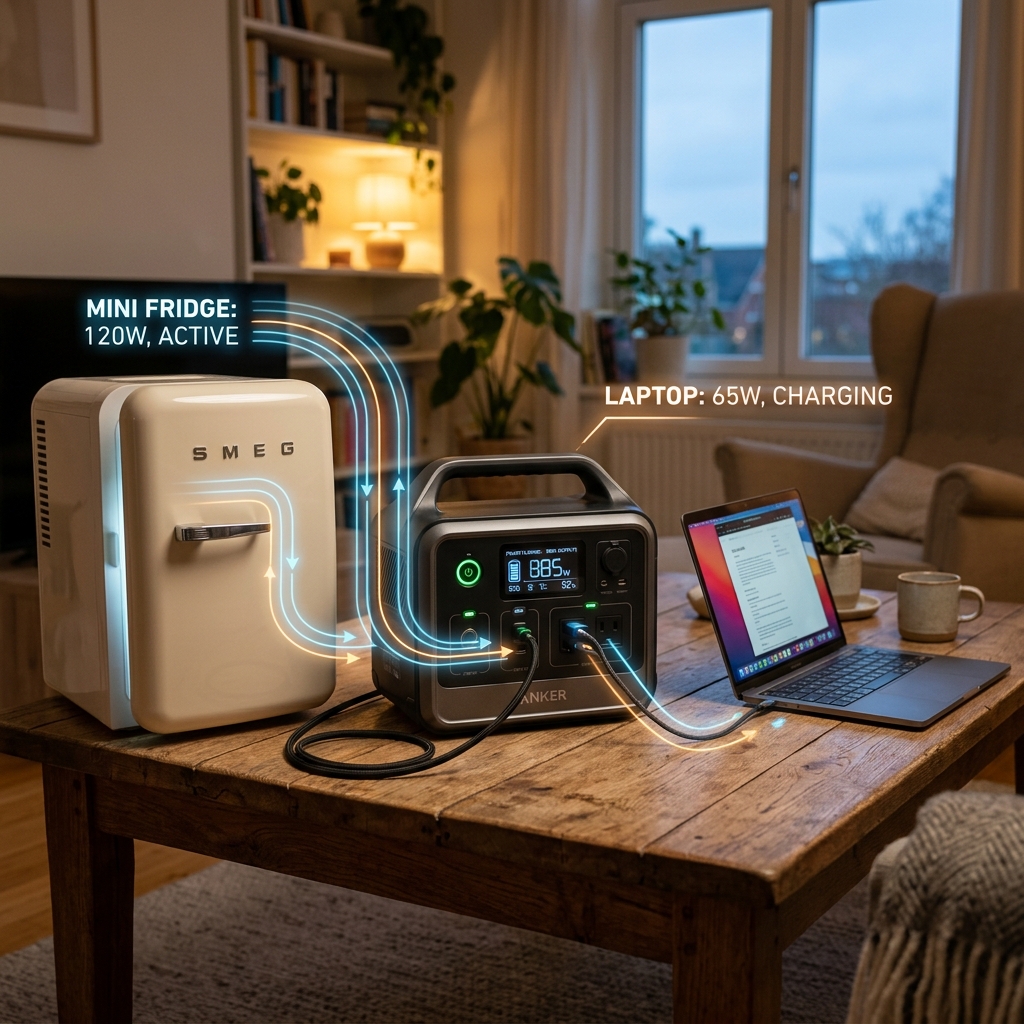
Direct answer: Learn exactly how long a portable power station will run a fridge, CPAP, laptop, or other appliances. Includes the runtime formula, efficiency factors, and a device-by-device reference table.
The capacity number on a power station's label — 1,000Wh, 2,000Wh, 4,000Wh — tells you how much energy is stored. It does not tell you how long your fridge will stay cold, or how many nights your CPAP will run. For that, you need to do some maths.
This guide covers the runtime formula, the efficiency losses most manufacturers don't highlight, and a device-by-device reference table so you can size your next unit accurately.
The Runtime Formula
The core calculation is straightforward:
Runtime (hours) = (Battery Wh × Inverter Efficiency) ÷ Device Watts
The inverter efficiency factor accounts for energy lost when the power station converts DC battery power to AC output. For AC ports, use 0.85 (15% loss is typical). For USB-C or 12V DC outputs, which bypass the inverter, use 0.92 — those ports lose significantly less.
Example 1: A 1,000Wh unit running a 60W laptop via AC:(1,000 × 0.85) ÷ 60 = ~14 hours
Example 2: The same unit powering a full-size fridge at an average 150W draw:(1,000 × 0.85) ÷ 150 = ~5.7 hours
That second number surprises people. It explains why fridge runtimes quoted in marketing materials often diverge from real-world performance — the unit is working as designed; the maths just doesn't produce the number buyers expected.
Why Duty Cycle Changes Everything
Device wattage figures are rarely the whole story. Many appliances don't run continuously at their rated wattage — they cycle.
A modern A++-rated fridge averages around 100–150W when the compressor runs, but the compressor is only active roughly 30% of the time, giving an effective average draw closer to 40–50W. A 12V compressor-style camping cooler behaves similarly, drawing 40–60W on average. This cycling is why a 1,000Wh station can run a compact fridge far longer than the flat formula suggests.
CPAP machines are another common use case. Without a heated humidifier, most CPAPs draw 30–60W for 7–8 hours per night — roughly 240–480Wh. A 500Wh unit handles a single night comfortably with margin. Switch the humidifier on and draw can jump to 80–150W, which more than doubles overnight consumption. If your CPAP has a 12V DC input and your power station has a compatible 12V port, using it directly bypasses the inverter and extends runtime by around 10–15%.
Space heaters are the opposite extreme. At a constant 1,500W with no duty cycle, a 1,000Wh station drains in under 40 minutes. Space heaters and portable power stations are fundamentally mismatched unless your unit exceeds 3,000Wh.
Surge Watts: The Specification That Catches Buyers Out
Appliances with motors or compressors — fridges, sump pumps, power tools — require 2–3x their running wattage for 1–2 seconds at startup. A fridge rated at 150W running may surge to 400–450W when the compressor kicks in. If your power station's continuous output is only 300W, that fridge will trip the overload protection and shut off — even though the capacity maths says it should work fine.
Always check both continuous output wattage and surge capacity against your appliance's nameplate. The capacity (Wh) determines how long it runs. The output rating (W) determines whether it starts at all.
Device Runtime Reference Table
All figures use 85% inverter efficiency for AC loads and assume LiFePO4 battery delivering 95% of rated capacity. Duty cycle adjustments applied where relevant.
| Device | Typical Draw | 500Wh Unit | 1,000Wh Unit | 2,000Wh Unit |
|---|---|---|---|---|
| Smartphone charging | 5–15W | 28–85 hrs | 56–170 hrs | 113–340 hrs |
| Laptop (general use) | 45–65W | 6.5–9.5 hrs | 13–19 hrs | 26–38 hrs |
| Tablet | 10–25W | 16–42 hrs | 32–85 hrs | 64–170 hrs |
| LED lighting (room) | 10–20W | 21–42 hrs | 42–85 hrs | 85–170 hrs |
| Wi-Fi router | 10–15W | 28–42 hrs | 56–85 hrs | 113–170 hrs |
| CPAP (no humidifier) | 30–60W | 7–14 hrs | 14–28 hrs | 28–56 hrs |
| CPAP (with humidifier) | 80–150W | 2.7–5.3 hrs | 5.3–10.6 hrs | 10.6–21 hrs |
| 12V compressor cooler | 40–60W avg | 7–10.6 hrs | 14–21 hrs | 28–42 hrs |
| Full-size fridge (A++) | 40–60W avg | 7–10.6 hrs | 14–21 hrs | 28–42 hrs |
| 42" LED TV | 70–90W | 4.7–6 hrs | 9.5–12 hrs | 19–24 hrs |
| Electric kettle (per boil) | 1,200–2,000W | 1–3 boils | 2–6 boils | 4–12 boils |
| Space heater (1,500W) | 1,500W | ~28 mins | ~57 mins | ~1.9 hrs |
Fridge figures use duty-cycle-adjusted average draw. Kettle figures assume 3-minute boil at 1,500W. Space heaters require a power station with 1,500W+ continuous output.
Sizing Rules
Add up your realistic simultaneous loads — not everything at once, but what genuinely runs at the same time. Apply the formula to each device individually, then combine. Add a 20–25% buffer on top: this covers battery degradation over time, cold temperatures (LiFePO4 loses capacity below 0°C), and wattages that vary from published averages.
For home outage backup covering a fridge, router, lights, and phone charging, you're typically looking at 1,500–2,000Wh minimum for a 24-hour period. Add a CPAP with humidifier and that rises to 2,000–3,000Wh. For multi-day outages without solar recharging, 4,000Wh+ with expansion capacity becomes the relevant tier.
For camping with a 12V compressor cooler, lights, and device charging over a weekend, 1,000–1,500Wh is the workable range for most setups.
→ Compare units by capacity and cost-per-watt on our comparison chart