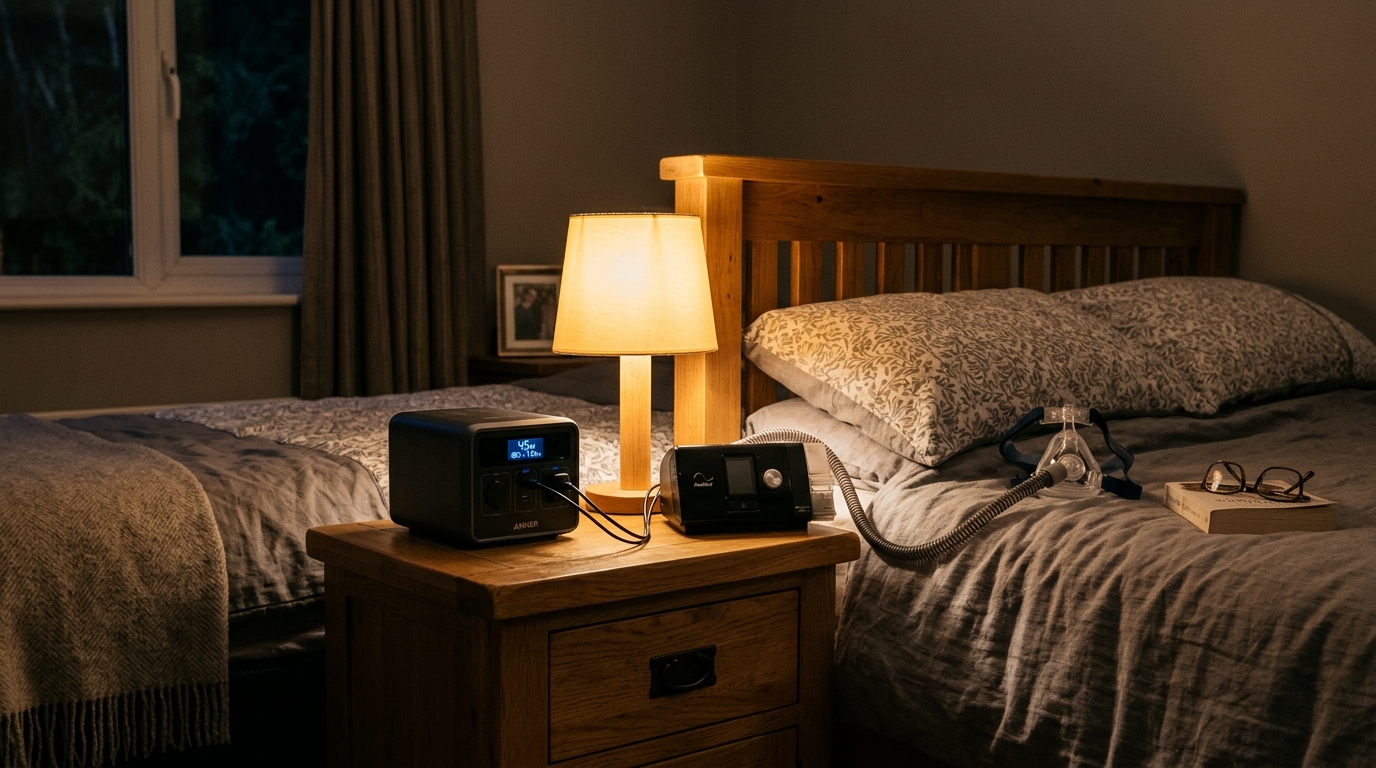
Direct answer: The Priority Services Register and 105 matter more than any battery in a power cut. What the register does and does not guarantee, who qualifies, and where a portable power station genuinely helps — and where it must not be used.
Editorial note: WhichWatts is an independent comparison site. Prices, availability, specifications, and retailer promotions change frequently. Check the live product table and retailer page before buying.
Power Cuts, the Priority Services Register, and What a Battery Cannot Do
Most household power planning starts with a shopping list. The official guidance starts somewhere else: with knowing who to call, who needs extra support, and what you will actually do when the lights go out. A portable power station is useful, but it is the third item on that list, not the first.
What the Priority Services Register is
The Be Ready guidance tells households to check whether they can join the Priority Services Register (PSR). It is a free register run by energy suppliers and network operators that flags households needing additional support during an interruption.
The guidance notes that "lots of households are eligible, including those with children under 5", and eligibility also commonly covers pensionable age, disability, a medical condition or dependence on powered equipment. Registration is per supplier, so it is worth confirming it follows you when you switch or move.
What it can provide, depending on the operator:
- Advance notice of planned interruptions where possible.
- Priority support during an unplanned cut.
- Alternative arrangements or welfare checks for people with medical needs.
- Communication in an accessible format, and a password scheme for callers.
What it does not do is guarantee that your power stays on, or that a generator will appear at the door. The register tells the network who needs help; it does not replace a plan. Join it through your supplier, and ask specifically what your network operator provides.
105 and a paper list
The guidance is explicit about the number to call: "105 in England, Scotland and Wales and 03457 643643 in Northern Ireland." Write it down. In a long outage the phone you are reading it from may be the one that is flat, which is exactly why the checklist asks for a charged power bank and printed contact details.
Where a power station genuinely helps
| Need | Covered? | Reality |
|---|---|---|
| Phones, radio, torches | Yes | Small loads, hours of runtime |
| Wi-Fi router | Yes | Around 240Wh a day |
| Fridge-freezer | Partly | 1–2kWh a day; keeps contents for hours, not days |
| Heating | No | A 2kW heater empties a 1kWh pack in 30 minutes |
| Kettle, hob, microwave | No | 2–3kW surge trips most portable units |
| Medical devices | Only with manufacturer approval | Clinical plan and PSR come first |
| Boiler electronics | Sometimes | Hard-wired; needs a competent person, not an adapter |
| Stairlift, lift, whole home | No | Not a portable-station job |
The pattern is consistent: a station is excellent at small electronic loads and poor at anything that makes heat. For the loads that genuinely fit, compare current models and browse live listings rather than buying on a watt-hour claim alone.
Medical equipment and medication
The guidance asks households to keep "essential medication and medical supplies" and to "request prescriptions up to 5 working days before you need your medicine." Two practical additions:
- Keep a printed list of medicines, doses and the equipment you rely on, as the checklist suggests.
- For anything life-sustaining, speak to the clinician and the equipment supplier about backup before buying hardware. Device-specific sizing is covered in power for medical equipment that must run 24 hours.
Never improvise a connection to household wiring, and do not assume a power station is approved for a medical device just because it has a mains socket.
If you care for someone else
The guidance recommends making "a plan to check in on neighbours if an emergency happens, particularly if the power goes out." That is easier with specifics: who has a key, who is on the PSR, who has medication in the fridge, and who can lift a battery. Write it on the same sheet as the emergency numbers.
A one-page household power plan
- Who is registered on the PSR, with supplier and account numbers.
- 105 (or 03457 643643 in Northern Ireland) written on paper.
- Which devices the station runs, and the last date you tested them.
- How long each load actually lasts, measured rather than guessed.
- Who can lift and move the unit.
- Where torches, batteries and the radio are kept.
- The recharge plan if the outage lasts beyond three days.
FAQ
Does the Priority Services Register guarantee backup power?
No. It flags that you need support and can improve communication and priority during an outage, but it does not guarantee supply or equipment.
Who qualifies for the PSR?
Eligibility varies by supplier but commonly includes pensionable age, disability, a medical condition, and households with children under 5. Ask your supplier to confirm.
What number do I call in a power cut?
105 in England, Scotland and Wales; 03457 643643 in Northern Ireland.
Can I run a CPAP machine from a power station?
Only with the device manufacturer's approval and a compatible connection — often a manufacturer-approved DC cable. Confirm the setup with your clinician or equipment supplier first.
Will my supplier provide a generator during an outage?
Some operators make welfare arrangements for customers with urgent medical needs, but this varies and is not a general service. Ask your supplier what it offers before you need it.
What to buy after the plan, not before
Register first, plan second, buy third. Once the Priority Services Register is confirmed and the household plan exists, the hardware question is narrow:
- Phones, radio, torches and a router: a 300–500Wh station covers three days comfortably. Compare current options in the price comparison table or browse the full catalogue.
- A fridge or medical equipment: size from measured load with the power station calculator, and read the medical equipment guide before assuming a station is approved.
- Brand ranges with published backup models: EcoFlow, Bluetti and Anker SOLIX.
Do not buy a generator for a flat, and do not buy capacity you cannot lift, store safely, or recharge.