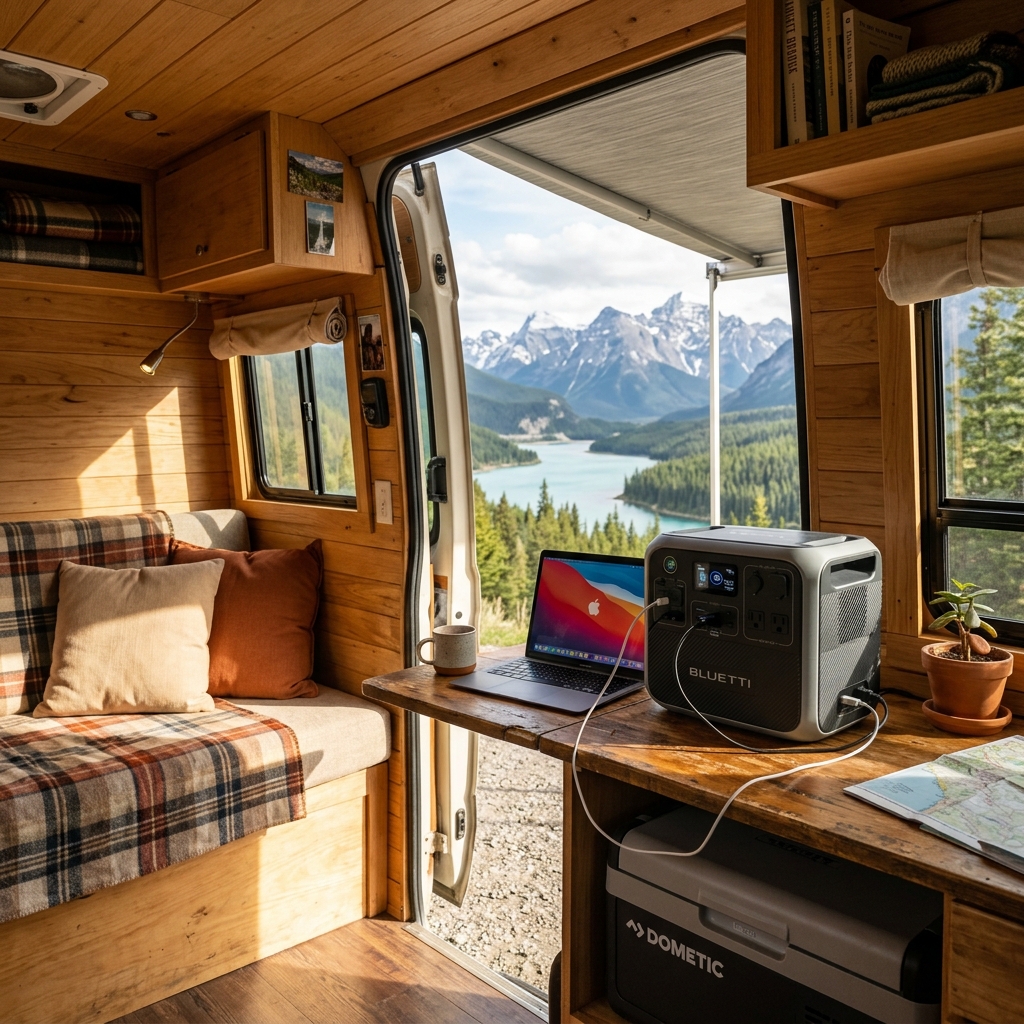
Direct answer: Building out a camper van? Don't buy a power station until you read this. We explain how to calculate your exact wattage needs for fridges, laptops, and more.
One of the most common mistakes new van lifers make is buying a portable power station that is either way too small (leading to warm beer and dead laptops) or completely overkill (wasting money and precious space).
In 2026, "solar generators" (a portable power station + solar panels) are the easiest way to power a van, requiring zero complicated wiring. But how do you know which size to buy?
Here is our foolproof guide to sizing your system.
Step 1: The Energy Audit (Calculating Watt-Hours)
You need to figure out exactly what you will be plugging in, how much power it draws, and how long you will use it each day.
Power is measured in Watts (W).
Capacity is measured in Watt-Hours (Wh).
Here is a typical daily van life energy audit:
- 12V Fridge: Draws ~40W when the compressor runs (assume 12 hours a day) = 480Wh
- Laptop Charging: 60W for 3 hours = 180Wh
- Phone Charging: 15W for 2 hours (x2 phones) = 60Wh
- LED Lights: 20W for 4 hours = 80Wh
- Water Pump: 30W for 30 mins = 15Wh
- Starlink / Internet: 40W for 8 hours = 320Wh
Total Daily Consumption: 1,135Wh
Step 2: The 20% Buffer Rule
Inverter inefficiency, extreme temperatures, and battery degradation mean you never get 100% of the stated capacity out of a battery.
If your daily need is 1,135Wh, you should multiply that by 1.2.
- Target Capacity: ~1,362Wh.
This means a 1,500Wh power station (like an EcoFlow DELTA 2 Max or Bluetti AC200L) is the sweet spot for this specific setup.
Step 3: Factoring in Solar Panels
The sun doesn't shine every day. If you have 3 cloudy days in a row, a 1,500Wh battery will be dead in 1.5 days.
You have two choices:
- Buy a much bigger battery (e.g., 3,000Wh) to last through cloudy days.
- Ensure you can charge via the alternator while driving.
If you are parking for weeks at a time, you need a larger battery. If you drive every 2-3 days, a smaller battery paired with a 12V car charging cable is perfectly fine.
Step 4: The Inverter Size (Surge Watts)
Watt-hours dictate how long things run. The Inverter Rating (e.g., 2000W) dictates what you can plug in.
- < 1000W Inverter: Good for phones, laptops, fans, and 12V fridges.
- 2000W Inverter: Can handle coffee makers, microwaves, or a small hair dryer.
- 3000W+ Inverter: Can run an air conditioner or induction cooktop.
Pro Tip: Induction cooktops and microwaves are power hogs. If you use them, you absolutely need a power station with a 2,000W+ inverter and at least a 2,000Wh battery capacity.
The Verdict
For weekend warriors, a 500Wh - 1,000Wh unit is usually enough.
For full-time remote workers with a 12V fridge and Starlink, aim for 1,500Wh - 2,500Wh.
For those running AC units or induction cooktops, you are in the 3,000Wh+ territory.