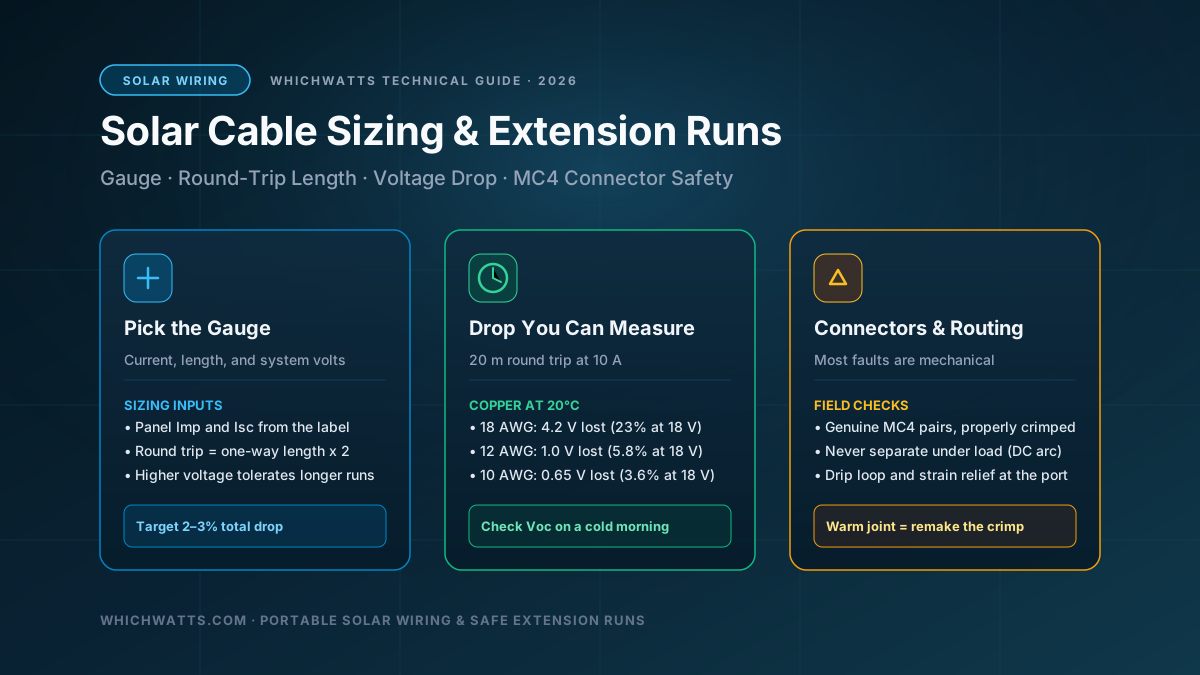
Direct answer: Cable gauge, not panel wattage, usually decides how much of a portable array’s output reaches the power station: keep voltage drop near 2-3%, use genuine MC4 connectors rated for the current, and check the station’s maximum solar voltage before adding an extension run.
Editorial note: WhichWatts is an independent comparison site. Prices, availability, specifications, and retailer promotions change frequently. Check the live product table and retailer page before buying.
Solar Panel Cable Sizing: Gauge, Length, and Connectors for Portable Setups
A folding panel and a power station can be perfectly matched on paper and still underperform because of the cable between them. On a low-voltage string, ten metres of thin extension lead can waste more energy than a passing cloud, and that loss shows up as heat in the cable rather than as a number on the station's display.
This guide covers the DC wiring between panels and a portable power station: how to choose a gauge, how to estimate voltage drop before you buy, and which connector and routing details cause most of the trouble in the field. It does not replace the manufacturer's instructions, and it is not a substitute for an electrician for anything fixed to a building.
What the cable actually does to the array
Every conductor has resistance. Current passing through it produces a voltage drop (V = I x R) and heat (P = I squared x R). For a solar array the drop matters twice: the panels are operating on a narrow part of their curve, and the charge controller sees a lower input voltage than the panel is producing. Long, thin cable therefore shifts the whole array away from its maximum power point, and the effect compounds in poor light when current is small and any fixed loss is a larger share of it.
The three numbers that decide the gauge
- Current. Use the panel's Imp, and its Isc for fusing and connector ratings. A typical 200 W folding panel with a Vmp near 18 V pushes roughly 11 A.
- Round-trip length. Measure the one-way distance and double it, because current travels out and back. A 10 m run is 20 m of conductor.
- System voltage. The same cable loses the same volts on an 18 V string and a 36 V string, but that loss is twice the percentage on the lower-voltage system.
A practical target for a portable array is 2-3% total drop. Above roughly 5% the loss is worth fixing; double-digit drop means the cable is the problem, not the weather.
Voltage drop, worked through
Copper resistance at 20 degrees Celsius is about 0.0172 ohm per square millimetre of cross-section per metre. That gives these rough values:
| Cable size | Resistance (ohm per metre) | Drop over 20 m at 10 A | Share of a 36 V input | Share of an 18 V input |
|---|---|---|---|---|
| 18 AWG (0.82 mm2) | 0.0209 | 4.2 V | 11.6% | 23% |
| 16 AWG (1.31 mm2) | 0.0132 | 2.6 V | 7.3% | 14.7% |
| 14 AWG (2.08 mm2) | 0.0083 | 1.7 V | 4.6% | 9.2% |
| 12 AWG (3.31 mm2) | 0.0052 | 1.0 V | 2.9% | 5.8% |
| 10 AWG (5.26 mm2) | 0.0033 | 0.65 V | 1.8% | 3.6% |
The table explains why higher-voltage arrays tolerate longer runs. Two panels in series at roughly 36 V lose the same number of volts as one panel at 18 V, but that fixed loss is half the percentage. Series wiring also keeps current low, which is gentler on connectors, at the cost of needing sunlight on both panels at once and of raising the open-circuit voltage.
Resistance rises with temperature - copper is roughly 0.4% worse per degree above 20 C - so a black cable lying in full sun performs a little worse than the table suggests.
The equipment limits matter more than the table
Before extending anything, confirm the station's solar input specification:
- Maximum PV voltage. This is a hard limit, and it applies to the open-circuit voltage (Voc), not the Vmp. Voc rises as cells get colder, so a string that sits comfortably under the limit on a warm afternoon can exceed it on a frosty morning. Leave headroom rather than sizing to the exact figure.
- Maximum PV current and wattage. Many stations cap input far below what the array can deliver. Over-panelling sometimes just clips the peak; exceeding the voltage limit can destroy the input stage. Only the first is safe to experiment with, and only within the manual's stated range.
- Connector rating. MC4 connectors are commonly rated around 30 A, well above what a portable array produces, but the plug-and-socket pairs on cheap adapters often are not.
- Fusing. A single panel into a station usually needs no fuse beyond what the manufacturer specifies. Parallel strings can back-feed a faulted panel, and that case needs the array's instructions followed rather than guessed.
Connectors are the quiet failure point
Most portable solar faults are mechanical, not electrical. The common ones:
- Clone MC4 connectors. The shape is standardised; the tolerances are not. Mixing brands, or using unbranded pairs, is a frequent source of high-resistance joints that heat and discolour.
- Poor crimps. A crimp that pulls out under light hand tension was never a connection. Tug each one before the first trip.
- Disconnecting under load. DC arcs do not self-extinguish the way AC arcs do at a zero crossing. Switch the input off, or cover the panel, before separating connectors.
- Water in the joint. Orient connector pairs so the junction hangs below the cable, and keep plugs out of standing water and mud. A rubber boot is not a submersion rating.
- Stacked adapters. Every additional pair adds resistance and a place to fail. A single correct-length cable beats a chain of short ones.
Extension runs in practice
- Shorten the run before thickening it. Moving the panel two metres closer is free; thicker cable is not.
- Do not use an AC extension lead for the DC side. The connectors are wrong for the job, the conductor is often thinner than it looks, and the assembly is not rated for the array's current in the way the label implies.
- Do not coil a cable that is carrying current. Coiled conductor traps heat. Lay it out, or keep the load light.
- Support and strain-relieve. A cable hanging from the station's input socket loads the connector, not the cable. A drip loop before the entry point keeps water out of the unit.
- Keep it out of walkways and standing water, and check the run after wind or animals have moved it.
- Check the temperature after twenty minutes of full output. A joint that is noticeably warmer than the cable beside it is a joint to remake.
A pre-purchase checklist
- Note the panel's Vmp, Imp, Voc and Isc from its label, not from the box marketing.
- Note the station's maximum solar voltage, current and wattage.
- Measure the one-way cable run you actually need, then double it.
- Pick the smallest gauge that lands near 2-3% drop, then go one size up if the run is permanent or the cable will sit in sun.
- Add the series voltage before you extend the run, and check the cold-morning Voc against the limit.
- Buy genuine connectors and crimp them properly, or buy a cable assembly made with them.
FAQ
Can I extend a solar panel cable with a longer MC4 lead?
Yes, within limits. The added length adds resistance, so check the voltage drop for the total run, keep the connectors genuine and crimped correctly, and confirm the station's maximum solar voltage is still respected. Two short extensions joined together are worse than one cable of the right length.
Does a thicker cable increase the power my panel produces?
It does not increase the panel's output, but it reduces what is lost on the way to the station. A 200 W panel that delivers 165 W through a thin long lead can deliver close to its rated output through a correctly sized one.
Can I connect panels in series to make a longer cable run work?
Series wiring raises the voltage and keeps current low, which reduces the percentage lost over distance. It also raises the open-circuit voltage, which is what can exceed the station's input limit, so check the cold-weather figure before doing it.
Why does my station show less solar input than the panel rating?
Rated wattage assumes standard test conditions that a real panel rarely sees. Angle, shade, heat, haze and cable loss all take a share. If the shortfall is large and the panel is cool and square to the sun, suspect the cable and connectors first.
Is it safe to join two MC4 extension cables together?
It is common practice and safe when both pairs are genuine, correctly crimped, dry and mechanically supported. Avoid it as a permanent arrangement in wet or windy locations, where a single cable is more reliable.
Bottom line
Size the cable to the current and the round-trip length, keep the drop near 2-3%, and treat the station's solar voltage limit as absolute. Then use the solar panel sizing calculator to check what the array can realistically deliver, and compare stations by solar input and cost per watt-hour in the price comparison table.