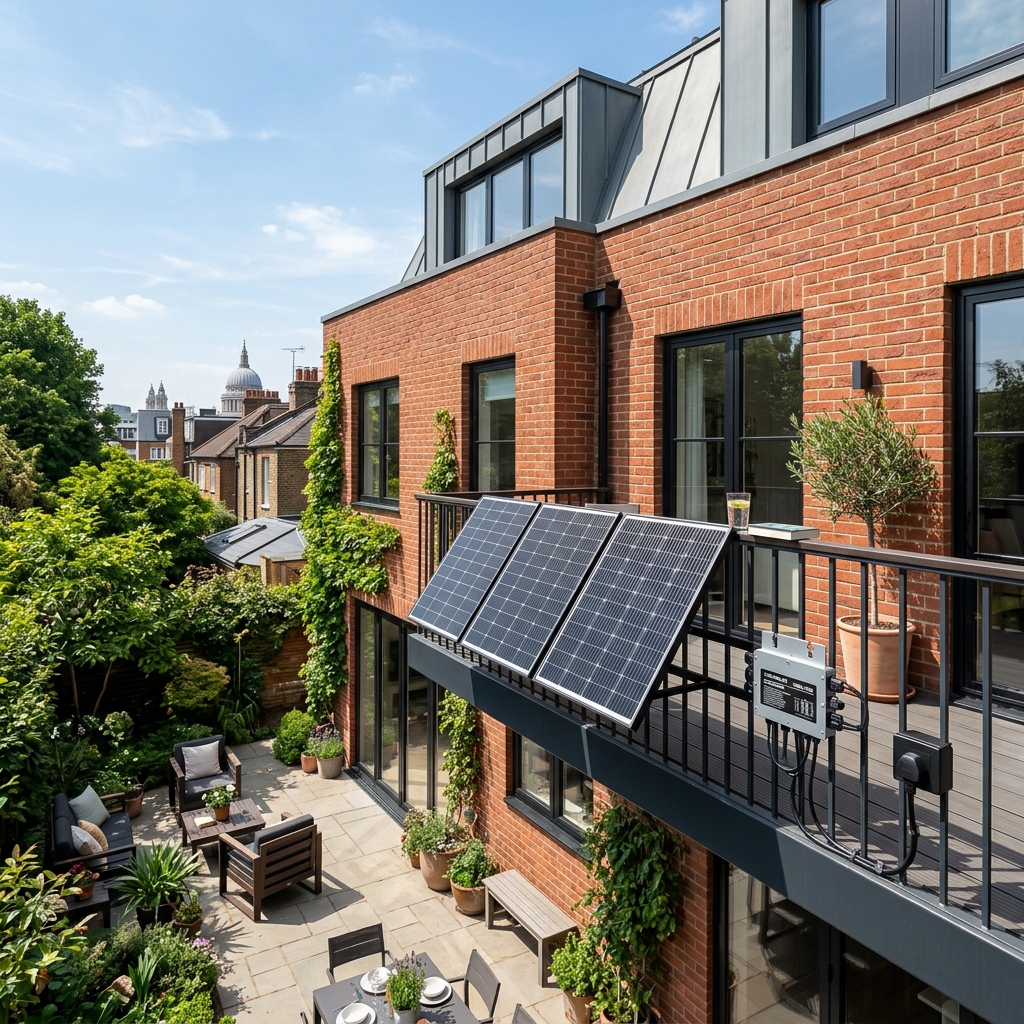
Direct answer: An in-depth legal and technical guide to the 2026 UK plug-in solar regulations, G98 DNO notification rules, 800W microinverter limits, BS 7671 electrical safety standards, and MCS exemptions.
Editorial note: WhichWatts is an independent comparison site. Prices, availability, specifications, and retailer promotions change frequently. Check the live product table and retailer page before buying.
UK Plug-In Solar Laws Explained (2026): G98 Rules, 800W Limits & Regulations
The UK energy market underwent a major policy shift regarding plug-and-play solar (also known as balcony solar or plug-in microgenerators). Previously restricted by strict wiring regulations and mandatory certified electrical sign-offs, updated UK regulations now explicitly accommodate sub-800W plug-in solar systems.
This legal guide breaks down the 2026 UK plug-in solar laws, including Distribution Network Operator (DNO) notification requirements, microinverter power ceilings, safety standards under BS 7671, smart meter compatibility, and landlord permissions.
Key Legal Pillars of the UK Plug-In Solar Framework
The updated legal framework rests on four technical standards designed to balance consumer adoption with national grid stability and home electrical safety:
1. The 800W Microinverter AC Power Limit
Under the updated UK standards (aligning with EU Commission EN 50549-1 recommendations), DIY plug-in solar microgenerators are capped at 800W AC continuous output.
While your solar panel wattage on a balcony or patio can exceed 800W (for example, pairing two 440W panels for 880W DC to optimize low-light generation), the microinverter connected to your household socket must electronically limit its AC output to 800W. This prevents overloading standard 13A UK ring mains or radial circuits.
2. DNO Notification: Engineering Recommendation G98
Under Engineering Recommendation G98, microgenerators rated up to 16A per phase (approx 3.68kW) benefit from a "Fit & Inform" process. For sub-800W plug-in solar systems:
- You do not need prior permission from your Distribution Network Operator (such as National Grid Energy Distribution, UK Power Networks, SSEN, or Northern Powergrid) before purchasing or setting up.
- You are legally required to submit a simple, free G98 notification form to your regional DNO within 28 days of commissioning the system.
- Most DNOs provide an instant online portal where you upload your microinverter's ENA Type Test certificate, serial number, and property address.
3. Electrical Safety Standards & BS 7671 Compliance
To operate legally and safely under UK wiring regulations (BS 7671: Requirements for Electrical Installations):
- Anti-Islanding Protection (DIN VDE 0126-1-1 / EN 50549): The microinverter must feature certified automatic shutdown within 20 milliseconds if grid power fails. This guarantees no backfeeding into dead lines while line workers carry out repairs.
- RCD Protection: The socket used for connection must be protected by a 30mA Residual Current Device (RCD). Outdoor sockets must be IP66 weather-rated with a PRCD (Portable Residual Current Device) built into the cable or plug.
- Socket Connection: Standard 13A UK 3-pin BS 1363 plugs are permitted for certified 800W kits with integrated anti-islanding protection, although dedicated Wieland RST sockets remain popular for permanent outdoor fixtures.
4. Microgeneration Certification Scheme (MCS) Exemption
Traditionally, solar installations required an MCS-certified installer to qualify for grid export payments and planning exemptions. Under the 2026 plug-in solar guidance:
- Portable and plug-in solar kits rated under 800W AC are exempt from mandatory MCS installation.
- Homeowners and renters can legally assemble and plug in certified plug-and-play kits without hiring an electrician, provided the kit carries CE/UKCA marking and ENA Type Test registration.
⚡ Top Legal UK Plug-In Solar Kits
All systems listed below include G98-compliant 800W microinverters with certified anti-islanding and UK 3-pin plug connectors:
- • EcoFlow PowerStream 800W Balcony Kit — Integrated microinverter with optional Delta 2 Max battery storage.
- • Anker Solix E1600 Solarbank & 800W Inverter — Smart app power control with 1.6kWh LFP battery module.
- • Bluetti Balcony Solar Ecosystem — Pairs directly with AC200L power stations for full off-grid backup.
Smart Meters and the Smart Export Guarantee (SEG)
One critical legal aspect of plug-in solar in the UK is metering:
- Older Analog (Disc) Meters: If you have an older mechanical electricity meter, solar export can cause the disc to spin backwards. This is technically illegal under UK metering laws (unregulated reverse metering). You must notify your electricity supplier to upgrade to a Smart Meter (SMETS2) free of charge.
- Digital Non-Smart Meters: Some older digital meters may register solar export as consumption, inadvertently charging you for the electricity you feed into the grid. Upgrading to a SMETS2 smart meter eliminates this issue.
- Smart Export Guarantee (SEG): While plug-in solar reduces your import bill by powering daytime loads directly, claiming export tariffs under SEG usually requires an MCS certificate. Because plug-in solar is designed for self-consumption, pairing your kit with a battery storage unit ensures zero wasted solar energy.
Landlord Rights, Renters, and Permitted Development
Under UK planning law (Town and Country Planning General Permitted Development Order):
- Permitted Development Rights (PDR): Solar panels installed on residential roofs or ground-mounted in gardens are generally covered by PDR, meaning no formal planning permission is required (subject to conservation area rules and listed building restrictions).
- Balcony Panels & Renters: Mounting solar panels on flat balconies or external balustrades in rented properties requires landlord consent. However, non-permanent fixtures (such as flexible panels strapped with weather-rated heavy-duty cable ties or freestanding patio mounts) do not alter the building structure, making landlord approval significantly easier to secure.
FAQ
Is plug-in solar legal in the UK in 2026?
Yes. Plug-in solar systems rated up to 800W AC are legal in the UK provided the microinverter has certified anti-islanding protection (EN 50549 / G98), carries CE/UKCA marking, and a G98 notification is submitted to your local Distribution Network Operator (DNO) within 28 days of connection.
Do I need an electrician to plug in an 800W balcony solar kit?
No. Sub-800W plug-in solar kits with built-in microinverters and standard UK 3-pin plugs do not legally require a certified electrician or MCS installer. You can safely plug the kit into a 30mA RCD-protected outdoor socket yourself.
What happens if my solar system generates more electricity than I use?
Without a storage battery, excess electricity flows past your consumer unit out to the national grid. If you have a SMETS2 smart meter, it will record the export harmlessly. To capture that free energy for evening use, pair your solar panels with a compatible battery storage system like the EcoFlow PowerStream or Anker Solix Solarbank.
Do I need permission from my Distribution Network Operator (DNO)?
Under G98 rules, sub-800W systems operate under a "Fit & Inform" model. You do not need prior approval; you simply complete a quick online notification form with your regional DNO within 28 days of plugging in the system.