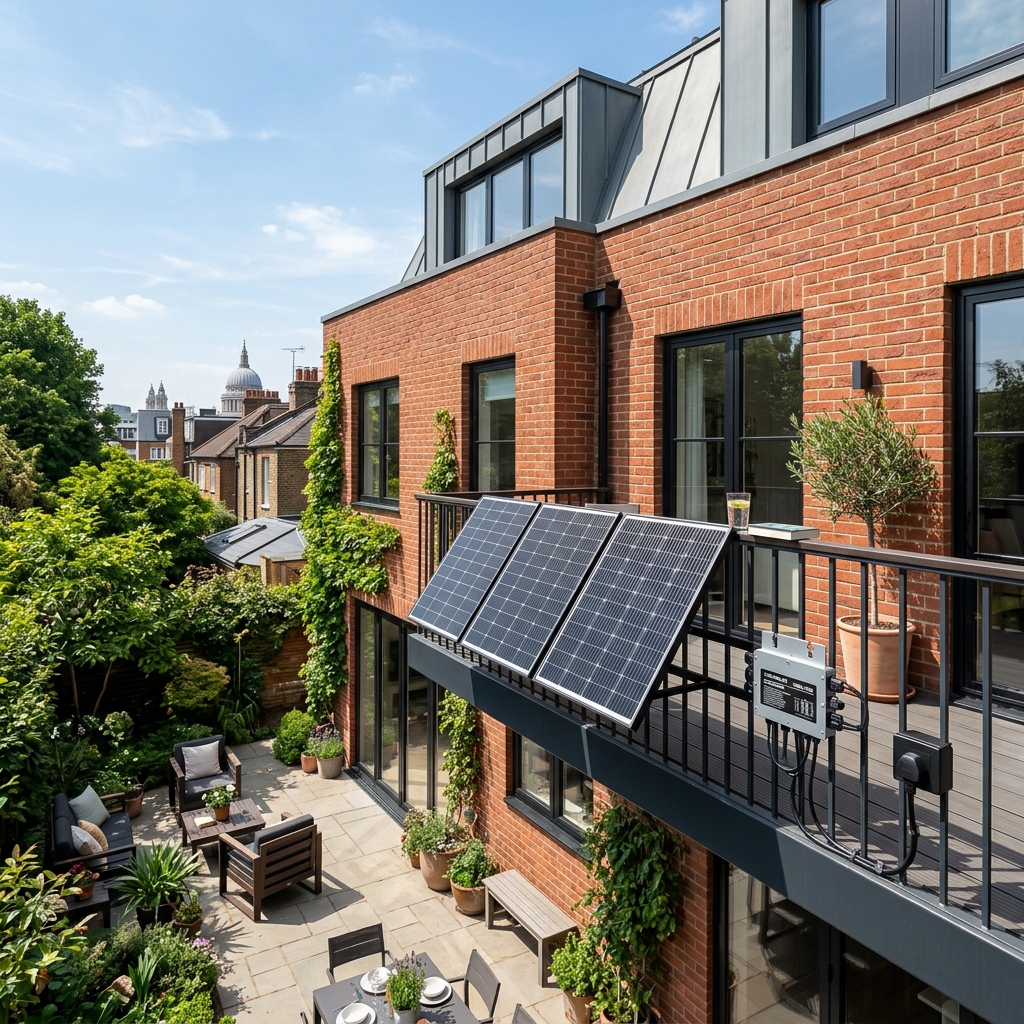
Direct answer: Can you legally plug solar panels directly into a UK 13A wall socket? Everything you need to know about G98 notifications, 800W limits, grid compliance, and UK regulations in 2026.
Plug-in solar — often called balcony solar or mini solar PV — allows households to generate electricity using solar panels connected via a standard 13A wall socket. While plug-in solar kits have exploded in popularity across Germany and Austria (where over 500,000 balcony units are active), the UK regulatory landscape has distinct rules that buyers must understand.
This guide explains current UK regulations in 2026, including grid connection standards (ENA Engineering Recommendation G98), microinverter safety limits, tenancy/property permissions, and how to stay fully legal.
Is Plug-In Solar Legal in the UK?
Yes, plug-in solar is legal in the UK, provided your setup complies with Electrical Safety Standards (BS 7671 Wiring Regulations) and Distribution Network Operator (DNO) grid connection requirements.
Unlike Germany, where special 'Schuko' plugs or Wieland connectors are explicitly codified for DIY solar feeds into household circuits, the UK requires strict adherence to anti-islanding protections and maximum AC output thresholds.
Key Legal Requirements at a Glance
| Requirement | Rule / Standard | Details |
|---|---|---|
| Max AC Power Output | 800W (Microinverter cap) | Upgraded from 16A (~3.68kW single phase) for simplified G98 notification |
| Grid Compliance | ENA EREC G98 / G98-1-4 | Must use certified microinverters with automatic loss-of-mains shutdown |
| DNO Notification | Form G98 (Notify within 28 days) | Free notification to your regional Distribution Network Operator |
| Socket Safety | Switched 13A Socket or RCD | Residual Current Device protection mandatory under BS 7671 |
| Planning Permission | Permitted Development (mostly) | No planning needed unless listed building or in a Conservation Area |
Step 1: DNO Notification & The G98 Rule
Under UK electricity regulations, any generator connected in parallel with the public electricity network must notify the local Distribution Network Operator (DNO) — such as National Grid Electricity Distribution, UK Power Networks, or SSEN.
What is G98?
Engineering Recommendation G98 applies to micro-generators rated up to 16A per phase (approx. 3.68kW). Under G98:
- You do not need prior permission before installing or plugging in.
- You must submit a simple G98 Notification Form to your DNO within 28 days of commissioning the system.
- The microinverter or plug-in battery unit must be registered on the Energy Networks Association (ENA) Type Test Register.
Important: Always ensure your plug-in microinverter (such as those manufactured by Hoymiles, Anker, EcoFlow, or TSUN) is G98 certified. Importing non-certified microinverters from unverified overseas sellers violates UK grid connection laws.
Step 2: Microinverter & Socket Safety (Anti-Islanding)
The primary safety concern with plugging power back into a home socket is islanding. If the public electricity grid goes down for maintenance and your solar panels continue pushing power into the wall socket, grid workers repairing external power lines could face fatal electrical shocks.
How Anti-Islanding Protects You
Every UK-compliant plug-in solar kit requires an integrated relay switch that detects grid voltage and frequency:
- When grid power drops, the microinverter cuts power output in under 20 milliseconds.
- No voltage remains on the pins of the 3-pin UK plug if it is pulled out of the wall.
Wiring & Socket Guidance
- RCD Protection: The circuit receiving solar feed must be protected by a 30mA RCD (standard on modern consumer units).
- Dedicated Spur vs. Extension Lead: Never plug a solar microinverter into a daisy-chained extension lead. Plug directly into a dedicated, unswitched or switched wall socket.
Step 3: Renters, Flats, and Planning Permission
Planning Permission
In England, Scotland, and Wales, installing solar panels on domestic rooftops or balconies falls under Permitted Development Rights. You do not require planning permission unless:
- Your property is a Listed Building.
- You live in a Conservation Area or World Heritage Site and panels are visible from a highway.
- Panels project more than 200mm from the wall or roof plane.
Renter & Leaseholder Rules
If you rent your home or own a leasehold flat:
- Freehold Consent: External balcony brackets or wall drilling usually require landlord or freeholding management approval.
- Non-Destructive Setups: Using balustrade clamp mounts, suction-grade window solar panels, or indoor sunny window setups with portable power stations does not alter the structure and is renter-friendly.
Summary Checklist for UK Buyers
- Verify Microinverter Certification: Ensure G98 certification (EN 62109-1/-2, EN 50549-1).
- Limit AC Output: Keep total microinverter AC export under 800W per household phase for simplified G98 notification.
- Notify Your DNO: Submit G98 form within 28 days of plugging in (free process).
- Pair with Battery Storage: To prevent sending free unmetered solar back to the grid without SEG payments, pair your panels with a portable power station or balcony battery storage unit.
→ Compare compliant UK Portable Power Stations & Solar Storage
→ Read our Best Plug-In Solar & Battery Systems Guide