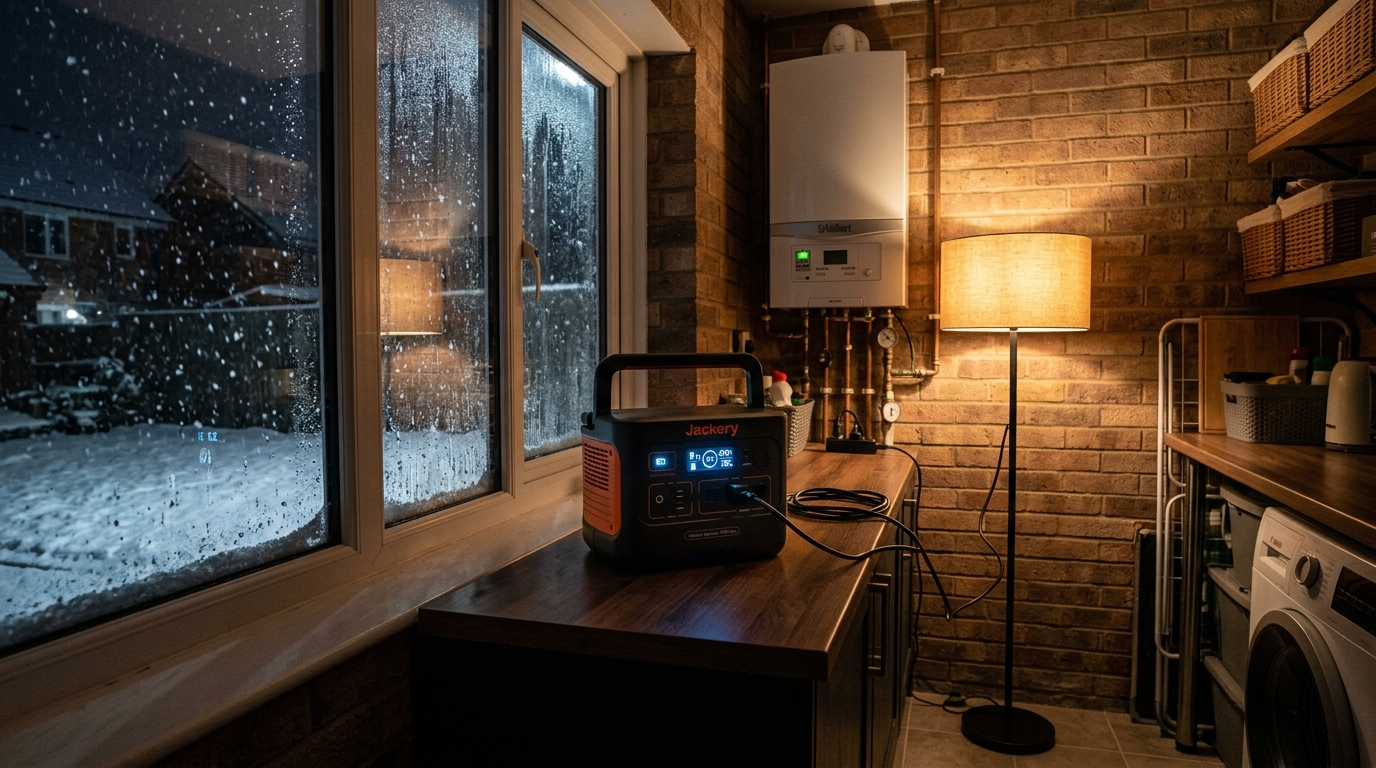
Direct answer: Step-by-step winter blackout planning: how to keep gas combi boilers, CPAP/medical machines, and fridge-freezers running, why fan heaters drain batteries, and key battery cold-storage rules.
Editorial note: WhichWatts is an independent comparison site. Prices, availability, specifications, and retailer promotions change frequently. Check the live product table and retailer page before buying.
Autumn & Winter 2026 Power Cut Prep: Emergency Backup for Gas Boilers, Medical Gear & Fridge-Freezers
When autumn storms arrive and sub-zero winter temperatures set in, a power cut transforms from a minor inconvenience into a serious domestic hazard. Modern gas central heating boilers, smart thermostats, fridge-freezers, home medical equipment, and broadband routers all depend entirely on continuous grid electricity to operate.
Preparing an emergency battery backup strategy before freezing weather strikes ensures you can keep your home warm, protect your food supply, and power vital medical devices without relying on dangerous, noisy petrol generators indoors.
This guide provides real-world electrical load calculations, runtime expectations, equipment safety rules, and battery cold-temperature operating guidelines for winter 2026.
Why Modern Gas Heating Fails in a Power Cut
A widespread misconception among homeowners is that gas-fired central heating will work during an electricity blackout because gas lines remain pressurised. In reality, virtually every domestic gas combi boiler, system boiler, and oil heating setup requires mains AC electricity for:
- Electronic ignition and flame rectification sensors (prevents gas build-up).
- The internal circulation pump (which moves hot water through radiators or underfloor loops).
- The exhaust flue fan and digital control PCB (monitors pressure and water flow).
- Smart thermostats, room stats, and zone motorised valves (e.g. Hive, Nest, Honeywell).
Without electrical power, the boiler shuts down instantly for safety.
Can You Power a Gas Boiler from a Portable Power Station?
Yes, provided you understand two critical electrical requirements:
- Continuous Power Draw: A running combi boiler and circulation pump typically consume between 60W and 150W of continuous electricity (with a brief 200W ignition spike). A standard 1,000Wh portable power station can keep a gas boiler firing for 7 to 12 hours, and a 2,000Wh unit can deliver 15 to 24+ hours of central heating.
- Pure Sine Wave Output: Boilers contain sensitive microprocessors and synchronous circulation pump motors. You must use a power station with a certified Pure Sine Wave inverter (standard on modern EcoFlow, Bluetti, Jackery, and Anker units). Modified sine wave units can overheat pump motors and cause PCB error codes.
- Earth/Neutral Floating Bonding: Some combi boilers with flame-ionisation rectification rods require an earth reference to detect the flame. Connecting via a dedicated fused connection spur plug wired to a properly earthed power station ensures safe, error-free ignition.
The Space Heater Trap: Why Fan Heaters Drain Batteries
The most common mistake during winter outages is plugging a 2,000W electric fan heater, convection radiator, or fan oil-heater into a portable power station.
| Heating Appliance | Typical Power Draw | Runtime on a 1,000Wh Battery | Runtime on a 2,000Wh Battery | Practical Verdict |
|---|---|---|---|---|
| 2,000W Electric Fan Heater | 2,000W | 24–28 minutes | 50–60 minutes | ❌ Inefficient; drains battery almost instantly |
| 1,000W Convection Heater | 1,000W | 50 minutes | 1.8 hours | ❌ Poor emergency choice for sustained warmth |
| Gas Combi Boiler (Pump + PCB) | 80W–120W | 7–10 hours | 15–20 hours | ✅ Best approach: heats the whole home on gas |
| 12V Heated Throw / Electric Blanket | 40W–60W | 14–18 hours | 30–38 hours | ✅ Excellent direct warmth for individuals |
| Heated Mattress Topper (Low Setting) | 30W–45W | 18–24 hours | 38–48 hours | ✅ Keeps beds warm overnight through deep cold |
Key Rule: Using electrical energy to create direct heat through high-wattage resistance elements is extremely inefficient on battery storage. Use your battery to power the boiler pump or low-wattage personal heated blankets, rather than trying to heat ambient room air with electric fan blowers.
Essential Winter Blackout Appliance Energy Budget
Here is an energy budget for a typical 24-hour winter blackout:
| Essential Appliance | Running Watts | Surge Watts | Daily Hours Needed | Total Daily Wh | Recommended Battery Size |
|---|---|---|---|---|---|
| Gas Combi Boiler (Pumping) | 90W | 200W | 8 hours (cycled) | 720 Wh | 1,000Wh – 2,048Wh |
| Tall Fridge-Freezer | 100W | 900W | 8 hours (duty cycle) | 800 Wh | 1,500Wh – 2,048Wh |
| CPAP Machine (No Humidifier) | 30W | 45W | 8 hours (overnight) | 240 Wh | 500Wh – 1,000Wh |
| CPAP with Heated Humidifier | 90W | 120W | 8 hours (overnight) | 720 Wh | 1,000Wh – 2,048Wh |
| Wi-Fi Router + ONT Fibre Box | 15W | 20W | 16 hours | 240 Wh | 300Wh – 500Wh |
| Smartphone Recharges (x4) | 20W | 20W | 2 hours | 80 Wh | Included in buffer |
| LED Emergency Lighting | 10W | 10W | 6 hours | 60 Wh | Included in buffer |
| Combined Essential Household Total | — | — | — | ~2,140 Wh / day | 2,048Wh to 3,000Wh |
Use our interactive power station sizing calculator to customise these figures for your exact household appliances.
Critical Winter Care: Cold Temperatures and LiFePO4 Batteries
Lithium Iron Phosphate (LiFePO4) is the safest, longest-lasting battery chemistry on the market, but sub-zero winter weather introduces one non-negotiable rule:
CRITICAL BATTERY SAFETY RULE:
You can safely discharge (draw power from) a LiFePO4 power station down to -20°C (-4°F). However, you must NEVER charge a standard LiFePO4 battery below 0°C (32°F). Attempting to recharge frozen lithium cells causes permanent metallic lithium plating on the anode, destroying battery capacity and creating internal short-circuit risks.
Winter Storage & Operation Checklist:
- Store Indoors: Always keep your emergency power station in a heated living space, hallway, or insulated utility room—never in an unheated garage, garden shed, or uninsulated loft during sub-zero months.
- Self-Heating Features: If you are installing an outdoor balcony solar battery (like the Anker Solix Solarbank or EcoFlow PowerOcean), confirm it includes built-in thermal heating pads that warm the cells above 0°C before accepting solar charge.
- Maintain 60%–80% Charge: Check your battery every 60 days during autumn and winter. Keeping it topped up to 80%–100% ensures you are always prepared when storm warnings are issued.
- Pre-Storm Rapid Charging: When weather forecasters warn of incoming severe windstorms (Storm Isha, Storm Kathleen, etc.), use the AC fast-charge mode to bring the unit to 100% 12 hours before the storm hits.
Top Power Stations for Winter Home Outage Backup
Review and compare models with sub-20ms EPS/UPS switchover and Pure Sine Wave outputs in our live price comparison chart:
- EcoFlow DELTA 2 Max (2,048Wh / 2,400W AC): Fast 80-minute AC recharge, expandable up to 6kWh with add-on batteries, ideal for multi-day boiler and fridge backup.
- Anker Solix F2000 (2,048Wh / 2,400W AC): Whisper-quiet operation for bedrooms and living rooms, durable LiFePO4 cells rated for 3,000+ cycles.
- Bluetti AC200L (2,048Wh / 2,400W AC): High surge capacity (up to 3,600W Power Lifting mode), robust UPS functionality, and fast 1,200W solar recharging.
Helpful Next Steps & Tools
- Calculate your exact runtime using the Power Station Sizing Calculator.
- Review our dedicated Best Power Stations for Home Backup rankings.
- Compare capacities, warranties, and cost-per-watt-hour across 500+ systems in the Price Comparison Table.
FAQ
Will a portable power station run my central heating boiler during a blackout?
Yes, as long as the station provides a Pure Sine Wave AC output. Gas combi boilers require between 60W and 150W of continuous power to run their internal pump, PCB, and fan. A 2,000Wh battery can power a typical central heating boiler for 15 to 20+ hours of intermittent winter heating.
Can I run an electric fan heater from a battery backup?
While a 2,000W battery station can technically supply the 2,000W output required for a space heater, it will fully drain the battery in less than an hour. A far more effective emergency solution is using low-wattage 12V or 230V heated electric throws (40W–60W), which can run for over 30 hours on the same charge.
What happens if I charge my power station in sub-zero temperatures?
Discharging power in cold weather is safe, but charging a standard LiFePO4 battery below 0°C (32°F) can cause permanent lithium plating, irreversibly ruining the battery cells. Always bring portable batteries into a warm room to reach at least 5°C before plugging them into mains power or solar panels.
How do I connect a power station to my boiler during a power cut?
If your boiler is wired to a standard fused connection spur, a qualified electrician can install an isolation switch or changeover plug allowing you to safely connect an emergency extension lead from your power station during grid outages.