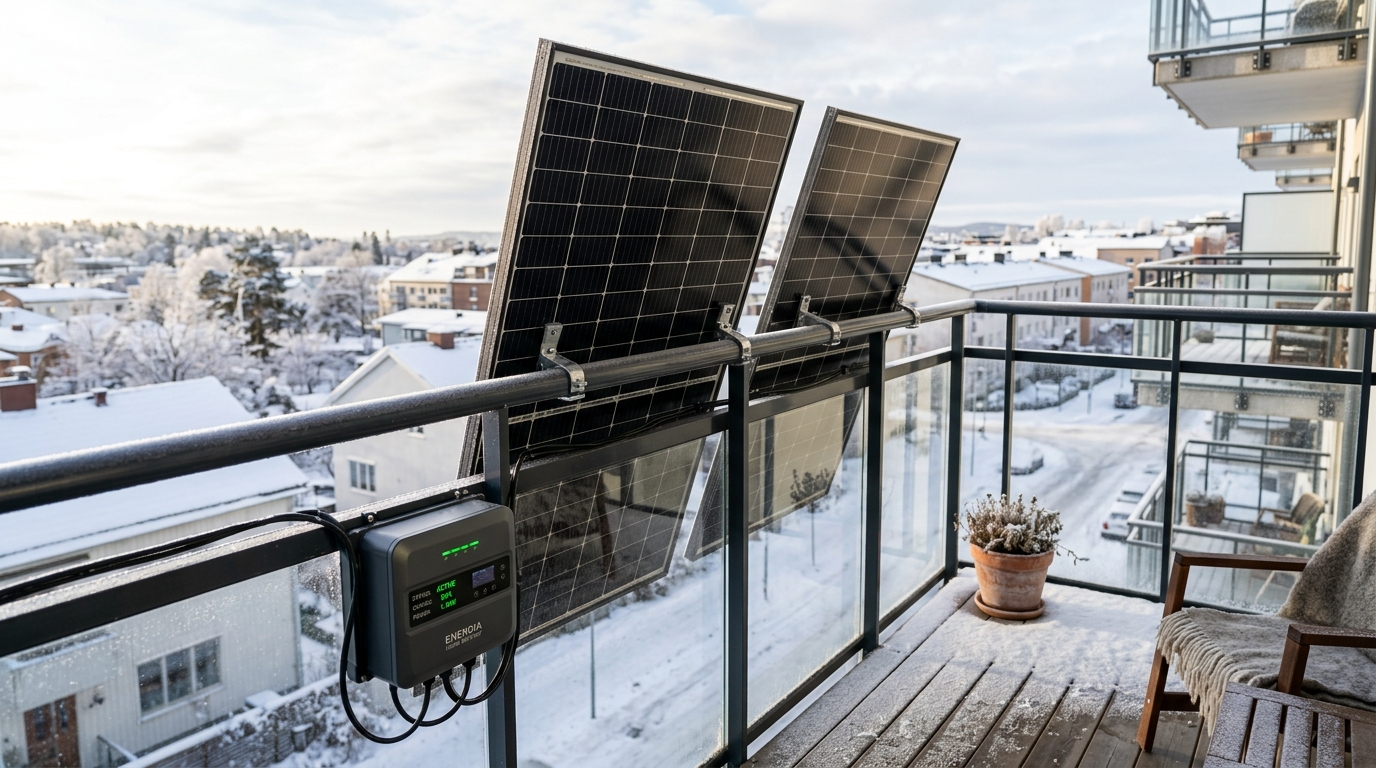
Direct answer: Understand winter solar panel performance, how low sun angles favour vertical balcony mounting, and why you must never charge standard LiFePO4 batteries below 0°C.
Editorial note: WhichWatts is an independent comparison site. Prices, availability, specifications, and retailer promotions change frequently. Check the live product table and retailer page before buying.
Winter Solar Generation & Sub-Zero Battery Charging (2026): Balcony Yields, Snow & Cold LiFePO4 Rules
A common myth in renewable energy is that solar panels stop working in the winter, and that lithium batteries can be charged anywhere at any time. Both assumptions are dangerously wrong.
In reality, photovoltaic cells are more electrically efficient at cold temperatures than in scorching summer heat, and winter daylight can produce meaningful daily power—especially for vertically mounted balcony solar panels. At the same time, sub-zero temperatures introduce a critical chemical hazard: attempting to charge a frozen lithium battery can permanently destroy its capacity in minutes.
This technical guide explains how solar generation changes between October and March, how low-angle winter sunlight favours vertical balcony mounting, how snow reflection boosts output, and the crucial rules for safely charging and storing LiFePO4 batteries in sub-zero weather.
Photovoltaic Physics in Cold Weather: Why Panels Love the Cold
Contrary to popular belief, solar panels do not require heat to generate electricity—they require photons (light). In fact, high temperatures degrade solar panel performance through the Temperature Coefficient of Pmax (typically -0.35% to -0.40% per °C above 25°C).
On a crisp, sunny winter day with ambient temperatures of 2°C (35°F), a solar panel operates at higher internal voltage and superior silicon efficiency than on a 35°C (95°F) summer afternoon.
The Real Winter Constraints: Irradiance & Sun Angle
While cell efficiency is higher in cold air, total daily energy yield (kWh) in northern latitudes (UK, Northern Europe, Northern US/Canada) is constrained by three factors:
- Shorter daylight hours: 7 to 8 hours of light in December versus 16+ hours in June.
- Lower solar elevation angle: The UK midday sun peaks at just 15° to 18° above the horizon in mid-winter (versus 62° at the summer solstice).
- Cloud cover & diffuse light: Overcast skies scatter sunlight into diffuse irradiance, reducing peak solar intensity from ~1,000 W/m² to 100–250 W/m².
Summer Sun (62° High Angle)          Winter Sun (15° Low Angle)
        ☀️
                                                 ☀️
           /                                       /
          /                                       /
         /                                       /
┌─────────────────┐                     ┌─────────────────┐
│ Flat Roof Panel │                     │ Vertical Balcony│
│ (Catches direct)│                     │  (Faces sun 90°)│
└─────────────────┘                     └─────────────────┘
Why Vertical Balcony Solar Outperforms Flat Roofs in Winter
One of the biggest surprises for new solar owners is that 90° vertical balcony railing mounting often generates more electricity in winter than a shallow 15°–30° flat roof installation:
- Perpendicular Sunlight Angle: Because the winter sun stays low on the horizon, vertical panels directly face incoming solar rays at nearly a 90° incidence angle, capturing maximum direct irradiance.
- Zero Snow Accumulation: Snow, frost, and leaves slide off vertical balcony glass immediately. Flat or low-pitch roof panels often stay covered under snow for days or weeks, producing zero watts.
- Ground Snow Albedo Effect: Fresh white snow reflects up to 80% of ambient sunlight. Bifacial balcony solar panels capture this reflected ground light from their rear glass surface, boosting cold-season output by 15% to 25%.
| Mounting Setup | Mid-Summer Yield (Relative) | Mid-Winter Yield (Relative) | Snow Accumulation Risk |
|---|---|---|---|
| Flat Ground / 15° Roof Mount | 100% (Peak) | 10% – 15% | ❌ High (Snow settles & covers panels) |
| Standard 35° Tilted Roof | 95% | 20% – 25% | ⚠️ Medium (Requires thawing to slide off) |
| Vertical 90° Balcony Railing | 70% | 35% – 45% | ✅ None (Snow cannot settle on vertical glass) |
The Sub-Zero LiFePO4 Charging Hazard (Lithium Plating)
While solar panels thrive in cold air, lithium battery chemistry faces severe electro-chemical limitations below freezing:
THE GOLDEN RULE OF COLD BATTERIES:
- Discharging (Using power): Safe between -20°C and +50°C (-4°F to 122°F).
- Charging (Receiving power): Safe ONLY between 0°C and +45°C (32°F to 113°F).
What Happens When You Charge Below 0°C?
At sub-zero temperatures, the internal diffusion of lithium ions into the graphite anode slows down drastically. When a charging current is applied, the lithium ions cannot intercalate into the anode structure quickly enough. Instead, they deposit onto the anode surface as solid metallic lithium (Lithium Plating).
This causes:
- Permanent capacity loss: The plated lithium is electrochemically dead and will never store energy again.
- Dendrite growth: Microscopic needles of metallic lithium grow across the separator, eventually puncturing it and creating internal short circuits and thermal runaway hazards.
How Modern Systems Protect Themselves in 2026
- BMS Low-Temperature Cut-Off: High-quality portable power stations (EcoFlow, Anker, Bluetti, Jackery) incorporate temperature sensors that automatically stop incoming charging current if internal cell temperature drops below 0°C.
- Integrated Battery Heating Pads: Next-generation outdoor systems—such as the Anker Solix Solarbank E1600 and EcoFlow Delta Pro 3—contain internal PTC heating elements. When solar power arrives in sub-zero conditions, the microinverter redirects the first 50W–100W of solar energy entirely into warming the battery cells to 5°C before allowing the main charge cycle to begin.
Winter Solar & Battery Maintenance Checklist
Follow these practical maintenance steps throughout the cold season:
- Keep Portable Power Stations Indoors: Never leave a portable power station in an unheated vehicle, shed, or outbuilding if you intend to charge it from portable solar panels. Run the solar extension cables through a window or letterbox into a heated room.
- Clean Snow with Soft Silicone: If snow settles on tilted panels, clear it using a soft rubber squeegee or foam snow broom. Never use metal shovels, stiff bristles, or boiling water (thermal shock can shatter tempered solar glass).
- Adjust Panel Angles in Autumn: If you use adjustable ground tilt brackets, increase your panel angle to 55°–65° in October to align with the lower winter sun trajectory and facilitate snow run-off.
- Check MPPT Voltage Limits: Solar panel open-circuit voltage ($V_{oc}$) increases in cold temperatures. Ensure your winter array $V_{oc}$ does not exceed the maximum solar input voltage ceiling of your charge controller.
Recommended Cold-Climate Solar & Battery Gear
Explore and compare systems with cold-weather certifications and self-heating technology:
- Anker Solix Solarbank E1600 (1.6kWh LFP): Features built-in thermal heating elements allowing safe outdoor balcony operation down to -20°C.
- EcoFlow DELTA 2 Max + 400W Portable Solar Panel: High MPPT voltage tolerance (11–60V / 15A), IP68 waterproof bifacial panels with exceptional low-light diffuse performance.
- Bluetti AC200L: Comprehensive BMS thermal protection, dual 1,200W MPPT controllers, and high-efficiency cold-weather pass-through.
Helpful Next Steps & Tools
- Estimate your location's seasonal solar yield using our Solar Panel Output Calculator.
- Calculate your winter appliance runtime on the Power Station Calculator.
- Review all top-rated outdoor solar generators in our Live Price Comparison Table.
FAQ
Do solar panels still generate electricity in the winter?
Yes. Solar panels convert light, not heat, into electricity. In fact, photovoltaic cells are more efficient at cold ambient temperatures. Although shorter daylight hours and lower sun angles reduce total daily kilowatt-hours, modern monocrystalline panels continue generating useful power through overcast and cold winter days.
Why is vertical balcony solar so effective in winter?
In winter, the sun sits low in the sky (only 15°–18° high at midday in the UK). Vertical 90° balcony panels directly face low-angle sunlight, shed snow and frost instantly without human intervention, and capture sunlight reflected off snowy ground via bifacial rear glass.
Can I leave my portable power station in an outdoor shed or garage during winter?
You can safely store and discharge power from a power station in a cold shed (down to -20°C), but you must never charge it when the battery cells are below 0°C (32°F). Doing so causes irreversible lithium plating. Always bring the battery into a warm room before charging.
What should I do if my solar panels are covered in snow?
If snow does not slide off automatically, use a soft silicone squeegee or soft brush on an extension pole to gently clear the surface. Never use hot water, sharp metal scrapers, or abrasive tools, as thermal shock or scratching can permanently ruin the anti-reflective glass coating.