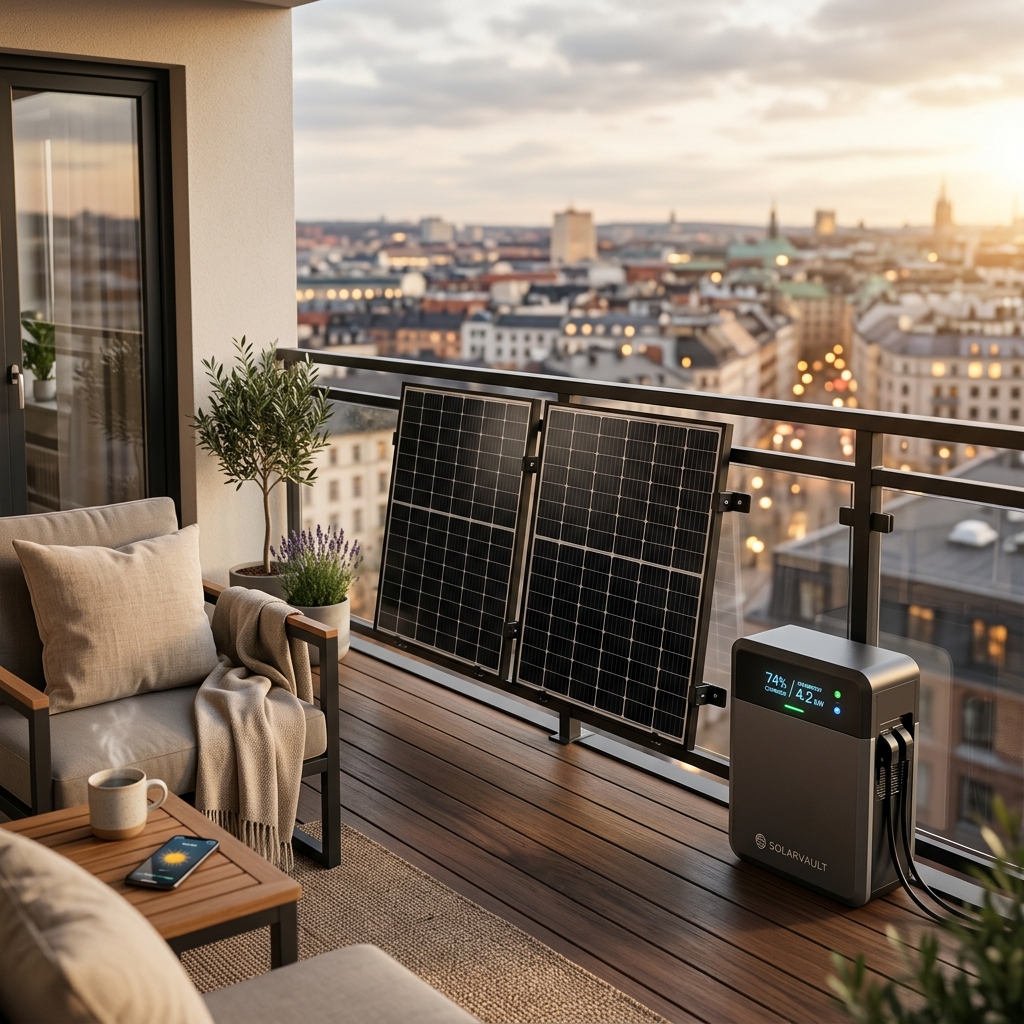
Direct answer: Standard plug-in solar wastes up to 50% of generated power back to the grid for zero reward. Discover how 2026 balcony battery systems capture midday surplus, power evening appliances, and double your return on investment.
Editorial note: WhichWatts is an independent comparison site. Prices, availability, specifications, and retailer promotions change frequently. Check the live product table and retailer page before buying.
Balcony Solar Battery Storage in 2026: Why Adding Batteries to Plug-in Solar Doubles Real-World Savings
Plug-in solar kits (often called balcony solar) have revolutionized residential renewable energy. By letting renters and homeowners plug one or two solar panels into a standard wall socket without £1,000s in installation fees, they made generating your own power genuinely accessible.
However, after installing a standard plug-in solar kit, many homeowners notice a frustrating pattern on their smart meters: up to half of the electricity generated is sent straight back into the grid for £0.00.
Because standard plug-in kits generate maximum power during the middle of the day—when most households are at work, school, or out of the house—your panels produce far more electricity than your baseline appliances can consume.
In 2026, a second-generation wave of hardware has arrived to eliminate this bottleneck: all-in-one balcony solar battery storage systems.
Led by modular systems from brands like Anker (Solix Solarbank 2 series), EcoFlow (STREAM / PowerStream with Delta), Zendure (SolarFlow Hyper), and Bluetti, these plug-and-play batteries store daytime excess and feed it into your home during the expensive evening peak.
This guide explains the engineering mechanics, smart metering controls, cost-benefit mathematics, and UK/EU regulations governing balcony solar battery storage in 2026.
The "Daytime Waste" Problem with Standard Balcony Solar
To understand why adding a battery doubles your real-world savings, you have to look at how a home uses power across a 24-hour cycle:
- The Generation Curve: In the UK and Europe, solar generation follows a pronounced bell curve. A typical two-panel 840W array produces minimal power before 08:30, ramps up rapidly to 600W–750W between 11:30 and 14:30, and tapers off by 18:00.
- The Household Baseload: When a home is unoccupied during working hours, the constant electrical draw—refrigerators, internet routers, heating pumps, smart hubs, and appliances on standby—typically averages just 120W to 200W.
- The Unmetered Export Trap: When your panels generate 700W at 13:00 and your home only consumes 150W, the surplus 550W flows out through your consumer unit into the public grid. Standard plug-in solar does not have dedicated Smart Export Guarantee (SEG) half-hourly metering. That surplus power is delivered to the grid for zero compensation.
In practical terms, a household with a standard plug-in solar kit achieves a self-consumption rate of only 40% to 55%. Nearly half of the solar energy you generated provided zero financial benefit.
How 2026 Balcony Battery Systems Work
A modern balcony battery system acts as an intelligent energy buffer between your photovoltaic panels and your domestic wall socket.
[ Solar Panels (2x 430W) ]
            │ (DC Cables via MC4)
            ▼
[ Balcony Battery Unit (1.6kWh - 3.2kWh LiFePO4) ]
   ├── Integrated MPPT Charge Controller
   ├── Smart Logic / App Power Scheduling
   └── Integrated 800W Microinverter
            │ (AC Cable)
            ▼
[ Standard 13A Wall Socket ] ──▶ Powers Home Appliances
1. Direct DC Solar Charging
Rather than connecting your solar panels to a microinverter and converting DC electricity to AC, the panels plug directly into the battery pack via standard MC4 connectors. The battery's internal MPPT (Maximum Power Point Tracking) controller captures high-efficiency DC power directly from the sun without inverter conversion losses.
2. Intelligent Power Allocation via Smart Plugs and CT Clamps
Modern 2026 systems monitor household consumption in real-time through two methods:
- Smart Socket Monitoring: Smart plugs placed on appliances (refrigerator, washing machine, desktop PC) report instantaneous wattage to the battery hub via Wi-Fi or Bluetooth.
- Smart Meter / Consumer Unit CT Clamp: A small wireless sensor clamped onto your main incoming live wire measures total household demand second by second.
If your home's total demand is 180W and the solar panels are producing 700W, the battery directs exactly 180W through its microinverter into your wall socket to cover your load. The remaining 520W of surplus solar flows directly into the battery cells.
3. Evening Peak Discharge
When the sun sets and your family returns home—switching on lighting, televisions, kitchen appliances, and entertainment devices—household demand jumps to 400W–800W.
Instead of drawing this electricity from the grid at full retail tariff rates, the battery discharges smoothly into your ring main, running your evening routine on stored daytime sunshine.
Result: Self-consumption climbs from ~45% to over 90%.
Financial Breakdown: Solar-Only vs Solar + Battery
How do the economics stack up under 2026 electricity tariffs (~24.5p/kWh under Ofgem price caps)?
| Metric | 800W Plug-in Solar Only | 800W Solar + 1.6kWh Battery | 800W Solar + 3.2kWh Battery (Dual Pack) |
|---|---|---|---|
| Typical Hardware Cost | £420 – £520 | £950 – £1,200 | £1,500 – £1,800 |
| Estimated Annual Generation | ~750 kWh | ~750 kWh | ~750 kWh |
| Self-Consumption Rate | ~45% (337 kWh used) | ~88% (660 kWh used) | ~95% (712 kWh used) |
| Annual Electricity Saved | £82 – £105 / year | £160 – £210 / year | £175 – £235 / year |
| Simple Payback Period | 4.5 – 5.5 Years | 4.8 – 6.0 Years | 6.5 – 7.8 Years |
| 15-Year Lifetime Savings (Net) | ~£800 – £1,050 | £1,500 – £2,100 | £1,200 – £1,750 |
Key Economic Takeaways:
- The 1.6kWh Sweet Spot: For most apartments and standard homes with two panels (800W–900W DC), a single 1.6kWh battery pack represents the economic sweet spot. It captures virtually all daytime surplus without excessive hardware cost.
- Double Lifetime Savings: While adding a battery extends the initial payback period by around 6 to 12 months, it more than doubles your net profit over the 15+ year operational lifespan of the LiFePO4 cells.
- Protection Against Future Tariff Hikes: Every kilowatt-hour stored behind your meter insulates your household from geopolitical energy spikes and network distribution charges.
2026 Engineering Innovations: Cold Weather & Durability
Early-generation lithium batteries struggled in outdoor balcony environments. The 2026 crop of balcony storage hardware addresses previous limitations:
- Sub-Zero Self-Heating (-20°C): LiFePO4 chemistry cannot safely accept charge below 0°C (32°F). Modern systems (such as the Anker Solarbank 2 Pro and Zendure SolarFlow Hyper) incorporate internal thermal heating pads. When winter temperatures plunge, the unit draws a fraction of incoming solar energy to warm the cells before charging begins.
- IP65 / IP67 Weatherproofing: Heavy aluminium alloy enclosures sealed against rain, snow, and UV radiation allow the battery to sit permanently on outdoor balconies or terraces without protective sheds.
- 6,000+ Cycle Lifespans: Utilizing automotive-grade LFP pouch and prismatic cells, modern balcony batteries are rated for 6,000 complete charge/discharge cycles to 80% remaining capacity—equating to over 16 years of daily cycling.
UK & EU Regulations: What You Must Know
Before purchasing a balcony solar storage system, ensure your setup complies with local electrical standards:
- G98 Micro-Generation Limit (UK): In the UK, equipment connected to a standard domestic socket must not export more than 800W AC to the grid. Compliant battery microinverters are factory-locked to 800W (or 600W in older EU jurisdictions), ensuring full compliance with ENA G98.
- Simplified Notification: You only need to submit a standard G98 notification form to your regional Distribution Network Operator (DNO) within 28 days of plugging the system in.
- No Electrical Permitting Needed: Because the system is pre-wired, self-contained, and plugs directly into a standard socket with automated anti-islanding relays, no expensive electrician callout or structural rewiring is necessary.
Summary Checklist: Should You Add a Battery?
Add Balcony Battery Storage if:
- Your home is typically unoccupied between 09:00 and 16:00 on weekdays.
- Your smart meter confirms your daytime baseload is under 250W.
- Your electricity tariff is high during peak evening hours (16:00 to 21:00).
- You want to maximize self-reliance and keep your energy bills as low as possible.
Stick with Solar-Only if:
- Someone works from home full-time, running computers, monitors, heat pumps, or appliances during the day.
- You have a strict upfront budget under £500.
- You already own a portable power station that you can manually charge from solar on sunny days.
Frequently Asked Questions
Can I leave a balcony battery outside in freezing winter weather?
Yes, provided the battery has an IP65+ weather rating and integrated self-heating. Quality 2026 balcony batteries automatically warm their cells using solar current before initiating charging, protecting the LiFePO4 chemistry from damage down to -20°C.
What happens when the battery is 100% full?
Once the battery reaches full charge on a sunny afternoon, the integrated charge controller bypasses storage and feeds solar power directly into your home's microinverter to power active household loads. Any excess beyond your immediate consumption flows safely to the grid.
Can a balcony solar battery run my home during a blackout?
Standard grid-tied microinverters shut off during a power cut for utility worker safety. However, premium 2026 balcony batteries (such as Anker Solarbank 2 Pro and EcoFlow STREAM) feature a dedicated off-grid emergency AC socket directly on the battery pack, allowing you to run critical appliances like refrigerators and Wi-Fi routers during a blackout.