Direct answer: Greater Manchester and Liverpool City Region have proposed plug-in solar initiatives worth up to £15m, including free kits for households in fuel poverty. Discover what these council pilots involve, how UK plug-in solar regulations work, and estimated bill savings.
Editorial note: WhichWatts is an independent comparison site. Prices, availability, specifications, and retailer promotions change frequently. Check the live product table and retailer page before buying.
£15m Plug-in Solar Schemes in Manchester & Liverpool: Council Pilots, Fuel Poverty & What It Means for UK Homes (2026)
Plug-in solar could soon become far more accessible to UK households struggling under the weight of stubborn energy tariffs, as two landmark municipal initiatives take shape in the North West of England.
Greater Manchester is preparing a plug-in solar procurement programme worth up to £10 million, while the Liverpool City Region Combined Authority is advancing a £5 million pilot designed to supply free plug-in solar kits directly to owner-occupiers experiencing fuel poverty. Together with emerging interest from London, these regional initiatives represent up to £15 million in public backing to bring balcony and garden solar into British communities.
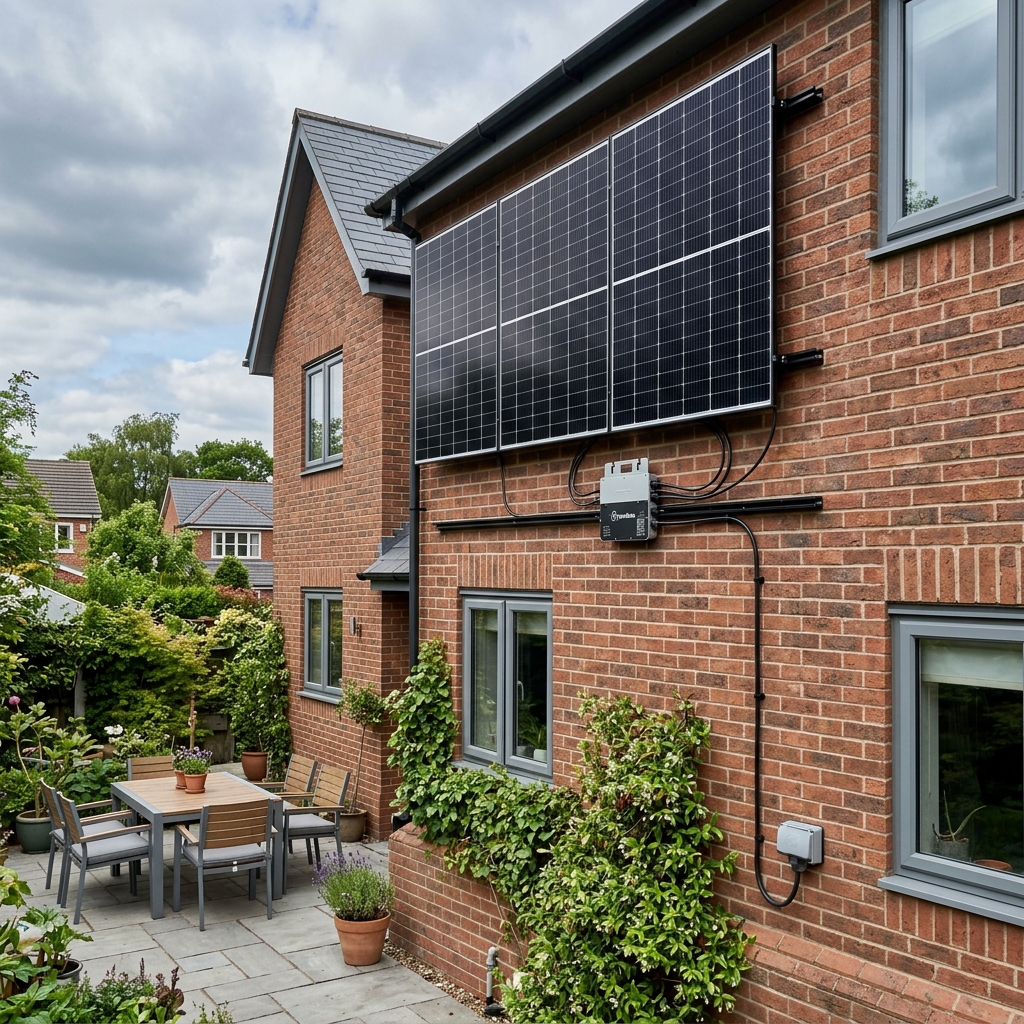
For years, the promise of solar generation was locked behind five-figure installation quotes, scaffolding, and long waits for structural surveys. Plug-in solar changes that equation: standard domestic solar panels wired to an 800W microinverter that plugs straight into an ordinary 13-amp domestic wall socket.
This guide details what the Greater Manchester and Liverpool proposals actually entail, how the UK government's national ambition fits into the picture, the real-world electricity bill savings you can expect, and how the technology is regulated under British electrical standards.
The National Backdrop: The Government's £25m Ambition
The push from Manchester and Liverpool builds directly upon national momentum. When the Department for Energy Security and Net Zero (DESNZ) confirmed policy reforms to support high-street plug-in solar kits in spring 2026, the primary objective was removing the burdensome cost of scaffolding and specialized electrical labor.
While DIY plug-in kits—featuring one or two panels starting from approximately £340 to £550—slashed the barrier to entry compared to traditional £6,000+ rooftop arrays, an upfront investment of several hundred pounds remains a serious roadblock for households in fuel poverty.
To address this divide, former Energy Secretary Ed Miliband announced in a statement to Parliament on 21 April 2026 that £25 million had been earmarked to explore targeted support:
"Following our announcement that we will bring plug-in solar to shops in the UK, we have earmarked £25 million with a view to piloting support for low-income families for plug-in solar and a vision of a house by house, street by street rollout."
— Statement to Parliament, April 2026
Six months after that parliamentary announcement, regional authorities in England are turning that vision into concrete procurement frameworks and funding bids.
Greater Manchester's £10 Million Procurement Offer
The largest municipal move comes from the Greater Manchester Combined Authority (GMCA). In its updated forward plan published at the start of October 2026, GMCA outlined an ambitious procurement strategy under the heading:
“Procurement of suppliers for the delivery of a Plug-in Solar Offer”
Key details from the official GMCA procurement register include:
- Procurement Value: Up to £10,000,000.
- Delivery Mechanism: Appointing vetted suppliers via the authority's existing Net Zero Housing Retrofit Framework Agreement.
- Decision Window: Formal procurement decisions are scheduled between October and December 2026.
What Does This Mean in Practice?
While the £10m figure denotes a maximum framework ceiling rather than an immediate cash spend, it demonstrates that Greater Manchester is moving beyond exploratory study into commercial delivery. By utilizing their Net Zero Housing Retrofit Framework, GMCA can establish bulk purchasing agreements with certified solar equipment suppliers, driving down unit hardware costs and establishing vetted safety installation protocols across its ten constituent boroughs (including Manchester, Salford, Bolton, and Wigan).
Whether kits will be provided completely free to vulnerable residents or heavily subsidized via mean-tested voucher schemes is set to be confirmed once supplier tenders are evaluated later this year.
Liverpool City Region's £5m Pilot for Fuel-Poor Households
While Manchester is setting up a commercial procurement umbrella, the Liverpool City Region Combined Authority (LCRCA) has taken the most detailed step yet in defining exactly who will receive equipment.
On 18 September 2026, LCRCA unveiled plans for a dedicated £5 million plug-in solar pilot, specifically targeting owner-occupiers experiencing fuel poverty.
Key milestones approved by the combined authority:
- Target Beneficiaries: Low-income homeowners who cannot afford standard rooftop solar and face disproportionate winter energy costs.
- Free Equipment: Eligible households will receive compliant plug-in solar kits at zero cost.
- Formal Funding Bid: At its cabinet meeting on 25 September 2026, the Combined Authority formally approved submitting the funding proposal to DESNZ to draw down from national low-income retrofit funding streams.
- Target Rollout Date: Anticipated delivery and installation is slated for July 2027.
By focusing on owner-occupiers in fuel poverty, Liverpool aims to bypass the landlord consent bottlenecks often encountered in rented social housing, establishing a clean testbed to measure exact year-round bill reduction.
London Signals Interest in Social Housing Retrofit
Interest in plug-in solar is not confined to the North West. On 24 September 2026, the Greater London Authority (GLA) published an integrated settlement decision on social housing retrofit.
In the mayoral decision paper, the GLA highlighted plug-in solar systems for low-income households as an adaptable technology eligible for support should additional central government funding tranches become available.
While London's position is earlier in development than Manchester or Liverpool—with no dedicated funding pool yet committed—it confirms that urban regional authorities view decentralized, balcony-mountable solar as a rapid-deployment tool for flats and urban tenancies.
How Much Money Does Plug-in Solar Actually Save in the UK?
For households counting every pound on their quarterly energy statement, the critical question is simple: what is the real financial return?
Under the UK's October 2026 Ofgem price cap (with electricity unit rates hovering around 24.5p per kilowatt-hour):
| System Setup | Rated DC Panel Power | Estimated Annual Generation (UK) | Self-Consumption Rate | Typical Annual Bill Savings |
|---|---|---|---|---|
| Single-Panel Kit | 420W – 440W | 340 – 420 kWh/year | 75% – 85% | £65 – £85 / year |
| Two-Panel Kit (Standard) | 840W – 880W | 680 – 820 kWh/year | 55% – 70% | £95 – £140 / year |
| Two-Panel Kit + Micro-Storage | 840W + 1.6kWh Battery | 680 – 820 kWh/year | 85% – 95% | £145 – £190 / year |
Why Doesn't a Household Save 100% of Generation?
A standard plug-in solar kit produces power during daylight hours (peaking between 11:00 and 15:00). If a household's daytime baseline consumption—the constant power drawn by a fridge, router, set-top box, and appliances on standby—is only 150W, an 800W kit producing 600W at midday generates a surplus of 450W.
Without battery storage, that excess 450W flows out through your consumer unit into the wider national grid. Because plug-in kits operate on a standard domestic socket without complex Smart Export Guarantee (SEG) export metering, that exported electricity is essentially donated to the grid for free.
Even so, covering your home's 150W daytime baseload for 5 to 7 hours every sunny day removes £95 to £140 worth of electricity from your annual supplier bill. For a family in fuel poverty receiving a kit at zero cost, that is immediate, guaranteed financial headroom every year for the 25-year lifespan of the panels.
Safety, Regulations & The UK's G98 Standard
A common misconception among British consumers is that plugging a solar panel into a wall socket is either unsafe or illegal. In 2026, the regulatory and engineering standards are clearly established:
- Anti-Islanding Protection (BS EN 62109 / VDE-AR-N 4105): Every compliant microinverter incorporates instant mechanical and solid-state decoupling. The moment you pull the 3-pin plug out of the wall socket, the inverter shuts off power generation in less than 20 milliseconds. The metal pins of the plug are completely dead to the touch, preventing any risk of electric shock.
- The 800W Inverter Limit: UK and European technical standards cap microinverter output at 800W. This ensures that the current flowing through a domestic ring main or radial circuit does not exceed the safe thermal capacity of domestic 2.5mm² twin-and-earth cabling.
- Distribution Network Operator (DNO) Notification: Under Energy Networks Association (ENA) rules, micro-generation systems under 800W fall under Engineering Recommendation G98. This is a simplified "fit and inform" procedure: you or the scheme installer simply submit a basic form to your regional DNO (such as Electricity North West or SP Energy Networks) within 28 days of connection. No pre-approval permission fees or lengthy engineering reviews are required.
Maximizing the Benefit: Pairing Plug-in Solar with Portable Batteries
For households looking to capture 100% of their generated electricity, the natural evolution is pairing plug-in solar with portable power stations or dedicated balcony battery banks:
- Daytime Capture: Instead of leaking surplus solar into the grid while you are at work or school, an intermediary battery stores that midday energy.
- Evening Relief: Between 17:00 and 21:00—when household lights, TVs, induction hobs, or kettles turn on—the stored battery power feeds your home, drastically cutting peak-rate grid usage.
- Emergency Blackout Resilience: Standard grid-tied microinverters shut down during a power cut to protect linesmen. A portable power station with solar pass-through, however, continues to provide emergency power to refrigerators and medical equipment during a local blackout.
What Happens Next?
With Manchester evaluating supplier procurement through late 2026 and Liverpool's funding application under review by DESNZ, the transition from national pilot ambition to street-level rollout is entering its defining phase.
If Liverpool's bid receives the green light, we could see the first municipal fleets of free plug-in solar kits being installed across Merseyside by summer 2027. If Greater Manchester's £10m framework succeeds, it will establish the commercial blueprint for local councils across Yorkshire, the Midlands, and London to follow.
Frequently Asked Questions
Will I need an electrician or scaffolding to install a plug-in solar kit?
No. Compliant plug-in solar kits are designed for DIY mounting on balconies, garden fences, flat shed roofs, or ground stands. They connect directly to an existing outdoor or indoor 13A wall socket without requiring scaffolding, roof alterations, or consumer unit rewiring.
Can plug-in solar damage my home's wiring?
Compliant kits capped at 800W output conform to British Standard BS 7671 wiring regulations and ENA G98. The maximum current injected into a domestic circuit is approximately 3.5 amps—well below the 13-amp continuous rating of standard UK socket outlets and domestic cables.
Do I get paid for electricity exported back to the grid?
Most plug-in solar systems are not connected to a dedicated export meter registered for the Smart Export Guarantee (SEG). Any excess power not consumed within your home spills back to the grid without compensation. To capture this surplus, many homeowners pair their kits with a modular balcony battery or portable power station.
Who will qualify for the free Liverpool plug-in solar scheme?
The Liverpool City Region pilot specifically targets owner-occupier households experiencing fuel poverty. Detailed eligibility criteria (such as income thresholds, Council Tax bands, and property suitability) will be finalized following DESNZ funding approval ahead of the planned 2027 rollout.