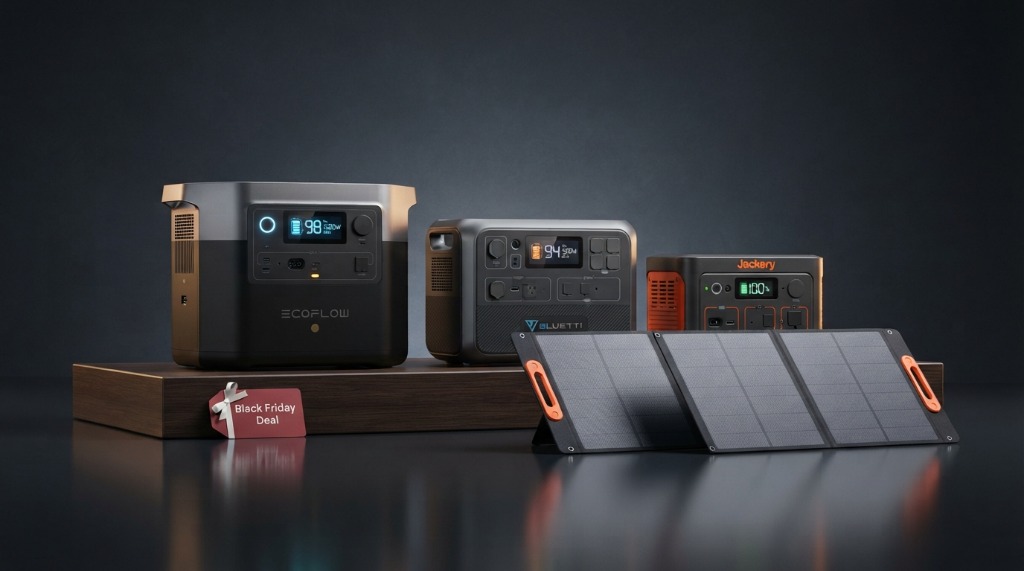
Direct answer: Black Friday brings some of the lowest prices of the year on portable power stations, but headline percentage discounts can be deceptive. Here is how to evaluate real cost-per-watt-hour value, current verified promo codes from EcoFlow, BLUETTI, Jackery and Anker, and what to check before buying.
Editorial note: WhichWatts is an independent comparison site. Prices, availability, specifications, and retailer promotions change frequently. Check the live product table and retailer page before buying.
Best Black Friday Portable Power Station Deals 2026: $/Wh Rankings & Buying Guide
Black Friday has become the most competitive window of the year for portable power stations and solar generators. Every major manufacturer—including EcoFlow, BLUETTI, Jackery, Anker SOLIX, and Pecron—runs aggressive seasonal promotions with claims of "up to 50% or 60% off."
However, headline percentage discounts in the battery industry can be notoriously misleading. Manufacturers sometimes benchmark discounts against outdated launch-day MSRPs or bundle overpriced proprietary accessories to inflate perceived value.
At WhichWatts, our primary benchmark is simple and transparent: cost per watt-hour ($/Wh, £/Wh, or €/Wh = live price ÷ rated capacity). By comparing what you pay for each usable watt-hour of stored lithium power, you cut through marketing hyperbole and find genuine value.
This guide breaks down the realistic price-per-watt-hour targets for Black Friday 2026, details verified active manufacturer discount codes, highlights standout deals by capacity tier, and flags the five traps that can turn an apparent bargain into an expensive mistake.
What Counts as a "Good Deal" on Black Friday 2026?
Battery cell costs (specifically lithium iron phosphate, or LiFePO4) have continued to drop throughout 2026. What was considered a historic bargain two years ago is now close to standard retail pricing.
Use these cost-per-watt-hour thresholds when assessing Black Friday sales:
| Tier | Cost per Watt-Hour ($/Wh or £/Wh) | What It Means | Typical Example |
|---|---|---|---|
| Standard Sale | $0.50 – $0.65 / Wh | Modest seasonal discount. Common on newly launched premium models. | 1,000Wh station for $550–$650 |
| Good Value Deal | $0.40 – $0.49 / Wh | True Black Friday pricing for Tier-1 brands with modern LiFePO4 cells and fast charging. | 1,000Wh station for $400–$490, or 2,000Wh for $800–$950 |
| Exceptional Deal | $0.30 – $0.39 / Wh | Excellent value. Often seen on mature flagship models, mid-size budget champions (e.g. Pecron, LiTime), or high-capacity units. | 2,000Wh station for under $750, or 3,000Wh for under $1,100 |
| Clearance / High Risk | Under $0.28 / Wh | Proceed with caution: verify whether the unit uses older NMC chemistry (500–800 cycles) or is a discontinued generation. | Older ternary lithium stock clearing out |
Note: All $/Wh ratios apply to standalone power stations. When evaluating solar bundles, subtract the realistic retail value of the panels (roughly $0.70–$1.00 per watt of folding solar) before calculating the station's $/Wh.
Standout Black Friday Deals by Capacity Class
1. Compact & Outdoor Stations (300Wh – 1,000Wh)
Best for: weekend car camping, festival trips, CPAP backup, emergency phone/laptop charging, and powering Wi-Fi routers during short blackouts.
- Anker SOLIX C1000 (1,056Wh / 1,800W continuous):
One of the most capable 1kWh units on the market. With 1,800W continuous output (and SurgePad carrying up to 2,400W), it can boil a travel kettle or run a microwave. Charges from 0% to 100% in under an hour from a wall outlet. - EcoFlow River 2 Pro (768Wh / 800W continuous):
Weighs just 7.8kg and uses durable LiFePO4 cells rated for 3,000+ cycles. A prime choice for campers who need reliable USB-C PD and light AC appliance runtime without breaking the bank. - Jackery Explorer 1000 Plus & v2 Series:
Jackery's updated Plus series shifted entirely to LiFePO4 cells, offering 4,000-cycle longevity and dual emergency charging speeds. Black Friday bundles frequently include folding SolarSaga panels at substantial savings.
2. Mid-Size Home Backup & RV (1,500Wh – 2,500Wh)
Best for: powering full-size domestic refrigerators (12–24+ hours), induction cooktops, power tools, water pumps, and extended outages.
- BLUETTI AC200L (2,048Wh / 2,400W continuous):
The benchmark 2kWh workhorse. Delivers a clean 2,400W pure sine wave inverter, fast 2,400W AC charging, and 1,200W solar MPPT input. Its expandable architecture lets you daisy-chain B230 or B300 expansion batteries as your energy needs grow. - EcoFlow DELTA 2 Max (2,048Wh / 2,400W continuous):
Features virtually silent operation at lower loads (under 30dB), making it ideal for indoor bedroom and apartment living during outages. Supports up to 1,000W of dual solar input and dual smart extra battery ports.
3. High-Capacity & Whole-Home Transfer Systems (3,000Wh – 6,000Wh+)
Best for: multi-day blackout resilience, sub-panel integration, heavy trade equipment, and off-grid cabins.
- Anker SOLIX F3800 (3,840Wh / 6,000W dual 120V/240V):
One of the only all-in-one portable power stations offering native split-phase 120V/240V output directly from the chassis, making it capable of running heavy well pumps and level-2 EV charging without an external fusion box. - BLUETTI AC300 / AC500 Modular Systems:
Modular systems that separate the inverter from the battery banks (B300S / B500K). This modularity keeps individual components liftable while enabling massive banks up to 18kWh+. - Pecron E3600LFP & F3000LFP (3,072Wh / 3,600W):
Consistently among the lowest cost-per-watt-hour leaders on WhichWatts. If pure capacity and heavy continuous AC output matter more to you than smartphone companion apps, Pecron delivers remarkable value on Black Friday.
Active Black Friday 2026 Manufacturer Discount Codes
Many brands offer stackable or sitewide coupon codes that reduce the price further at checkout:
| Brand | Region | Code | Promotion Details |
|---|---|---|---|
| BLUETTI | Global / AU / EU | AFF5OFF |
Extra 5% off sitewide during Black Friday promotional period |
| ALLPOWERS | EU / UK | APBF12 / APBF10 |
10%–12% extra off sitewide on solar generators and power stations |
| LiTime | US / EU / UK | MEMBER10 / BF10 |
10% off eligible LiFePO4 batteries and off-grid accessories |
| Renogy | UK / EU | 12SHADOWFLEX |
12% off ShadowFlux flexible anti-shading solar panels |
| Jackery | UK / DE / US | Auto-applied | Official Black Friday bundle pricing with complimentary accessory gifts |
To see the full real-time database of daily price drops and regional coupons, check our dedicated Discount Codes & Deals Page.
Five Traps to Avoid During Black Friday
Sales promotions create artificial urgency. Keep these five criteria in mind before entering your payment details:
1. The NMC vs LiFePO4 Battery Trap
Never buy a power station with older Nickel Manganese Cobalt (NMC or ternary lithium) chemistry unless it is priced at a severe discount and intended only for occasional light use.
- NMC cells last roughly 500 to 800 charge cycles before degrading to 80% capacity.
- LiFePO4 (LFP) cells last 3,000 to 4,000+ cycles—which equals nearly a decade of daily usage.
Virtually all modern 2026 units from EcoFlow, BLUETTI, Anker, and Jackery use LiFePO4. Check the cell chemistry on the specifications sheet.
2. Peak "Surge" vs Continuous Running Output
A station advertised as "3,000W Output!" may actually be an 1,800W continuous inverter with a temporary 3,000W motor startup peak. If you intend to run resistive heating loads (like an electric kettle, space heater, or tumble dryer), peak wattage means nothing. The appliance needs continuous wattage for minutes or hours. Make sure the Continuous AC Output exceeds your appliance's nameplate draw.
3. Bundled Proprietary Solar Panels
"Complete Solar Generator Kits" often look attractive, but bundled solar panels can be overpriced compared to rigid rooftop or standard third-party panels. Furthermore, verify whether the station uses standard MC4 / XT60 solar inputs or proprietary connectors. Standard connectors allow you to purchase high-wattage panels from any manufacturer.
4. Recharge Speed From the Wall
Older generation battery stations could take 5 to 8 hours to recharge from an AC wall outlet. Modern fast-charging units can reach 80% in 45–60 minutes. In an emergency scenario where power cuts are rolling (e.g. 2 hours of grid power followed by 4 hours of blackout), slow charging leaves your station stranded with an empty battery.
5. Over-Sizing Without a Real Power Audit
Buying a 5kWh battery station because it is heavily discounted is a waste of money if you only need to keep a CPAP machine, router, and fridge alive. A 1kWh to 2kWh unit covers essential loads comfortably at half the weight and cost.
Calculate Your Actual Outage Needs
Before deciding on a station capacity, run your household appliances through our sizing formula:
$$\text{Required Wh} = \frac{\text{Running Watts} \times \text{Hours Needed}}{0.765}$$
(Where 0.765 accounts for depth-of-discharge buffers and typical 85% inverter conversion losses).
For example, a typical 120W refrigerator running at a 40% duty cycle uses roughly 48W per hour:
$$48\text{W} \times 12\text{ hours} \div 0.765 \approx 753\text{Wh of rated battery capacity}$$
Use our interactive tools to verify your numbers:
- → Power Station Load & Sizing Calculator
- → Live Cost per Watt-Hour Price Comparison
- → Appliance-by-Appliance Runtime Guides
Frequently Asked Questions
Should I buy on Black Friday or wait for Cyber Monday?
In the portable power market, Black Friday and Cyber Monday are effectively merged into a single promotional week. Most manufacturers launch their lowest promotional pricing the week before Thanksgiving and run price-match guarantees through Cyber Monday. The primary risk of waiting until Cyber Monday is inventory stock-outs on the most popular 1kWh and 2kWh models.
How does WhichWatts calculate the $/Wh value?
Cost per watt-hour is calculated by dividing the current live purchase price by the manufacturer's rated battery capacity in watt-hours:
$$$/\text{Wh} = \frac{\text{Sale Price}}{\text{Capacity (Wh)}}$$
A lower number represents more energy storage per dollar spent.
Are refurbished units worth buying on Black Friday?
Official manufacturer-certified refurbished units (such as EcoFlow Official Refurbished or BLUETTI Refurbished on eBay or official sites) typically come with full or partial manufacturer warranties and can offer industry-best value below $0.30/Wh. However, avoid third-party, non-certified used batteries where cycle degradation cannot be verified.