Direct answer: Compare budget and premium portable power stations by verifiable specifications, warranty, chemistry, usable capacity, and total ownership cost—not unsupported failure-rate claims.
Editorial note: WhichWatts is an independent comparison site. Prices, availability, specifications, and retailer promotions change frequently. Check the live product table and retailer page before buying.
Cheap Power Stations Versus Expensive Models Performance
Most consumers face the same dilemma: choose a lower-priced station or spend more on a larger or more feature-rich model. The upfront cost difference is clear, but price alone does not establish a reliability advantage. The useful choice depends on how you plan to use the station, the exact specifications, and the support terms you can verify.
There is not enough public, comparable failure-rate data to claim that budget stations fail at a particular rate versus premium models. Compare the evidence that is available: exact battery chemistry, stated cycle-life test conditions, continuous and peak output, thermal protections, warranty scope, service terms, and transparent long-term testing.
What Creates the Price Gap Between Budget and Premium Power Stations?
Prices vary by model, capacity, chemistry, promotions, and included accessories. These examples are illustrative rather than fixed market tiers:
- Lower-priced examples: compact stations with lower capacity or output.
- Mid-range examples: models that balance capacity, output, portability, and price.
- Higher-priced examples: larger systems or models with additional charging, expansion, or integration features.
These descriptions are not fixed price bands or product recommendations. Check the exact US model, revision, and current retailer price before comparing.
Price differences can reflect battery chemistry, charging hardware, inverter output, thermal design, enclosure, accessories, warranty, service, and retailer promotions. These features vary by model; do not infer a particular battery-management system, protection feature, or quality-control process from price tier alone.
Feature sets, protection systems, and disclosed testing vary by model and manufacturer. Do not infer a particular test or quality-control process from price alone; look for published specifications, certifications, warranty terms, and reproducible independent testing.
How Do Failure Rates Compare Between Budget and Premium Models?
Public, comparable failure-rate data for portable power stations is limited. Reviews and service reports may identify issues to investigate, but they do not establish how often a problem occurs or whether it is typical of a price tier.
Cycle-life figures are chemistry- and model-specific, and manufacturers may test to different end-of-life thresholds, temperatures, depths of discharge, and loads. Compare the exact model’s published rating and test definition; do not turn a generic chemistry range into a promised lifespan.
Anecdotal reviews can identify issues to investigate, but they are not a controlled failure-rate study. Treat reports about ports, inverters, or shutdowns as leads and verify them against model-specific testing, support records, or manufacturer documentation.
Extreme temperatures, frequent cycling, and sustained high-wattage loads can expose differences in thermal behavior. Any conclusion should be based on model-specific documentation or a reproducible test, not on price tier alone.
Why Battery Chemistry Determines Long-Term Reliability
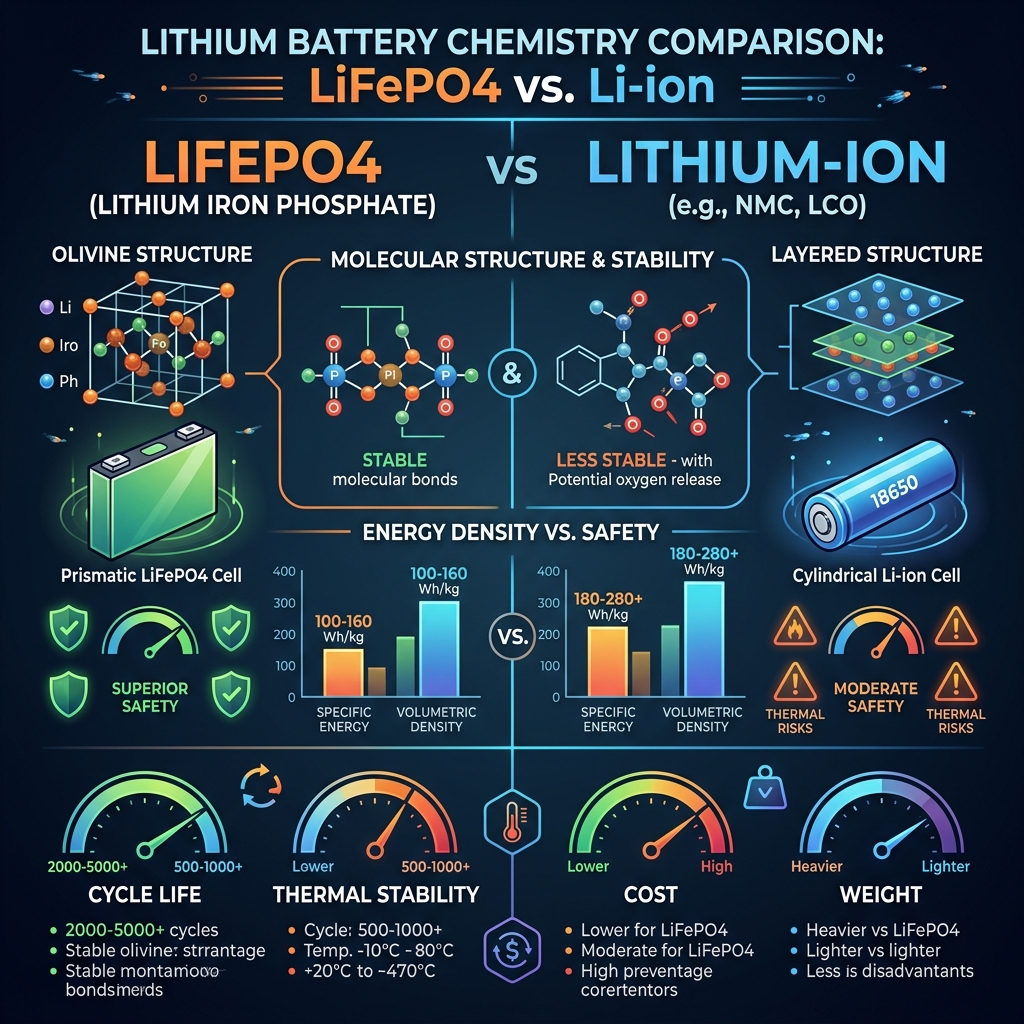
Battery chemistry is one comparison field, not a standalone reliability ranking. Portable stations may use NMC, LiFePO4, or another chemistry across different price points, so check the exact model’s specification and test definition rather than inferring chemistry from price.
Battery chemistries can age differently, but the result depends on the cells, battery-management system, load, temperature, depth of discharge, and test definition. Frequent deep discharge, heat, and unsuitable storage can accelerate capacity loss. A calendar estimate such as “18–24 months” is not reliable without a defined model, workload, temperature profile, and measurement protocol. Use measured runtime and the manufacturer’s warranty or service threshold instead.
LiFePO4 is often selected for frequent cycling and thermal-stability goals, but chemistry is not a guarantee of service life or performance in every product. Compare the exact model's test conditions, capacity-retention threshold, operating limits, warranty, and service path.
Charging and battery-management features vary by model. Look for documented protections, charging limits, temperature guidance, and test evidence rather than assuming that a higher price means more sophisticated cell monitoring.
Does Warranty Coverage Reflect Actual Reliability?
Warranty length and scope vary by model, region, component, battery-degradation threshold, and purchase channel. Compare the actual US warranty document, exclusions, service process, and replacement terms instead of inferring reliability from a broad price category.
Manufacturer warranty policies are model-specific and can change. Check the current warranty document for the exact unit, including whether battery capacity loss, accessories, labor, shipping, and retailer purchases are covered.
Service experiences can differ by manufacturer, region, retailer, and claim. Treat anecdotal reports as leads and verify the current support process before relying on a product for an important backup role.
Warranty coverage matters most when the station supports frequent or consequential use. Usage frequency alone does not predict whether a fault will occur, so compare the actual warranty scope, exclusions, service process, and replacement terms.
Calculating Cost-Per-Year of Reliable Performance
An ownership calculation can make assumptions visible when comparing lower- and higher-priced models. It divides total ownership costs by an explicitly stated service-life assumption, but it cannot prove how long a model will remain reliable.
Do not present a model’s price divided by an invented service life as a forecast. For a transparent ownership scenario, state the assumed purchase price, usage frequency, measured or manufacturer-stated capacity threshold, replacement cost, and uncertainty. Actual results vary with use, environment, maintenance, and warranty support.
An ownership calculation can favor a mid-range model, but only when its purchase price, usage, measured or documented capacity threshold, service costs, and replacement assumptions are stated. It is not evidence that a price tier is inherently more durable.
When Budget Power Stations Make Perfect Sense
A lower-priced power station may suit an occasional-use backup or camping trip if it meets the required load and the consequences of failure are acceptable. Do not assume infrequent use prevents degradation or reveals nothing about a product's limitations.
A compact station may be adequate for phone charging and LED lights on a weekend, but verify the exact model's output, runtime, and charging limits before relying on it. No usage pattern guarantees that a unit will avoid failure.
A lower-priced station may suit a secondary or car-emergency application when its load, storage conditions, inspection routine, transport, and service or replacement plan are appropriate. Price alone does not predict how long a station will remain usable.
A lower-priced unit can be a way to learn your actual power needs before a larger investment, provided the test load is non-critical and the unit is used within its documented limits. Upgrade based on measured usage rather than assuming a more expensive model is automatically better.
Testing Methodology: How to Evaluate Power Station Reliability
Reliable power station evaluation requires testing multiple factors beyond basic capacity claims. Key metrics include cycle-life testing under various load conditions, thermal performance under temperature stress, and charging efficiency over time.
Capacity retention testing involves cycling units through complete charge and discharge cycles while monitoring actual watt-hour output. This reveals how quickly batteries degrade under real-world conditions.
Thermal testing exposes units to temperature extremes and monitors performance degradation. Testing may reveal capacity loss in cold conditions or thermal shutdowns in heat, but those results must be measured on the exact model with stated conditions.
Component stress testing involves running units at maximum rated output for extended periods. This identifies inverter reliability issues and cooling system adequacy.
Long-term reliability assessment requires months of regular-use monitoring. This testing reveals which components fail first and how manufacturers handle warranty claims.
Choosing Between Budget and Premium: Use Case Matching
Your power station requirements determine how much redundancy and documented support you need. Off-grid living can make an outage consequential, so size conservatively and prioritize a tested configuration, a realistic recharge plan, and support terms you have verified. Do not infer suitability from price tier or warranty length alone.
RV and van life applications need a balance of capacity, weight, recharge options, and serviceability. Compare those requirements against the exact model and your fallback charging options; no price band guarantees the best balance.
Home backup power should be sized for the essential loads, surge demand, runtime target, recharge path, and consequences of failure. A smaller unit can be a better fit than a larger one when it matches those requirements, regardless of price tier.
Recreational camping may allow more flexibility when failure would be an inconvenience rather than an emergency. Choose a model that meets the trip’s loads and recharge plan, and do not treat price as a guarantee of dependable operation.
Brand comparisons: what the data can and cannot show
Brand-level impressions are not a substitute for model-level evidence. A brand may sell products with different chemistries, capacities, firmware, warranties, and support policies. Do not infer reliability, longevity, durability, or customer service quality across an entire lineup from one review or model.
For a defensible comparison, record the exact model and revision, current US price, published specifications, test conditions, warranty document, and any reproducible independent test. Label manufacturer claims, editorial observations, and measured results separately.
Solar Panel Integration and Charging Reliability
Charging behaviour can materially affect usability, but it varies by model rather than price tier. Compare the documented solar-input range, maximum input, charge modes, temperature limits, and behaviour with multiple charging sources.
An MPPT controller can help a station track a solar array, but its real-world benefit depends on the model, array, conditions, and input limits. Confirm the manufacturer’s documented controller and test conditions before comparing charging efficiency.
Multiple charging options can improve resilience when they are supported by the exact model and used within its limits. Confirm whether simultaneous solar and AC charging is supported rather than inferring it from price.
Connector durability is product-specific. Look for documented connector ratings, strain relief, replacement-part availability, and independent test evidence instead of assuming that a price tier predicts port life.
Noise Levels and Portability Trade-offs
Cooling design affects noise and thermal behaviour, but fan life and sound levels require model-specific measurements. Compare published limits or reproducible tests rather than assuming a lower-priced unit uses a less durable fan.
Portability, enclosure design, and protection involve trade-offs that vary by model. Weight alone does not establish structural durability, so check the exact enclosure, protection rating, and test evidence.
Weight and enclosure material should be compared from the exact manufacturer specifications. A heavier or metal-enclosed unit is not automatically more durable, and a lighter unit is not automatically fragile.
Noise during operation and charging varies with load, charge mode, firmware, temperature, and model design. Use a stated measurement method or manufacturer limit; do not claim that a premium price guarantees quieter operation.
Gas Generator vs Portable Power Station Reliability
Gas generators offer different reliability trade-offs compared to portable power stations. Generators provide unlimited runtime with fuel but require maintenance, produce emissions, and generate significant noise.
Portable power stations do not produce combustion exhaust at the point of use, but they still have limited capacity and may produce fan or inverter noise. Reliability becomes crucial because you cannot simply add more fuel to extend runtime.
The convenience factor often determines choice. A power station may be usable indoors when the manufacturer permits it, but it still needs safe storage, charging, inspection, and service according to its manual. Generators need fuel, oil changes, ventilation, and periodic starting.
A combination approach can add a second charging path, but it also adds equipment, cost, and maintenance. Choose and test the configuration against the loads, ventilation requirements, and safety guidance for the intended use.
FAQ
Do cheap power stations really fail 3–5 times more often than expensive ones?
There is no reliable, public, apples-to-apples failure-rate dataset supporting that multiplier. Compare model-specific warranty and service evidence, independent test methods, and documented specifications instead.
How long should I expect a $200 power station to last with weekly use?
Price and weekly use are not enough to predict service life. Check the exact chemistry, cycle-life definition, storage and temperature limits, warranty, and measured runtime over time; replace or service the unit when it shows the manufacturer’s stated end-of-life or safety symptoms.
Is the warranty difference between budget and premium models significant?
It can be, but coverage varies by model, region, component, and battery-degradation threshold. Compare the actual US warranty document, exclusions, service process, and replacement terms rather than assuming a premium tier is covered longer.
Should I buy two cheap power stations instead of one expensive one?
Two lower-priced units can provide redundancy, but they also add cost, charging complexity, and more equipment to maintain. For critical applications, choose a configuration supported by the device manufacturer and tested under the intended load; price alone does not establish reliability.
How do I calculate the true cost per watt-hour over a power station's lifespan?
Divide the total purchase price by the unit's watt-hour capacity, then divide again by expected years of reliable service. This reveals the annual cost per watt-hour of storage capacity.
Which battery chemistry lasts longest in portable power stations?
LiFePO4 is commonly selected for frequent cycling, but chemistry alone does not determine a product’s lifespan. Compare the exact model’s cycle-life test conditions, end-of-life threshold, thermal management, warranty, and replacement or service path.