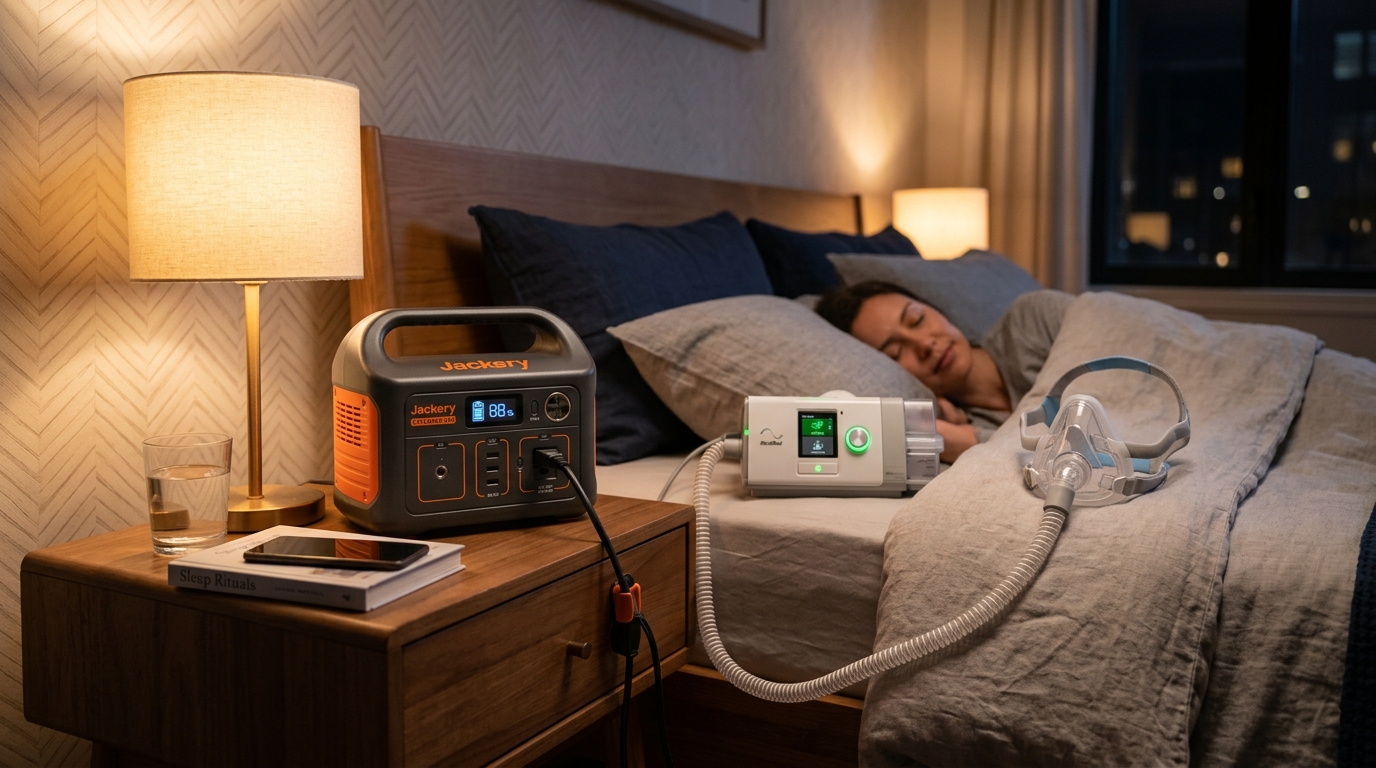
Direct answer: How to run your CPAP or BiPAP machine all night off-grid or during blackouts. Learn the exact runtime formula, why 12V/24V DC converters double battery life compared to AC plugs, and FAA rules.
For millions of people living with Obstructive Sleep Apnea (OSA), a Continuous Positive Airway Pressure (CPAP) or BiPAP machine is not a luxury appliance—it is essential medical equipment. Waking up during an overnight power outage choking or struggling for breath is dangerous and distressing.
Whether you are preparing for seasonal storm blackouts, planning a weekend camping trip, or living off-grid, a portable power station provides whisper-quiet, clean, and reliable power through the night.
However, sizing a power station for a CPAP machine is where many buyers make costly mistakes. If you simply plug your CPAP's standard 3-pin wall plug into a power station's AC outlet with the heated humidifier turned on high, you can drain an expensive 500Wh battery in less than 5 hours. Yet with the right 12V/24V DC converter cable and optimized settings, that exact same battery can easily last three full 8-hour nights.
This guide reveals the exact engineering math, power consumption benchmarks, DC adapter strategies, and battery sizing recommendations for CPAP users in 2026.
The #1 Rule for CPAP Users: Always Use a DC Adapter
The single most critical takeaway for powering a CPAP machine off-grid is this: Never use the standard AC wall plug if your power station has a DC 12V or 24V output port.
Why the AC Outlet Wastes So Much Battery
Inside your portable power station, the battery stores energy as Direct Current (DC). When you turn on the station's AC outlet, an internal inverter converts that DC battery power into 110V/230V Alternating Current (AC).
When you plug your CPAP machine's brick into that outlet, the CPAP power supply immediately converts that 110V/230V AC back down to 12V or 24V DC to run the motor!
This double conversion process introduces severe energy losses:
- Inverter Idle Power Consumption: The power station's internal AC inverter consumes between 10W and 25W just staying powered on and generating a 50Hz/60Hz pure sine wave, even if your CPAP motor is drawing almost nothing. Over an 8-hour sleep, the inverter alone burns 80Wh to 200Wh of battery purely in wasted heat.
- Double Conversion Efficiency Loss: Converting DC to AC and back to DC results in an overall efficiency of roughly 70% to 75%.
The DC Cable Advantage
By using an official or high-grade 12V/24V DC power cord (available for ResMed AirSense 10/11, Philips DreamStation, and others):
- You plug straight into the power station's 12V cigarette lighter port or USB-C PD port.
- The power station's hungry AC inverter remains completely turned off.
- DC-to-DC conversion efficiency reaches 85% to 92%.
- Result: You get 40% to 60% more runtime from the exact same battery.
Power Draw Breakdown: Pressure vs Humidifier vs Heated Hose
A common question among CPAP users is: "My machine's power brick says 90W. Does it draw 90 watts all night?"
No. That rating is the maximum peak capacity of the external transformer. The actual power your CPAP draws depends primarily on your prescribed air pressure (cm $H_2O$) and, most importantly, whether the heating elements are turned on.
| CPAP Operating Mode | Typical Power Draw (Watts) | Watt-Hours per 8-Hour Night |
|---|---|---|
| Pressure Only (No Humidifier, No Heated Tube) | 8W – 15W | 65 – 120 Wh |
| Pressure + Passive Humidifier (Chamber filled, heat off) | 8W – 15W | 65 – 120 Wh |
| Pressure + Heated Humidifier (Setting 2–3) | 25W – 40W | 200 – 320 Wh |
| Pressure + Heated Humidifier + Heated Hose (Max) | 50W – 80W | 400 – 640 Wh |
Key Rule of Thumb: The heating element in the water tub and the copper wiring in the heated tubing consume up to 75% of the total electricity. If you are in an emergency blackout or camping off-grid, turning the humidifier heat setting down or using passive humidity will multiply your battery runtime by 3x to 4x.
The CPAP Battery Runtime Formula
To calculate exactly how long a power station will run your specific CPAP setup, use this tested formula:
$$ ext{Usable Capacity (Wh)} = ext{Rated Battery Capacity (Wh)} imes ext{Efficiency Factor}$$
- DC Cable Efficiency Factor: $0.85$ (conservative allowance for DC-DC step-up/down and BMS overhead)
- AC Inverter Efficiency Factor: $0.70$ (accounting for inverter idle draw and AC transformation)
Then divide by your machine's hourly power draw:
$$ ext{Hours of Sleep} = rac{ ext{Usable Capacity (Wh)}}{ ext{Average Machine Power (Watts)}}$$
Real-World Example: ResMed AirSense 11 on a 512Wh Power Station
Scenario A: Standard AC Plug with Humidifier & Heated Hose (~55W draw)
$$ ext{Usable Wh} = 512 imes 0.70 = 358.4 ext{ Wh}$$
$$ ext{Runtime} = rac{358.4}{55} = 6.5 ext{ Hours}$$
Result: The battery runs out before you finish a full night's sleep.Scenario B: DC Cable with Humidifier Heat Off (~12W draw)
$$ ext{Usable Wh} = 512 imes 0.85 = 435.2 ext{ Wh}$$
$$ ext{Runtime} = rac{435.2}{12} = 36.2 ext{ Hours}$$
Result: Over 4 full 8-hour nights of uninterrupted sleep!
Sizing Guide: How Much Capacity (Wh) Do You Need?
Depending on how many nights of power you require and your tolerance for running with or without heated humidification, here is our recommended sizing tier:
1. The Compact Overnight / Flight Solution (250Wh – 300Wh)
- Ideal for: 1 to 2 nights off-grid with DC adapter (humidifier off), or short storm power cuts.
- Typical Models: 256Wh–300Wh portable power stations.
- Weight: ~3.5kg to 4.5kg (7.5–10 lbs).
- Estimated Runtime:
- With DC cord & no heat: 18 to 22 hours (2 to 3 nights)
- With AC plug & heated humidity: 3 to 4 hours (will not last one night)
2. The Weekend Camping & Multi-Night Sweet Spot (500Wh – 768Wh)
- Ideal for: A long 3-day weekend camping trip without recharging, or 1 to 2 nights with mild humidification.
- Typical Models: 512Wh–768Wh LiFePO4 power stations.
- Weight: ~6kg to 8kg (13–17 lbs).
- Estimated Runtime:
- With DC cord & no heat: 35 to 50 hours (4 to 6 nights)
- With DC cord & low humidity (25W): 16 to 24 hours (2 to 3 nights)
3. The Whole-Week & Emergency Home Backup Tier (1,000Wh – 2,000Wh)
- Ideal for: Severe storm blackouts, hurricane prep, or users who medically require heated humidification at all times.
- Typical Models: 1,024Wh–2,048Wh power stations.
- Estimated Runtime:
- With full heated humidifier & heated tube (60W): 14 to 28 hours (2 to 3.5 nights)
- With DC cable & no heat: 70 to 140 hours (8 to 17 nights of sleep)
Essential Features to Check Before Buying
Not every power station on the market is suitable for bedroom CPAP use. When reviewing models on WhichWatts, check for these five critical specs:
- Regulated 12V/24V DC Port: Ensure the 12V cigarette/car port is regulated at a constant 12.6V–13.6V. Cheaper unregulated stations drop to 10.5V as the battery drains, which triggers low-voltage error shutoffs on sensitive ResMed machines.
- Quiet Fan Noise (<30dB) or Fanless Low-Power Mode: Under low 15W–40W DC draw, quality power stations do not turn their cooling fans on at all. Look for models with zero fan noise when running on DC so your sleep is not disrupted.
- Pure Sine Wave AC Output: If you ever must use the AC plug, verify that the inverter is Pure Sine Wave (not Modified Sine Wave). Modified sine waves will overheat the sensitive motors and electronic microprocessors in medical devices.
- UPS Switchover (<20ms): If keeping the station plugged into the wall permanently next to your bed as a power backup, ensure it has an automated UPS bypass. When the grid drops during a storm, the station switches over in under 20 milliseconds without restarting or interrupting your CPAP air pressure.
- LiFePO4 Battery Chemistry: Provides 3,000+ charge cycles, ensuring the station can remain on standby at 100% charge for years without severe battery degradation.
Air Travel and FAA Regulations for CPAP Batteries
If you travel by air, note that portable power stations are subject to strict lithium battery aviation rules enforced by the FAA, EASA, and CAA:
- Under 100Wh: Permitted in carry-on baggage on all commercial flights without airline pre-approval. (Most compact travel battery packs).
- 101Wh to 160Wh: Permitted in carry-on baggage with airline prior approval (usually limited to two spare batteries per passenger).
- Over 160Wh: Strictly prohibited in both carry-on and checked luggage on commercial passenger flights.
Travel Note: Standard 256Wh and 512Wh portable power stations cannot be flown on commercial planes. For flights, use dedicated sub-100Wh FAA-approved medical travel batteries, and reserve full-sized power stations for road trips, camping, and home emergency backup.
Frequently Asked Questions
Can I leave my power station plugged into the wall and connect my CPAP every night?
Yes, provided the power station features an EPS or UPS pass-through mode. When connected to AC wall power, pass-through allows the CPAP to draw directly from the wall grid while keeping the internal battery topped up. If the grid drops during a blackout, the station instantly switches to battery power.
What DC cable do I need for a ResMed AirSense 10 or 11?
The ResMed AirSense 10 and AirSense 11 operate internally on 24V DC. Therefore, you cannot use a simple direct 12V wire. You must use an official ResMed DC-to-DC converter cable (or a reputable 12V-to-24V step-up adapter) designed specifically for your model, which steps up your power station's 12V cigarette socket to the 24V required by the ResMed unit.
Can I charge my CPAP power station with a portable solar panel?
Yes. During extended off-grid camping or multi-day power cuts, a 100W or 200W portable solar panel can fully recharge a 500Wh power station in 3 to 5 hours of direct sunlight, providing virtually indefinite off-grid CPAP power.
Will turning off the heated humidifier make my nose and throat dry?
If you suffer from airway dryness without heated humidity, you can still fill the water chamber with distilled water and turn the heating element OFF (or set humidity to passive). Air passing naturally over the water will provide moderate moisture without consuming 40W+ of continuous electrical heat.