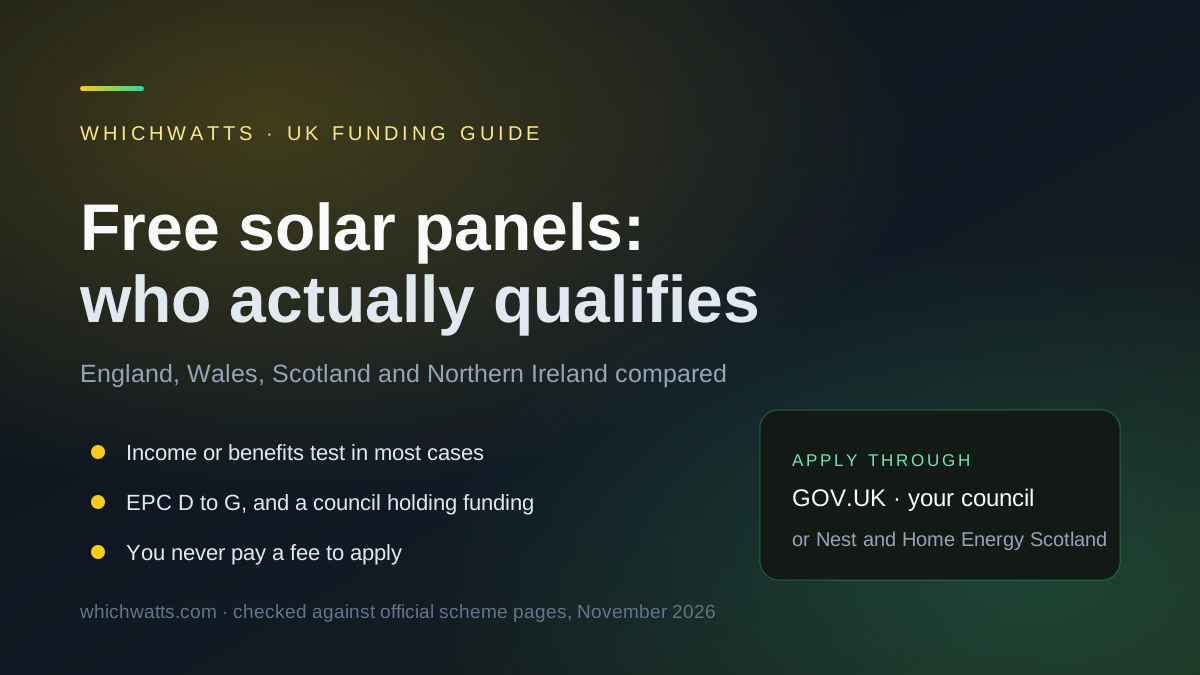
Direct answer: Free solar panels do exist in the UK in 2026, but only through means-tested and social housing routes that vary by nation. Here is who qualifies in England, Wales, Scotland and Northern Ireland, what the survey involves, and the red flags that give away a fake offer.
Editorial note: WhichWatts is an independent comparison site. Prices, availability, specifications, and retailer promotions change frequently. Check the live product table and retailer page before buying.
Free Solar Panels in the UK: Who Qualifies in 2026
Free solar panels do exist in the UK in 2026. They are not a national entitlement, they are not available in every council area, and they are not something a doorstep salesperson can authorise. They come through schemes aimed at low-income households and social housing, and which one you can use depends on where you live and who owns your home.
This guide sets out the routes that are actually open, the eligibility tests in plain English, and the red flags that separate a real scheme from a pitch.
The two ways solar gets paid for
Almost every genuinely free installation in the UK arrives through one of two structures:
- A means-tested grant, delivered by a council or a devolved programme, which pays for the work outright.
- Landlord-led funding for social housing, where the council or housing association applies and the tenant receives the improvement.
Everything else described as "free solar" is either a loan, a lease or a power purchase arrangement, and those are commercial products with terms attached. They are not grants, and this guide does not treat them as such.
England: the Warm Homes: Local Grant
The Warm Homes: Local Grant is the main free-solar route in England. It replaced the household support grant model that preceded it, and it is council-delivered: your local authority arranges a survey, agrees the improvements, then organises and pays for the work. The published guidance is explicit that you will not need to pay for it.
Who qualifies
- The home is in England.
- It is privately owned, either by you or by a private landlord.
- It has an EPC rating of D, E, F or G.
- Household income is usually £36,000 a year or less. If you earn more, you may still be eligible if you live in a certain postcode area or someone in your household receives certain benefits.
That combination is broader than many people assume — an owner-occupier on a modest income in an older, poorly rated house is exactly the target household — and narrower than the adverts suggest, because the council must also hold funding.
What you can get
The measures named in the official guidance are wall, loft and underfloor insulation, air source heat pumps, smart controls and solar panels. Your council will decide, after a survey, which of those your home needs; it is not a shopping list.
Batteries do not appear on the published list. If storage is what you want, ask your council whether it can be included, and expect the answer to depend on the local scheme design rather than on a national rule.
How to apply
Start the application through GOV.UK, or call the Warm Homes: Local Grant assisted digital support helpline on 0800 098 7950. Lines are open Monday to Friday 8am to 6pm and Saturday 9am to 12pm, excluding bank holidays.
The guidance says your council will usually contact you within 10 working days to gather more information and arrange a home survey. There is no fee at any stage.
What the survey involves
Expect a visit that looks at the fabric of the house — wall construction, loft depth, ventilation, the age and type of heating — as well as the roof's suitability for panels. The assessor is working out what will actually improve the EPC and what the property can take, which is why the agreed package sometimes includes insulation before solar: a leaky house wastes the generation.
Wales: Nest
Nest, the Welsh Government's Warm Homes programme, is the closest Welsh equivalent. It provides free, impartial advice to any household in Wales, and for eligible households it recommends a tailored package of improvements that can include heating work, insulation and solar panels.
The programme says it has delivered free home energy improvements to more than 60,000 households since 2011, with solar among the measures.
Practically, Nest behaves more like an advice service with a delivery arm than like a form to fill in. Call 0808 808 2244 (Monday to Friday, 9am to 6pm) and an advisor will work out whether you qualify. If you do not, they will point you to schemes that fit — which is more useful than a rejection letter.
Social housing tenants
If you rent from a council or a housing association, there is no application for you to make. The funding is awarded to your landlord through the Warm Homes: Social Housing Fund in England, which runs to March 2028 and includes solar PV among its eligible measures.
Your move is a conversation: ask your landlord or housing association whether your property is in their programme, and what they are planning for your home. A tenant cannot apply directly, and no private company can apply on a tenant's behalf.
Scotland and Northern Ireland: no free-solar route
It is worth being blunt here, because a lot of content muddles the nations.
- Scotland: the Home Energy Scotland Grant and Loan supports heat pumps and energy efficiency with grants, and offers interest-free loans for solar thermal and hybrid PV-T systems. There is no grant for solar PV and no battery funding line.
- Northern Ireland: there is no solar-specific grant. The Affordable Warmth Scheme concentrates on heating and insulation, and the Northern Ireland Sustainable Energy Programme part-funds eligible measures through annual rounds.
In both nations, the realistic funding route for panels is the Warm Homes Loan Scheme, which covers the whole UK and supports borrowing of up to £15,000 for solar and up to £15,000 for a battery.
If you do not qualify
Free installation is not the only way to make a system affordable, and it is worth knowing what the alternatives really are.
- Government-backed borrowing. The Warm Homes Loan Scheme, open since 27 October 2026, cuts participating lenders' rates by up to five percentage points, with some products interest free. Our guide to the scheme covers the caps and the paperwork.
- 0% VAT. Qualifying residential installations are zero rated until 31 March 2027, reverting to 5% afterwards. On a several-thousand-pound job that is a meaningful discount, and it applies whether or not you borrow.
- Group-buying schemes. Council-backed collective purchase programmes such as Solar Together are not grants, but they can produce a keener installed price because the installer is buying at scale. Availability depends entirely on whether your council runs a round.
- Export payments. Once a system is installed and registered for the Smart Export Guarantee, your supplier pays for exported electricity. That is a running return, not upfront help.
Private renters: read this before you agree
The Warm Homes: Local Grant does cover privately rented homes, but the landlord is usually the applicant and may be required to contribute to the cost. Two things follow.
First, get written consent before any work is arranged. Second, be clear about who benefits: a solar installation changes what the property consumes from the grid, and you do not want to discover that a rent increase has absorbed the saving.
If your landlord is approached by a company offering "free solar" in exchange for a roof lease, that is a commercial arrangement, not a grant, and it can complicate a future sale. It is not the same thing as a council-delivered grant.
Red flags that identify a fake or misrepresented offer
- A fee to "secure" the grant. No government scheme charges to apply.
- Approval promised on the doorstep. Eligibility depends on your EPC, income and your council's funding position, none of which a salesperson can confirm on the doorstep.
- A reference to the Green Homes Grant. That scheme ended years ago. Any 2026 offer citing it is not a government scheme.
- Pressure to sign on the day. Grant-funded work is arranged after a survey, not before.
- No MCS certification. Grant and loan-funded installation requires MCS-certified installers; a company that cannot produce a certificate is not delivering scheme work.
- Bank details requested before a survey. The grant route asks for information, not payment.
If an offer feels wrong, check with your council or call the GOV.UK helpline before signing anything.
What to gather before you apply
- Your EPC. Free to look up on the GOV.UK energy certificate register. If your home has no EPC, that becomes the first job.
- Income evidence. Payslips, benefit letters or a pension statement, depending on your circumstances.
- Your council's position. A two-minute check of whether your local authority is running the Warm Homes: Local Grant saves weeks.
- Your tenancy, if you rent. For private renters, the landlord's details and consent; for social tenants, the landlord's programme contact.
- A note of what you actually want. Solar, a battery, or a warmer house? The schemes are designed around the last of those, and being clear about it keeps the conversation honest.
FAQ
Are free solar panels really available in the UK?
Yes, but only through targeted schemes. In England, the Warm Homes: Local Grant can pay for solar panels for low-income households in privately owned or privately rented homes with an EPC of D to G, where the council holds funding. In Wales, Nest packages can include solar panels. Scotland and Northern Ireland have no grant that covers solar PV.
What income do I need to qualify?
The Warm Homes: Local Grant usually requires household income of £36,000 a year or less. Above that, you may still qualify if you live in a certain postcode area or someone in the household receives certain benefits. Nest uses its own assessment, and Home Energy Scotland has no benefit test at all.
Do I need a bad EPC rating to get free solar?
The English grant requires an EPC of D, E, F or G, so a home rated C or above does not qualify on that route. The rating also shapes what the survey recommends, and insulation is often installed alongside or before solar.
Can I get free solar if I rent?
If you rent privately in England, your home can be eligible, but the landlord is usually the applicant and may have to contribute. If you rent from a council or housing association, the funding is awarded to the landlord, so ask them whether your property is in their programme.
Who installs the system?
On the Warm Homes: Local Grant, your council organises the work and pays for it, so the installer is appointed through the scheme rather than chosen by you. On any loan-funded installation, MCS certification is required, and you can usually choose among MCS-certified installers.
Can I get free solar and a free battery?
Batteries are not on the published list of measures for the Warm Homes: Local Grant, so do not assume storage is included. Ask your council what its local scheme covers. The Warm Homes Loan Scheme is the route that explicitly supports battery borrowing, up to £15,000.
Sources
- Apply for the Warm Homes: Local Grant — eligibility, measures, helpline hours, council contact timescale.
- Nest Warm Homes Programme — Welsh support and measures.
- Home Energy Scotland Grant and Loan — which measures are grant funded.
- Help from your energy supplier: the Energy Company Obligation — benefit-linked help and the December 2026 closure.
- Warm Homes Loan Scheme factsheet — the loan alternative for households that do not qualify.
- Extension of VAT energy-saving materials relief — the 0% rate and end date.
Eligibility rules and council funding positions change, sometimes mid-year. Confirm the current position with the scheme itself before relying on anything here.