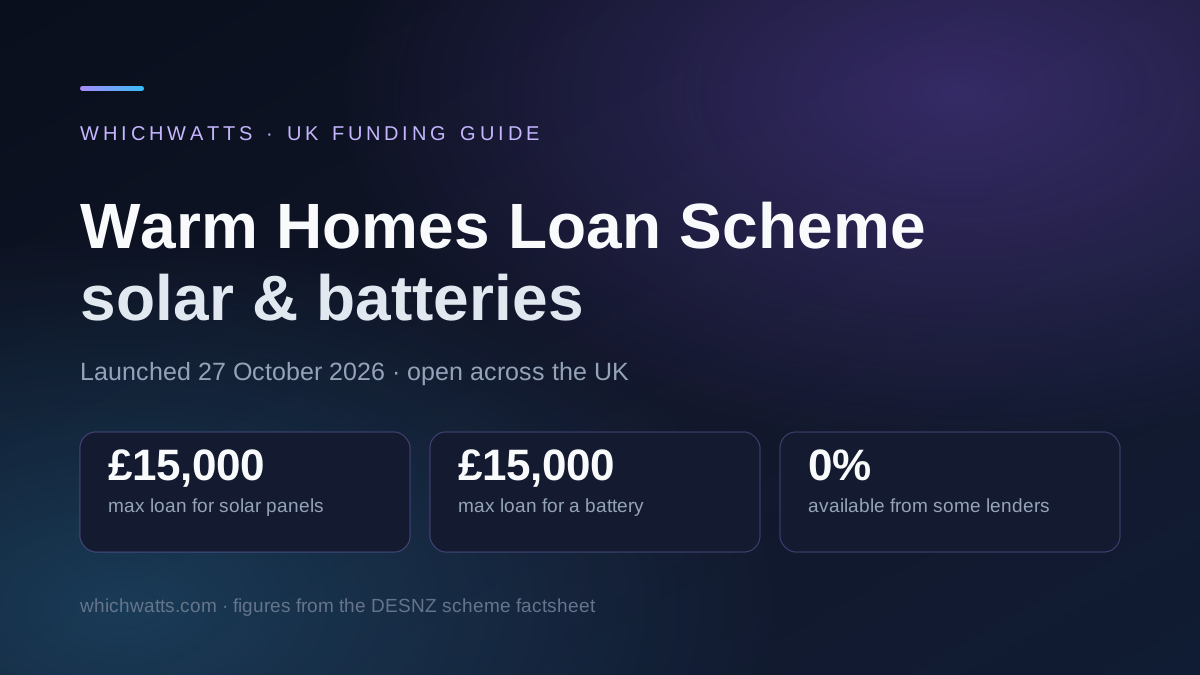
Direct answer: The Warm Homes Loan Scheme opened on 27 October 2026 with £15,000 caps for solar and for batteries, ten launch lenders and rates cut by up to five percentage points. Here is how the borrowing works, what it costs, and how to tell whether it beats waiting.
Editorial note: WhichWatts is an independent comparison site. Prices, availability, specifications, and retailer promotions change frequently. Check the live product table and retailer page before buying.
Warm Homes Loan Scheme: Solar and Battery Finance Explained
The Warm Homes Loan Scheme opened on 27 October 2026. It is the part of the government's Warm Homes Plan aimed squarely at households that will never qualify for a means-tested grant but still cannot find several thousand pounds for a solar array and a battery in one go.
It is worth being precise about what it does, because the marketing around it is already loose. The scheme does not make an installation cheaper. It makes the money cheaper, and it stretches the repayment over a period that can run to 30 years with some lenders. Whether that is a good deal depends entirely on the rate you are offered, the term you accept, and what the system actually saves.
How the scheme is built
The government did not become a lender. It worked with lenders through the Green Home Finance Strategic Partnership to bring rates down, and the loans are written by the lenders themselves.
- Rate reduction: participating lenders have cut rates by up to five percentage points against their regular products. Some launch products are interest free.
- Term: up to 30 years in some cases, though not every lender offers the longest terms.
- Coverage: the whole UK, including Scotland, Wales and Northern Ireland.
- Installation standard: MCS-certified installers are required for everything except heat network connections.
- Underwriting: the lender carries out normal affordability, credit and eligibility checks. A scheme badge does not mean guaranteed approval.
The government describes the ten launch lenders as the first phase, with further lenders and products expected to join. That matters practically: if the first lender you try declines you or quotes a rate you do not like, the panel is worth revisiting.
The caps, by technology
| Technology | Maximum loan supported |
|---|---|
| Solar panels | £15,000 |
| Electrical storage battery | £15,000 |
| Air source heat pump (air to water) | £20,000 |
| Air-to-air source heat pump | £10,000, where MCS certification is available |
| Ground source heat pump | £35,000 |
| Biomass boiler | £20,000 |
| Heat network connection | £7,500 |
| Micro-renewable system | £20,000 |
The solar and battery caps are separate, which is the detail that matters most for readers of this site. A quote that bundles panels and a battery is not automatically capped at £15,000; it can draw on both lines. If you are pricing one array and one battery, the caps are unlikely to be your binding constraint — affordability will be.
The ten launch lenders
- HomeServe, partnering with E.ON
- Hometree Finance
- Propensio
- Secure Trust Bank
- Selina Finance
- South Manchester Credit Union
- Sunsave
- Tandem Bank
- The Money Co-op
- This Bank
They are not interchangeable. Some partner with specific installers, others let you use any MCS-certified installer. A credit union will serve a narrower geography than a national bank. Compare at least two before you commit to a quote.
What the rate cut is actually worth
The scheme factsheet gives one worked example: a homeowner borrowing £10,000 at 8% over seven years would repay around £155 a month, and through the scheme could save up to £285 a year on repayments.
Two things follow from that.
First, a five-point reduction is a meaningful cut but not a transformation. If your mortgage lender will let you borrow against your home at a lower rate, or you have savings earning very little, the scheme loan may not be the cheapest money available to you. Compare the total amount repayable — not the headline rate, not the monthly figure.
Second, the government's own savings estimate is modest. DESNZ says a heat pump, battery and solar panels together could save a family up to £550 a year, rising by a further £300 a year on a time-of-use tariff. Those are estimates across three technologies, not a promise about your house. On a solar-and-battery-only installation the saving will be smaller.
Does borrowing for solar and a battery make sense?
Sometimes. The test is straightforward, even if the numbers are not:
- What does the system generate and when? Use the solar calculator with your own roof orientation and shading, not a national average.
- How much of that will you use? Self-consumption is where the saving comes from. A battery raises it by moving daytime surplus into the evening peak.
- What tariff are you on? A battery paired with a time-of-use tariff earns its keep differently from one on a flat rate, and the export rate you can get changes the sums again. Our price cap and battery arbitrage guide covers the mechanics.
- What is the monthly repayment? Compare it with the monthly saving. If the repayment exceeds the saving, you are buying the system on finance and paying for the privilege — which may still be rational, but should be a conscious choice.
- What happens if you move? The loan does not move with the panels. Ask the lender what early repayment costs, because selling a home with an outstanding improvement loan is an avoidable complication.
Do not let a loan raise your specification. The most common expensive mistake in home energy is borrowing for a battery size that the household's evening load cannot absorb, and then discovering the payback stretches past the warranty. Size the system for the load, then finance it.
Stacking the loan with grants and tax relief
- Boiler Upgrade Scheme: the factsheet states that a loan can be combined with a grant of up to £9,000 through the scheme. That figure comprises the £7,500 heat pump grant plus the £1,500 uplift for oil and LPG off-gas homes available until March 2027.
- Home Energy Scotland: Scottish households can combine a Warm Homes Loan with Home Energy Scotland grant funding, though note that the Scottish scheme's solar support is limited to an interest-free loan for solar thermal and PV-T systems.
- 0% VAT: qualifying residential installations are zero rated until 31 March 2027, reverting to 5% from 1 April 2027. This applies to the installer's invoice and is not something you claim.
There is no grant to stack against the solar or battery element itself, which is why the loan scheme exists. Our overview of every open UK scheme sets out which households can get free installation instead.
What to have ready before you apply
- An MCS-certified quote for the exact specification, including battery capacity and inverter rating.
- Your EPC, which most lenders will ask for and which the installer needs anyway.
- Proof of address and ownership.
- Income and expenditure details for the affordability assessment.
- A second quote, so you can tell whether the first price is competitive before you borrow against it.
After completion, keep the quote, the finance agreement, the invoice, proof of purchase and the MCS certificate. Those documents are what a future grant scheme, a warranty claim or a buyer's solicitor will ask for.
Questions to ask before signing
- What is the total amount repayable, including any fees?
- Is the rate fixed for the whole term, and what is the APR?
- Is the loan secured against my home? Ask explicitly — a secured loan is a materially different commitment.
- Can I repay early, and what does that cost?
- Must I use the lender's installer, or any MCS-certified installer?
- What happens if the installation is delayed past the VAT change on 1 April 2027?
- Does the product require me to buy system care or insurance alongside it?
FAQ
Is the Warm Homes Loan Scheme a grant?
No. It is government-backed borrowing. The government negotiated lower rates with lenders, but you repay the money. Grants for solar and batteries are limited to means-tested schemes such as the Warm Homes: Local Grant in England and Nest in Wales.
How much can I borrow for solar and for a battery?
Up to £15,000 for solar panels and up to £15,000 for an electrical storage battery. Those are separate limits, and the scheme also covers heat pumps, biomass boilers, heat network connections and other micro-renewable systems at their own caps.
Which lenders are taking part?
Ten launched with the scheme: HomeServe with E.ON, Hometree Finance, Propensio, Secure Trust Bank, Selina Finance, South Manchester Credit Union, Sunsave, Tandem Bank, The Money Co-op and This Bank. The government says more lenders and products are expected to join.
Do I need an MCS installer?
Yes, for every technology except heat network connections. The MCS certificate is also part of the evidence trail lenders and future schemes will expect.
Can I get the loan if I am on a low income?
The lender runs an affordability and credit check, so approval is not automatic and the scheme does not override normal lending rules. If you are on a low income, check the grant routes first — the Warm Homes: Local Grant pays for installations outright where you qualify.
Can I combine the loan with the Boiler Upgrade Scheme?
Yes. The factsheet confirms a loan can be combined with a Boiler Upgrade Scheme grant of up to £9,000, and with Home Energy Scotland funding in Scotland.
Sources
- Warm Homes Loan Scheme: factsheet — DESNZ, published 27 October 2026: caps, lenders, worked example, savings estimates.
- Boiler Upgrade Scheme: what you can get — grant levels and the off-gas uplift.
- Apply for the Warm Homes: Local Grant — the free-installation alternative.
- Extension of VAT energy-saving materials relief — 0% until 31 March 2027, then 5%.
Lender panels, rates and caps can change at short notice. Treat any figure here as a starting point for a conversation with a participating lender, and read the finance agreement rather than a comparison site's summary.