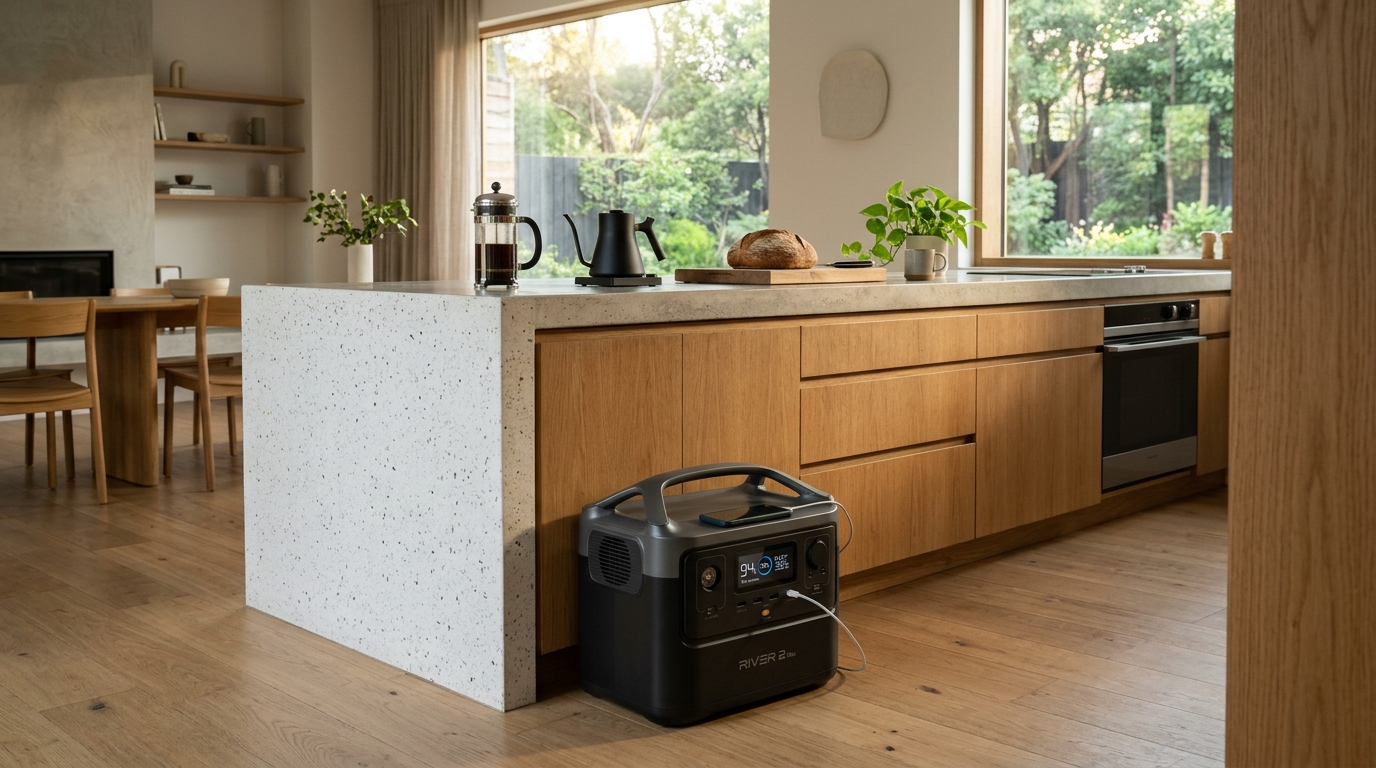
Direct answer: Learn the exact engineering formula to size an emergency battery backup for your home: calculating continuous watts, inductive motor surge peaks (LRA), usable watt-hours, and inverter efficiency.
Editorial note: WhichWatts is an independent comparison site. Prices, availability, specifications, and retailer promotions change frequently. Check the live product table and retailer page before buying.
How to Size a Portable Power Station for Emergency Home Backup: The Complete Calculation Guide
When severe gales, substation floods, or winter freezes bring down the electrical grid, an emergency portable power station is the difference between sitting in a freezing, dark house with spoiled food and maintaining a warm, connected, fully functional home.
However, the most common and costly mistake homeowners make when shopping for emergency backup is guessing their capacity:
- Under-sizing leaves you in the dark after just 8 hours when your refrigerator cycles on, tripping the inverter on an unexpected compressor motor surge.
- Over-sizing means spending thousands of pounds on massive, 80kg battery banks with heavy capacity you will never realistically cycle.
Sizing an emergency power station is not guesswork—it is a straightforward mathematical calculation.
This comprehensive engineering guide walks you step-by-step through the Universal Home Backup Sizing Formula: understanding the critical distinction between Watts and Watt-Hours, calculating inductive motor surge headroom (LRA), accounting for real-world inverter conversion losses and Depth of Discharge (DoD), and designing the perfect emergency energy budget for 24, 48, or 72 hours.
                     THE UNIVERSAL EMERGENCY SIZING PIPELINE

┌─────────────────────────┐       ┌─────────────────────────┐
│   1. CONTINUOUS WATTS   │       │   2. PEAK SURGE WATTS   │
│ Sum of active running   │  AND  │ Largest motor startup   │ ──> Inverter Rating (W)
│ loads at any one moment │       │ surge (3x to 5x rating) │     Must exceed both!
└─────────────────────────┘       └─────────────────────────┘
             │
             ▼
┌───────────────────────────────────────────────────────────┐
│                    3. WATT-HOURS (Wh)                     │
│ Continuous Watts (W) × Planned Operating Hours per Day    │
└───────────────────────────────────────────────────────────┘
             │
             ▼
┌───────────────────────────────────────────────────────────┐
│              4. REAL-WORLD EFFICIENCY BUFFER              │
│ Divide by 0.85 (Inverter losses + BMS idle overhead)      │ ──> Battery Size (Wh)
│ Multiply by Planned Outage Days (1, 2, or 3 Days)        │
└───────────────────────────────────────────────────────────┘
1. Watts vs. Watt-Hours: The Speedometer vs. The Fuel Tank
Before touching a calculator, you must master the fundamental difference between Watts (W) and Watt-Hours (Wh):
| Metric | Everyday Analogy | What It Measures | Why It Matters for Sizing |
|---|---|---|---|
| Watts (W) | The Speedometer | The instantaneous rate of electrical power being consumed right now. | Determines how big your inverter must be. If your running appliances draw 1,600W, a 1,200W inverter will instantly trip. |
| Watt-Hours (Wh) | The Fuel Tank | The total volume of electrical energy stored in the battery cells over time. | Determines how many hours or days your appliances will run before the battery is exhausted. |
$$\text{Energy (Watt-Hours)} = \text{Power (Watts)} \times \text{Time (Hours)}$$
Example: A modern 40W gas combi boiler circulation pump running for 10 hours consumes:
$$40\text{ W} \times 10\text{ hours} = 400\text{ Wh of energy.}$$
2. The Inductive Motor Surge Trap: Why Appliances Trip Inverters
Most household appliances fall into two electrical categories: Resistive and Inductive.
1. Resistive Loads (Zero Surge):
Resistive appliances convert electricity directly into heat or light through an electrical resistance element:
- Electric heaters, incandescent bulbs, toasters, curling irons, flat-screen LED TVs.
- Surge Behavior: When turned on, a 1,000W resistive space heater demands exactly 1,000W. It requires zero surge headroom.
2. Inductive Loads (Severe Motor Inrush):
Inductive appliances use electric motors, compressors, or electromagnets to create mechanical motion:
- Refrigerator compressors, chest freezers, air conditioners, sump pumps, well pumps, combi boiler circulation pumps, microwave magnetrons, power drills.
- Surge Behavior: When an electric motor starts from a dead standstill, it must overcome physical inertia and establish an electromagnetic field. For the first 100 to 300 milliseconds, the motor draws its Locked Rotor Amps (LRA)—demanding 3x to 5x its normal running wattage.
Inductive Compressor Startup Spike:
Wattage
  ▲
600W ┼         ┌──┐ (Inrush Peak: 100ms - 300ms)
     │         │  │
120W ┼─────────┘  └────────────────────────────── (Continuous Running: 120W)
     │
  0W ┴─────────────────────────────────────────► Time
| Appliance | Running Wattage | Inrush Startup Surge Peak | Inverter Sizing Rule |
|---|---|---|---|
| Modern Inverter Refrigerator | 60W – 100W | 250W – 400W | Minimum 600W Inverter |
| Older Standard Chest Freezer | 100W – 150W | 600W – 900W | Minimum 1,200W Inverter |
| 1/3 HP Basement Sump Pump | 600W – 800W | 2,200W – 2,800W | Minimum 2,400W Inverter |
| 1/2 HP Deep Well Submersible Pump | 900W – 1,100W | 3,500W – 4,500W | Minimum 4,000W Inverter |
Pro-Tip on Inverter Ratings: Quality power stations—such as the EcoFlow DELTA 2 Max or Bluetti AC200L—feature surge ratings equal to 2x their continuous output (e.g. 2,400W continuous with 4,800W peak surge), specifically designed to swallow these momentary inductive startup spikes without tripping.
3. The 85% Efficiency Reality: Inverter Overhead & BMS Parasitic Draw
A common beginner mistake is assuming a 2,048Wh battery delivers exactly 2,048Wh to your domestic wall plugs. In the physical world, two energy drains reduce net usable energy:
- DC-to-AC Inversion Losses (8% to 12%): Converting low-voltage direct current stored in lithium cells into 230V alternating current generates waste heat across MOSFET transistors and copper transformers. Modern pure sine wave inverters run at 88% to 92% efficiency.
- BMS & Idle Display Draw (15W to 35W): When a power station's AC inverter is turned on, internal microprocessors, Bluetooth/WiFi radios, cooling fans, and DC-DC converters consume power continuously, even if nothing is plugged in.
- Depth of Discharge (DoD) Protection (5% to 10%): The internal Battery Management System (BMS) reserves roughly 5% of cell capacity to prevent catastrophic over-discharge, preserving your LiFePO4 cells for 3,000+ cycles.
The Universal Usable Capacity Formula:
$$\text{Usable AC Capacity (Wh)} = \text{Nameplate Battery Capacity (Wh)} \times 0.85$$
- 1,024Wh Power Station: $1,024 \times 0.85 = \mathbf{870\text{ usable Wh}}$
- 2,048Wh Power Station: $2,048 \times 0.85 = \mathbf{1,740\text{ usable Wh}}$
- 3,840Wh Power Station: $3,840 \times 0.85 = \mathbf{3,264\text{ usable Wh}}$
4. The 4-Step Home Backup Sizing Calculation
Follow this exact four-step process to size your emergency battery:
Step 1: List Your Critical Essential Appliances
Do not try to back up your whole house during a blackout. Focus on Life, Preservation, and Comms:
- Refrigeration: Refrigerator/freezer (food safety).
- Heating: Gas boiler pump or 12V heated blanket (thermal survival).
- Connectivity: Fibre ONT, WiFi router, smartphone charging.
- Lighting: Low-draw LED lamps or lanterns.
Step 2: Determine Daily Operating Hours (Duty Cycles)
Not all appliances run 24 hours a day. Modern refrigerators only run their compressors roughly 20 minutes out of every hour (33% duty cycle):
| Appliance | Running Draw (W) | Operating Hours / Day | Daily Consumption (Wh) |
|---|---|---|---|
| Domestic Fridge-Freezer | 80W | 8 hours (cycling 33%) | 640 Wh |
| Gas Combi Boiler Pump | 100W | 4 hours (timed bursts) | 400 Wh |
| Fibre ONT & WiFi Router | 15W | 24 hours (continuous) | 360 Wh |
| Smartphones & Tablets (x4) | 40W | 3 hours (charging cycles) | 120 Wh |
| Living Room LED Lighting | 15W | 5 hours (evening) | 75 Wh |
| Laptop / Remote Work | 60W | 4 hours | 240 Wh |
| Total Net Daily Load | — | — | 1,835 Wh / Day |
Step 3: Determine Your Peak Inverter Requirement
Find the single moment of maximum concurrent load, factoring in startup surge:
$$\text{Peak Running Draw} = 80\text{W (Fridge)} + 100\text{W (Boiler)} + 15\text{W (WiFi)} + 60\text{W (Laptop)} = 255\text{W}$$
$$\text{Worst-Case Surge} = 255\text{W} + 500\text{W (Fridge Inrush)} = \mathbf{755\text{W Surge Peak}}$$
Verdict: An inverter rated for 1,000W to 1,500W continuous pure sine wave will comfortably power this entire essential setup.
Step 4: Calculate Total Battery Size for 24h, 48h, or 72h
Take your net daily consumption ($1,835\text{ Wh}$) and divide by the $0.85$ real-world efficiency factor:
$$\text{Required Daily Capacity} = \frac{1,835\text{ Wh}}{0.85} = \mathbf{2,158\text{ Wh of Battery Storage / Day}}$$
- For 24-Hour Blackout Protection: A 2,000Wh battery (e.g. EcoFlow DELTA 2 Max or Bluetti AC200L) covers the day cleanly.
- For 48-Hour Blackout Protection: ~4,000Wh (a 2kWh base unit plus one 2kWh modular expansion battery).
- For 72-Hour (3-Day) Independence: ~6,000Wh (or pairing a 2kWh unit with 400W of portable solar panels for daily replenishment).
5. Sizing Matrix: Recommended Hardware by Capacity Class
| Capacity Tier | Recommended Hardware | Continuous AC Output | Real-World 72-Hour Application | Best For |
|---|---|---|---|---|
| Entry Sizing (768Wh – 1,056Wh) |
Anker SOLIX C1000 Bluetti AC70 |
1,000W – 1,800W | 24h fridge cycling + phones + WiFi + LED lamps | Flats, small apartments, home office backup |
| Mid Sizing (2,000Wh – 2,400Wh) |
EcoFlow DELTA 2 Max Bluetti AC200L |
2,400W pure sine wave | 48h to 72h combi boiler heating + fridge + microwave + comms | Standard 3–4 bedroom suburban family homes |
| Heavy Sizing (3,600Wh – 6,000Wh) |
EcoFlow DELTA Pro 3 Anker SOLIX F3800 |
4,000W – 6,000W (Dual-voltage) | Whole-home transfer switch; powers well pumps, induction hobs, medical devices | Large detached homes, rural properties |
Helpful Next Steps & Sizing Tools
- Calculate your custom appliance list on our interactive Power Station Sizing Calculator.
- Model solar recharge times with our Solar Harvest & Panel Sizing Tool.
- Compare current battery storage pricing and £/Wh metrics in our Live Price Comparison Table.
- Ready to explore transfer switches? Read our Consumer Unit Manual Transfer Switch Guide.
Frequently Asked Questions
Can I run my home's central heating boiler on a portable battery station?
Yes. A modern gas combi boiler requires very little electrical power—typically 90W to 130W to run its electronic ignition circuit board, exhaust fan, and circulation pump (the actual thermal heat is generated by burning gas). However, your power station must output a pure sine wave (THD < 3%) and provide an isolated ground reference so the boiler's flame rectification sensor operates safely.
How do I calculate how long a specific device will run?
Use this simple calculation: Multiply the power station's rated watt-hours by 0.85 (inverter efficiency), then divide by your device's active wattage. For example, running an 85W television on a 1,024Wh power station gives: $(1,024 \times 0.85) / 85\text{W} = \mathbf{10.24\text{ hours}}$ of continuous runtime.
What is the difference between an expandable power station and buying two separate units?
An expandable power station (such as the EcoFlow DELTA 2 Max or Bluetti AC200L) allows you to connect secondary "smart battery packs" into the main unit's DC bus. This doubles or triples your total energy storage (e.g. from 2,048Wh to 6,144Wh) using a single inverter, single screen, and single set of AC outlets. Buying two separate units gives you two separate inverters, which offers portability across rooms but requires managing two separate charging cables.