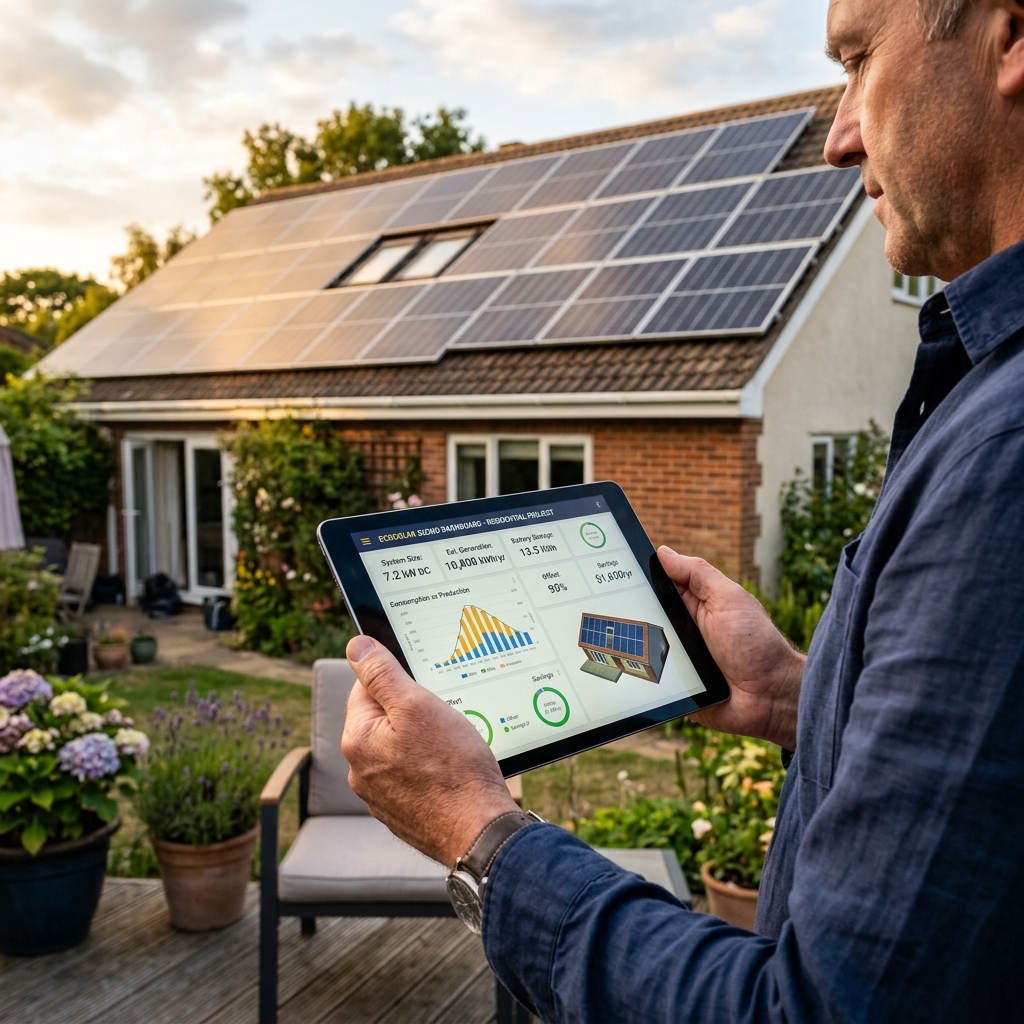
Direct answer: The government's impact assessment models 690 kWh a year from a tilted 800W kit and 378 kWh from a vertical one. Here is what that means in pounds, why a home never keeps all of it, and what moves your own figure.
Editorial note: WhichWatts is an independent comparison site. Prices, availability, specifications, and retailer promotions change frequently. Check the live product table and retailer page before buying.
What an 800W Plug-in Solar Kit Generates and Saves: the Government's Figures
Every plug-in solar kit is sold on a promise about your electricity bill. The most useful second opinion is not the retailer's — it is the government's own impact assessment, published with the plug-in solar consultation outcome on 16 July 2026. It models an 800W kit in two mounting positions and puts numbers on both the generation and the saving.
The two modelled installations
| Mounting position | Modelled generation | Modelled use in the home | Modelled annual saving |
|---|---|---|---|
| Tilted at around 30°, south-facing | 690 kWh/year | 428 kWh/year | £110/year |
| Vertical, wall or balcony fixing (east/west) | 378 kWh/year | 272 kWh/year | £70/year |
The same assessment puts the hardware at around £400 to £600, excluding any additional electrical or installation work you might need. These are modelled examples rather than guarantees: the figures come from modelled conditions, and savings are valued at the price-cap unit rate that was in force when the assessment was produced.
The middle column is the one to read first
Generation and saving are not the same number, and the gap is the assessment's own modelling rather than a rounding error.
Of the 690 kWh modelled for a tilted kit, 428 kWh is counted as used in the home. The rest — 262 kWh — is not credited as a saving. For the vertical case, 106 of the 378 kWh falls outside the home's own use. A kit generates the same way regardless of who owns it; what differs is how much of any given sunny hour your house happens to be drawing.
That is why mounting position changes the result so sharply. A well-angled kit generates more in total, and because it generates more at the times of day a home tends to be using power, a larger share of it lands where it counts.
What that means for payback
Put the two published numbers side by side and do the arithmetic:
- £400–£600 of hardware against £110 a year is roughly four years, before accounting for tariff changes or the life of the electronics.
- The same hardware against £70 a year is closer to eight years.
That range is arithmetic on the government's modelled figures, not a guaranteed return. Your own number depends on the retail price you actually pay, the tariff you are avoiding, where the panels point, how much shade they see, and — the quiet variable — how much electricity your home uses while the sun is up.
What moves your own figure
- Mounting angle and direction. The assessment's own comparison is the clearest guide available: the tilted kit outpaced the vertical one in every column — generation, use in the home, and saving.
- When you use power, not just how much. Flexible loads — laundry, dishwashers, charging — moved into the middle of a sunny day land in the "used in the home" column instead of the gap beside it.
- Shade. The assessment's modelled conditions do not include the tree, chimney or neighbouring roofline that shades your particular wall.
- The tariff you avoid buying at. The saving is the value of the units you did not have to import. A higher unit rate raises the value of the same kilowatt-hours; that is the whole reason the figure is quoted as "at the price-cap rate in force", not as a fixed number.
Check your own case before you buy
- Estimate your own generation with the WhichWatts solar calculator.
- The 2026 rules guide sets out the product specification every kit must meet, the 800W limit in law and the G98 notification step.
- If you want to capture generation your home cannot use at the moment it is made, balcony battery storage covers what a battery can realistically add, and what it cannot.
Sources and limits
- DESNZ, Plug-in solar: impact assessment (published with the consultation outcome, 16 July 2026) — the source of the cost, generation, use and saving figures above.
- GOV.UK, Plug-in solar: consultation and outcome — where the impact assessment and the interim product specification are published.
These are modelled examples for an 800W system, not a prediction for any particular home. Nothing here is a quote, and no figure should be read as a guarantee of savings.