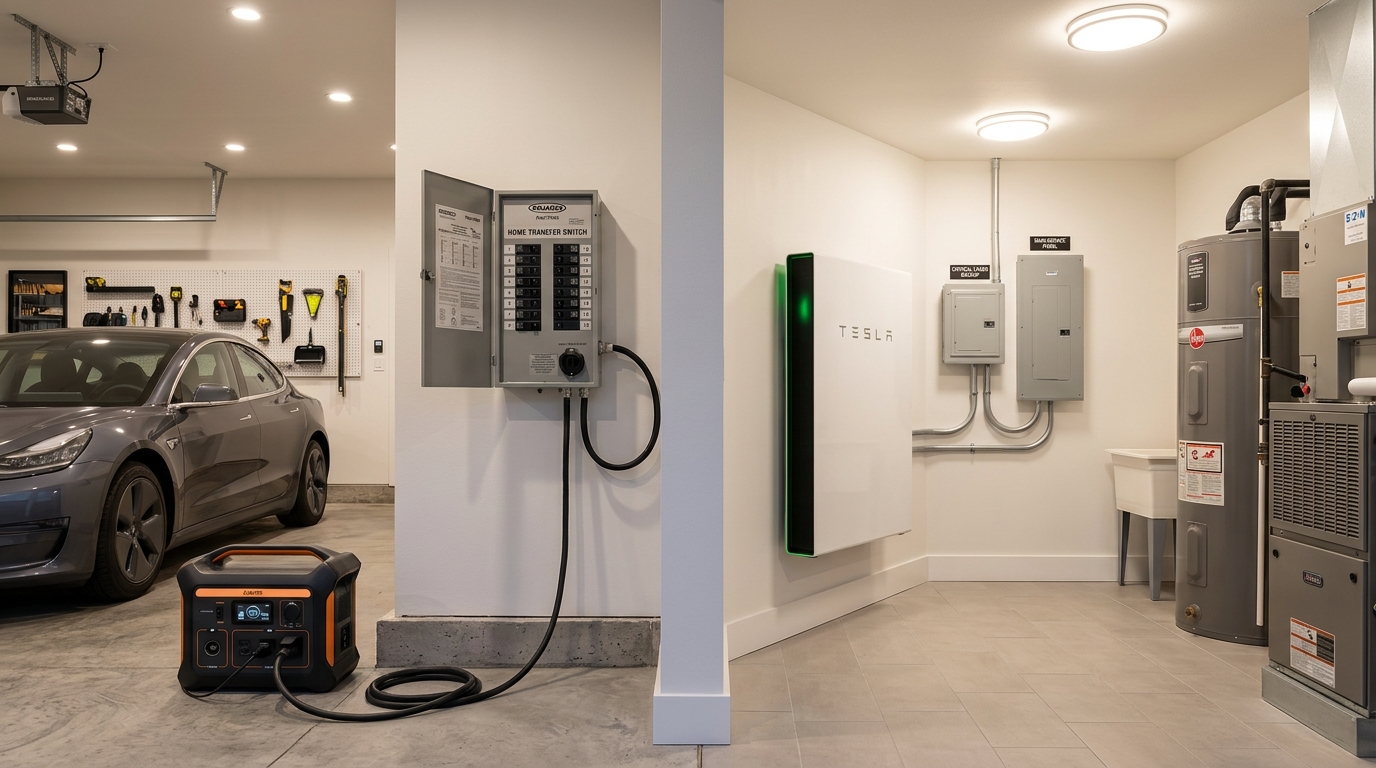
Direct answer: Should you install a permanent home battery like Tesla Powerwall or connect a high-capacity portable power station to a transfer switch? Compare installation costs, permitting, portability, and ROI.
When preparing a home for severe weather, grid outages, or rising peak electricity tariffs, homeowners face a critical crossroad: should you invest in a permanent wall-mounted home battery storage system, or buy a high-capacity expandable portable power station paired with a home transfer switch?
Historically, fixed residential batteries (such as the Tesla Powerwall 3, Enphase IQ Battery 5P, or GivEnergy All-in-One) were the only way to power essential home circuits during a blackout. But in 2026, modular power stations—such as the EcoFlow Delta Pro 3 / Ultra, Bluetti EP800 / AC500, and Anker Solix F3800—have grown into 120V/240V split-phase powerhouses pushing 6,000W to 12,000W of continuous output and expandable up to 30kWh+.
This guide provides an honest, transparent breakdown of equipment costs, electrician installation fees, permitting rules, electrical capabilities, and long-term return on investment (ROI).
At a Glance: Cost and Spec Comparison
Before diving into the technical details, here is how the two approaches compare on key metrics in 2026:
| Comparison Factor | Fixed Home Battery (e.g., Powerwall 3 / GivEnergy) | Expandable Portable Power Station (e.g., Delta Pro Ultra / F3800) |
|---|---|---|
| Typical Usable Capacity | 13.5 kWh – 27 kWh | 3.8 kWh – 24 kWh (modular expandable) |
| Continuous Power Output | 5.0 kW – 11.5 kW | 3.6 kW – 12.0 kW (with split-phase hub) |
| Equipment Cost | $8,500 – $13,000 per unit | $2,800 – $6,000 (base station + battery) |
| Installation Labor & Permits | $3,500 – $6,500 (Complex wiring, gateway) | $600 – $1,400 (Manual transfer switch or inlet box) |
| Total All-In Cost (Turnkey) | $12,000 – $19,500 | $3,500 – $7,500 |
| Permits & Utility Approval | Mandatory (Building permit + DNO/Utility Interconnection) | Minimal (Standard generator inlet / transfer switch permit) |
| Mobility / Portability | Permanent (Bolted to wall, stays with home) | 100% Portable (Wheels, can take camping or when moving) |
| Outage Switchover Time | Seamless UPS (<10ms automatic gateway) | 10–20ms on dedicated panel, or manual switch flip |
| Grid Peak Tariff Arbitrage | Fully automated via smart software & grid export | App-controlled AC scheduling (usually no grid export) |
| Warranty | 10-year manufacturer warranty | 5 to 10-year manufacturer warranty |
1. Upfront Equipment and Installation Costs
The financial difference between these two systems is substantial. Much of the gap comes down to installation complexity and soft costs.
The Fixed Home Battery Route
When you purchase a permanent home battery like a Tesla Powerwall 3 or GivEnergy system, you aren't just buying a battery pack. You are installing a permanent grid-tied power plant:
- The Hardware: A 13.5kWh battery unit costs between $8,000 and $10,500.
- The Backup Gateway / Automatic Transfer Switch: Adds $1,200 to $1,800.
- Labor & Engineering: Licensed electricians must mount the heavy unit (130kg+), rewire your main service panel or install a critical loads sub-panel, install rapid-shutdown equipment, and route heavy conduit.
- Permitting & Utility Interconnection: Requires local municipal electrical permits, fire department inspections, and utility engineering approval (DNO in the UK, electric utility PTO in the US), which typically adds $1,000 to $2,500 in fees and 4 to 12 weeks of wait time.
- Average Total Cost: $13,500 to $18,500 before local tax incentives.
The Portable Power Station + Transfer Switch Route
Modern large-format power stations have built-in inverters, charge controllers, and battery management systems all in a pre-certified, wheeled enclosure:
- The Hardware: A 4kWh to 6kWh expandable station with 3,600W to 6,000W 120V/240V output costs approximately $2,800 to $4,500.
- The Manual Transfer Switch (MTS): A standard 6 to 10-circuit indoor transfer switch (such as a Reliance Controls Pro/Tran 2) or an outdoor L14-30 generator inlet box costs $250 to $450.
- Labor: An electrician can install a generator inlet box and manual transfer switch in 2 to 3 hours, running a single conduit from your existing breaker panel.
- Permitting: Requires only a standard residential electrical permit without complex utility interconnection reviews, since the transfer switch mechanically prevents backfeeding into the grid.
- Average Total Cost: $3,600 to $6,000.
Cost Verdict: A high-capacity portable power station paired with a manual transfer switch delivers critical-circuit home backup for one-third the price of a fixed residential battery.
2. Power Capabilities: What Can They Actually Run?
Both systems can handle essential household appliances, but they differ in how they manage high-draw inductive loads.
Essential Loads (120V / 230V Single Phase)
Both setups will effortlessly power:
- Full-size kitchen refrigerator & freezer (150W running, 500W surge)
- Wi-Fi routers, smart home hubs, laptops, monitors, and lighting circuits
- Medical equipment (CPAP, oxygen concentrators)
- Gas furnace or boiler blower motor (300W–600W)
- Sump pumps and aquarium filters
Heavy Loads (240V Split-Phase / Multi-Phase)
This is where fixed home batteries historically held an advantage. Appliances such as central air conditioning (3-ton to 5-ton condensers), electric heat pumps, well pumps, electric clothes dryers, and EV chargers require 240V split-phase power and huge startup surge currents.
- Fixed Batteries: Most permanent installations deliver 5kW to 11.5kW continuous output with 15kW+ surge capability. A single Powerwall 3 can soft-start and run a central AC unit without additional hardware.
- Portable Power Stations: In 2026, stations like the EcoFlow Delta Pro Ultra and Anker Solix F3800 feature native 120V/240V split-phase output directly from the unit. While a single unit (3.6kW–6kW) can run a 240V well pump, running a full central air conditioner typically requires pairing two units together or adding a soft-start capacitor to your AC compressor.
3. The Portability & Renter Advantage
One of the most overlooked realities of permanent home batteries is sunk capital.
- Permanence: If you spend $16,000 installing a fixed battery on your garage wall and sell your home 3 years later, real estate appraisal data shows you rarely recoup the full installation cost. For renters or leaseholders, installing a permanent battery is virtually impossible.
- Total Mobility: A portable power station is your personal asset. You can wheel it into your home during a winter blackout, pack it into your vehicle for an off-grid camping or overlanding holiday, bring it to a remote job site to run heavy power tools, and pack it into a moving van when you relocate to a new home.
4. Solar Charging and Grid Optimization
How each system integrates with solar panels represents a key operational difference:
- Fixed Home Batteries: Designed for seamless integration with rooftop solar arrays. They feature high-voltage DC solar inputs (often 300V to 600V string inputs) or AC-coupled microinverters. They automatically charge from excess daytime solar and discharge during expensive peak utility rate hours (Time-of-Use arbitrage), occasionally exporting power back to the grid for virtual power plant (VPP) revenue.
- Portable Power Stations: Utilize low-to-medium voltage MPPT solar charge controllers (typically 12V–150V, with high-end models accepting up to 450V). They pair easily with ground-deployed portable solar panels or a dedicated off-grid rooftop string. While you can schedule them to charge from the wall at off-peak electricity rates (e.g., overnight EV tariffs) and discharge during peak hours, they generally do not feed power back into the public grid.
How to Connect a Portable Power Station to Your Home Safely
If you choose the portable power station route, never connect your battery to your home wiring using a male-to-male "suicide cord" into a wall outlet. This is illegal, dangerous, and can send lethal high-voltage current back onto power lines, injuring utility workers.
The Two Safe Connection Methods:
- Manual Transfer Switch (MTS): An electrician installs a sub-panel next to your main electrical panel with dedicated toggle switches (e.g., 6, 8, or 10 circuits). When the grid fails, you connect a heavy-duty cable from the power station's 30A outlet to the inlet box and flip the switches from "LINE" to "GEN". Only the chosen circuits receive power.
- Smart Home Sub-Panel (e.g., EcoFlow Smart Home Panel 2 / Anker Home Power Panel): An automated sub-panel wired into your breaker box that senses a power cut and automatically switches designated circuits to battery power in under 20 milliseconds, providing true uninterrupted power supply (UPS) protection.
Summary Checklist: Which Should You Choose?
Choose a Fixed Home Battery (Powerwall) if:
- You own your home and plan to stay for 7+ years.
- You already have (or are installing) a large grid-tied rooftop solar array (6kW+).
- You want whole-home automatic backup that powers central AC, electric ovens, and EV charging without thinking about manual switches.
- You want to participate in utility Virtual Power Plant (VPP) export programs.
- You have a $12,000–$20,000 budget.
Choose an Expandable Portable Power Station if:
- You want robust emergency backup for critical circuits (fridge, medical devices, lights, Wi-Fi, furnace) for under $5,000.
- You want an installation that can be completed in an afternoon without months of utility permit reviews.
- You rent, live in a flat, or plan to move in the near future.
- You want a battery that can leave the house for outdoor recreation, van life, or remote work.
- You prefer modular expandability—starting with 3.8kWh and adding expansion batteries over time as your budget allows.
Frequently Asked Questions
Can a portable power station run a 240V well pump?
Yes, provided the power station supports native 240V split-phase output (such as the EcoFlow Delta Pro Ultra, Bluetti EP800, or Anker Solix F3800) and has a continuous output of at least 3,600W to handle the inductive startup surge of the pump motor.
Does a portable power station qualify for government tax credits?
In the United States, under the Inflation Reduction Act (Section 25D), energy storage systems with a capacity of 3kWh or greater qualify for a 30% federal clean energy tax credit, even if they are modular. Always consult a tax professional to verify eligible hardware and installation receipts.
How long will a 5kWh power station keep my home running during a blackout?
For essential critical circuits (a modern refrigerator consuming ~1.2kWh/day, home Wi-Fi and laptop drawing ~100W, LED lighting, and occasional phone charging), a 5kWh power station will comfortably power your home for 48 to 72 hours. If running continuous heating or cooling appliances, runtime will be reduced to 8–16 hours.