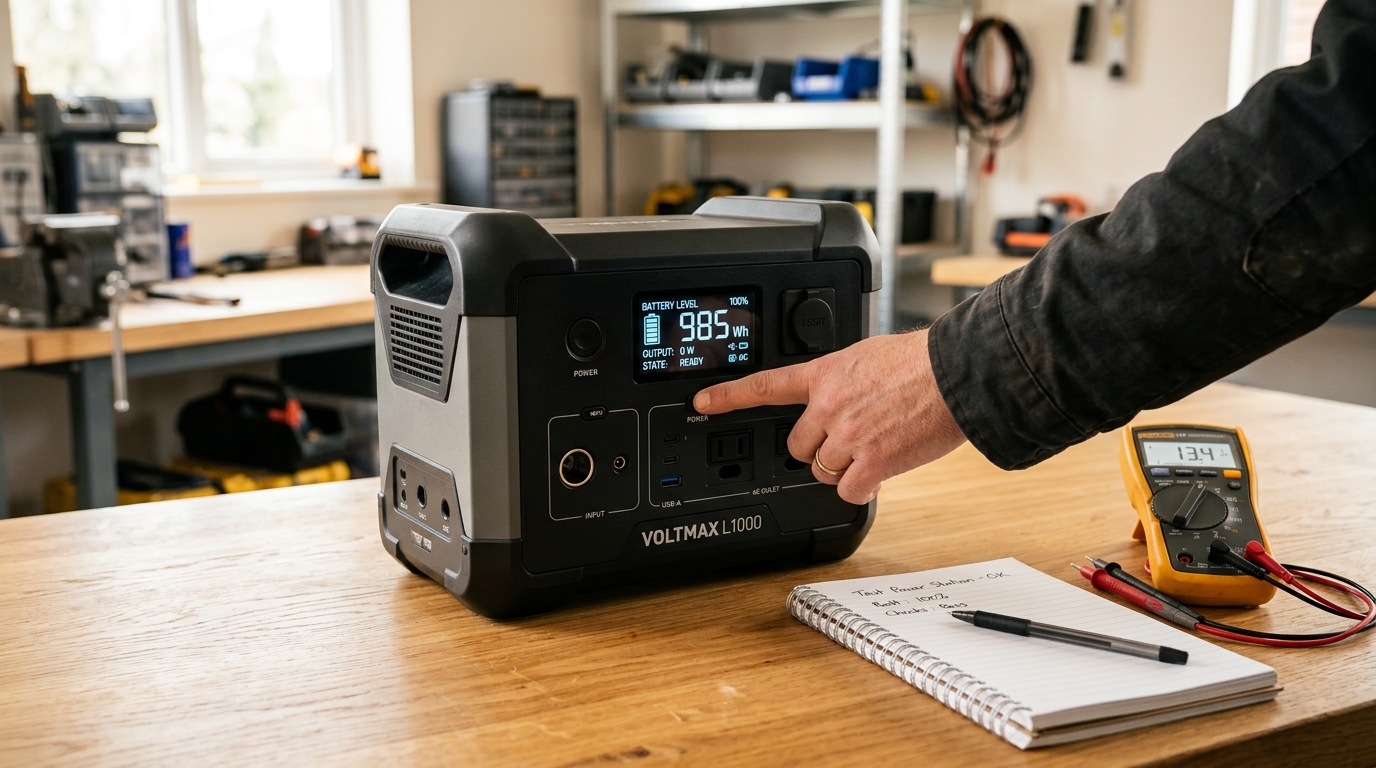
Direct answer: A stored power station degrades quietly at 100% or 0% charge. A monthly five-minute check and a six-month deep test — the rhythm the government recommends for emergency kit — keep it usable when the grid fails.
Editorial note: WhichWatts is an independent comparison site. Prices, availability, specifications, and retailer promotions change frequently. Check the live product table and retailer page before buying.
Six-Month Readiness: The Routine That Keeps a Power Station Usable
Emergency kit fails in storage more often than it fails in use. The Be Ready guidance makes the point directly: "Set a reminder every six months to check expiry dates and swap out items that need replacing." A battery deserves the same discipline, because a power station that has sat at 100% in a warm cupboard for two years, or at 0% in a cold garage, may not deliver what its label promises when you finally need it.
This is the maintenance routine that keeps a station trustworthy: a five-minute monthly check, a deeper test every six months, and a short family drill.
Why a stored power station fails quietly
- Calendar ageing. Lithium cells lose capacity fastest when held at a high state of charge, especially when warm. Storing at 100% is convenient and slightly costly.
- Self-discharge and BMS sleep. Most units slowly drain, and some enter a deep sleep that needs a charger to wake them.
- Storage at 0%. Leaving a pack flat for months can permanently reduce capacity, and some units refuse to accept charge afterwards.
- Cold. A garage that drops below freezing slows charging and can trigger protection modes.
- Hardware. Ports collect dust, cables stiffen, plugs work loose and fans clog.
- Firmware and apps. Updates fix charge behaviour and telemetry, but only if you connect occasionally.
None of this is visible on a shelf. It shows up as a station that reports 100% and then dies after twenty minutes.
The monthly five-minute check
- Read the state of charge. If it is below 40%, charge to 60–80%. If it is at 100% and has been for months, discharge it to about 70%.
- Run a known load. A 300–500W heater or lamp for ten minutes gives a repeatable number. Note the percentage drop.
- Inspect the hardware. Look for scorched or loose sockets, cracked insulation, a blocked fan and any swelling.
- Check the display and app. Clear error codes, confirm the charge limit and re-pair Bluetooth if needed.
- Note the storage conditions. A cupboard at 18°C is fine; a south-facing car boot in July is not.
A written log turns those readings into a trend:
| Date | State of charge | Test load | Duration | Drop | Notes |
|---|---|---|---|---|---|
| 05/11/2026 | 72% | 400W heater | 10 min | 9% | Fan slightly noisy |
If the same load starts dropping 15% where it used to drop 9%, the pack is ageing or a cell group is failing. That is worth knowing before a blackout rather than during one.
The six-month deep test
This is the government's twice-yearly reminder applied to power:
- Charge to 100% and let the unit settle.
- Discharge with a measured load down to about 50%, logging the delivered watt-hours against the rated capacity. Expect roughly 80–90% usable energy after inverter losses; a large shortfall is a warning sign.
- Update firmware and confirm the app still connects.
- Test the solar path. Inspect the panel, check connectors for corrosion, and — only if you are competent with a multimeter — confirm open-circuit voltage is in the expected range. Then run a real charge test in sunlight.
- Test the car cable and its fuse, since that is the recharge route most likely to be available in a winter outage.
- Check the rest of the kit at the same time: water and food dates, medication, the printed contact list, Priority Services Register details and the 105 number. The Priority Services guide explains what to confirm.
Storage rules that actually matter
| Rule | Why |
|---|---|
| Store at 50–80% for long periods | Slows calendar ageing without risking a flat pack |
| Keep it cool and dry, ideally 0–25°C | Heat is the main accelerant; damp corrodes contacts |
| Never store at 0% | Deep discharge can permanently reduce capacity |
| Charge before winter | Cold reduces usable capacity just when demand peaks |
| Top up every three months if unused | Offsets self-discharge and BMS drain |
| Avoid the car boot in summer | Interior temperatures can exceed 50°C |
Manufacturer instructions override all of these. If the manual says store at 100% for standby use, follow it.
A two-hour family drill
The point of a drill is to discover the gaps while nothing is at stake. Pick a dry evening and move selected loads onto the station — do not isolate circuits or touch the consumer unit unless you are competent to do so.
- Find the torches in the dark and check every one works.
- Tune the radio and confirm you can get a station.
- Charge two phones from the station and note the drop.
- Run the router from it for an hour and see whether the connection survives.
- Lift the unit and carry it to where it would actually be used. Weight is the most common surprise.
- Write down what did not work and add it to the shopping list.
Label the unit
A strip of tape on the side with the purchase date, capacity, last test date and storage target saves guesswork for everyone in the house — and for anyone helping you.
If a test shows the pack has faded, compare replacement models and browse current stations before buying the same size again.
FAQ
How often should I test a power station?
Run a short load test monthly and a full charge-discharge test every six months. That matches the twice-yearly reminder the government recommends for emergency kit.
Is it bad to store a power station at 100%?
For lithium packs, holding 100% for months accelerates ageing. Store at 50–80% unless the manufacturer specifies otherwise.
Should I run it completely flat every month?
No. A full discharge is a diagnostic step, not routine maintenance. Regular deep discharges add wear.
Is a cold garage bad for the battery?
Below freezing, charging is restricted and capacity drops. Store indoors where possible, and let the unit reach room temperature before charging.
Do I need to test the solar panel too?
Yes, at least twice a year: inspect for cracks and corrosion, confirm the connectors seat properly, and run a real charge test in sunlight. A panel that has silently failed is worse than no panel.
When the test says replace
A station that delivers well under 80% of its rated watt-hours, refuses to charge, or trips under a load it used to carry is no longer emergency kit. Before replacing it:
- Re-run the six-month test at room temperature with a known load.
- Check the warranty terms and the manufacturer's battery-care guidance.
- Compare a like-for-like replacement in the price comparison table, not against the newest flagship.
Browse the power station catalogue for current capacity and output, or check the brands most often used for backup: EcoFlow, Bluetti, Anker SOLIX and Jackery. If the failing unit only ever ran phones and a router, replace it with the same size rather than upsizing.