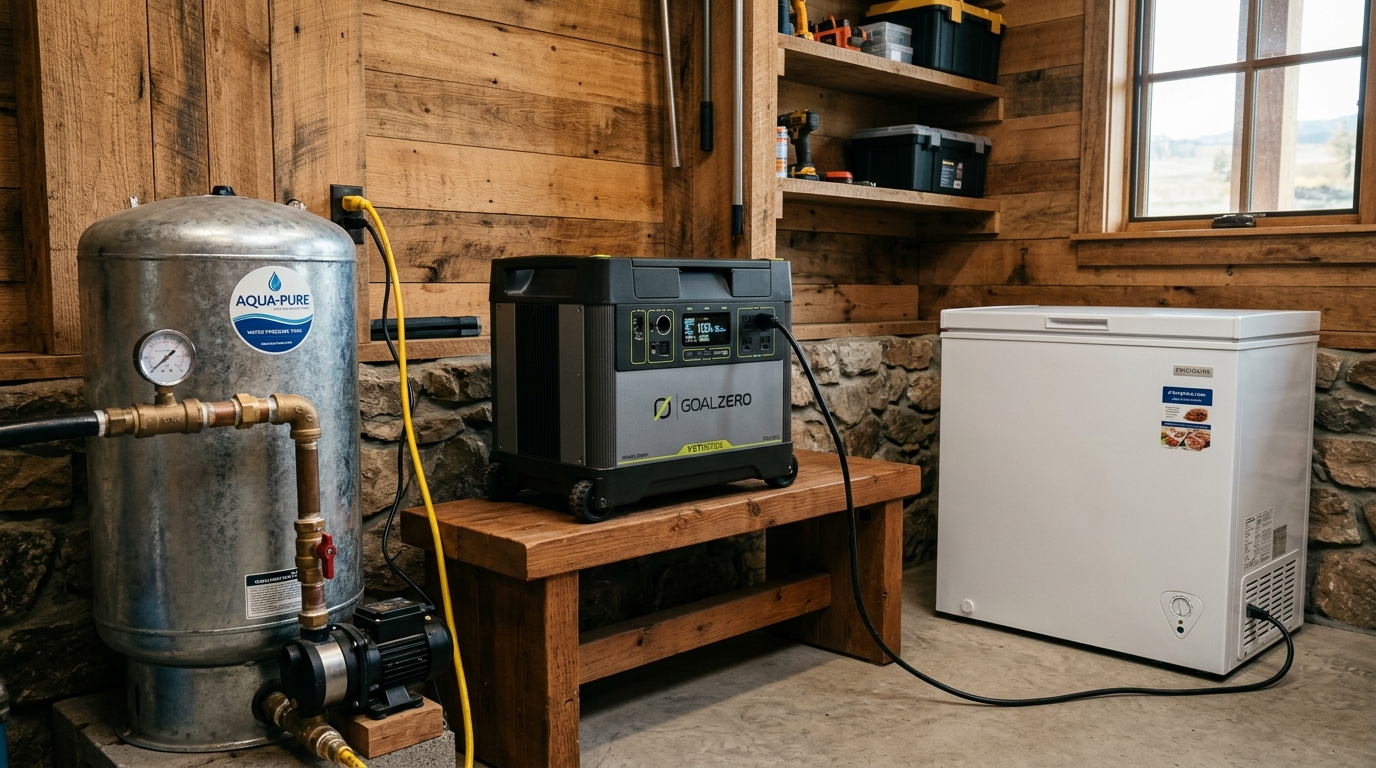
Direct answer: Living off municipal utility lines? Learn how to size emergency battery power for high-voltage 240V submersible well pumps, storm sump pumps, and multi-day deep freeze food preservation.
Editorial note: WhichWatts is an independent comparison site. Prices, availability, specifications, and retailer promotions change frequently. Check the live product table and retailer page before buying.
Rural Emergency Power Sizing: Backing Up Submersible Well Pumps, Sump Pumps & Deep Freezers
For urban and suburban households connected to municipal utilities, a power cut is an annoying inconvenience.
For rural homeowners, semi-rural villages, and off-grid homesteads, a blackout is an immediate survival crisis:
- No Electricity Means Zero Running Water: Rural properties depend on private water wells powered by deep-well submersible pumps. When the electricity cuts, your kitchen taps run dry, shower pressure vanishes, and toilets cannot refill.
- Flooding Risk from Sump Pump Failures: Storms that down power lines frequently bring torrential rainfall. If a basement or foundation sump pump loses electricity, thousands of pounds of water damage can flood your home in under two hours.
- Loss of Massive Food Reserves: Rural families frequently keep 300 to 500-litre chest freezers stocked with whole livestock cuts, seasonal game, and garden harvests worth thousands of pounds.
- Delayed Restoration Timelines: While city centers see grid power restored in 4 to 8 hours, rural distribution network lines can take 3 to 7 days to repair when fallen trees block remote access roads.
Sizing backup power for rural homesteads requires mastering high-voltage 240V split-phase power, brutal motor starting surges (Locked Rotor Amps), and continuous inductive duty cycles.
This engineering guide provides the exact specifications, electrical calculations, and hardware configurations required to keep rural well pumps pumping, sump pumps protecting, and freezers frozen through extended multi-day emergencies.
                    RURAL CRITICAL LOADS ELECTRICAL MATRIX

┌─────────────────────────────────────────────────────────────────────────────┐
│ 1. DEEP WELL SUBMERSIBLE PUMP (240V Split-Phase)                            │
│    • Running Draw: 800W - 1,500W | Inrush Surge Peak: 3,500W - 5,500W       │
│    • Pressure Tank Cycling: 5 to 8 pump cycles per day (~450Wh/day)         │
├─────────────────────────────────────────────────────────────────────────────┤
│ 2. BASEMENT / FOUNDATION SUMP PUMP (120V / 230V)                            │
│    • Running Draw: 600W - 900W | Inrush Surge Peak: 2,200W - 3,000W         │
│    • Storm Inundation Cycling: 15 mins total run time per hour (~300Wh/day) │
├─────────────────────────────────────────────────────────────────────────────┤
│ 3. LARGE CHEST FREEZER (300L - 500L)                                        │
│    • Running Draw: 90W - 140W | Inrush Surge Peak: 700W - 1,100W            │
│    • Thick Insulation Cycling: 15 mins per hour (~600Wh/day)                │
├─────────────────────────────────────────────────────────────────────────────┤
│ 4. BIOMASS / PELLET BOILER / COMBI HEATING PUMP                             │
│    • Running Draw: 120W - 180W | Auger & Circulation Motor (~800Wh/day)     │
└─────────────────────────────────────────────────────────────────────────────┘
1. Sizing for Private Water Wells: The 240V Submersible Pump Challenge
A standard 120V domestic power station cannot run a deep-well water system. Private wells utilize multi-stage centrifugal impellers submerged 100 to 400 feet underground:
Electrical Characteristics of Submersible Well Pumps:
- Voltage Requirements: Most modern residential well pumps operate exclusively on 240V AC power (or 240V split-phase across two 120V legs in the US). If your power station only outputs 120V, it cannot power the pump control box without an expensive step-up autotransformer.
- Continuous Power:
- 1/2 Horsepower (HP) Pump: Consumes 800W to 1,050W continuous.
- 3/4 HP Pump: Consumes 1,200W to 1,500W continuous.
- 1.0 HP Pump: Consumes 1,600W to 2,000W continuous.
- The Inrush Surge Shockwave: When the pressure switch detects water pressure dropping below 30–40 PSI, the electric motor must overcome the immense physical column weight of standing water inside the drop pipe. For 200 milliseconds, the motor demands 3.5x to 5x its running power:
- A 1/2 HP pump requires 3,500W to 4,200W surge peak.
- A 3/4 HP pump requires 4,500W to 5,500W surge peak.
Submersible Well Pump Starting Surge Profile:
Watts
  ▲
4,800W ┼         ┌──┐ (Inrush Current: 200ms)
       │         │  │
1,050W ┼─────────┘  └────────────────────────────────────── (Running Draw: 1,050W)
       │
    0W ┴────────────────────────────────────────────────► Time (Seconds)
The Pressure Tank Hack (Energy Conservation):
You do not need to leave your well pump energized 24 hours a day.
- A private water system utilizes a captive-air pressure tank (typically 20 to 80 gallons / 80 to 300 litres).
- The pump only turns on when tap use draws down the tank pressure.
- Emergency Operating Protocol: Turn on the power station inverter to pressurize your tank to 50 PSI, fill all kitchen water jugs, kettle, and sinks, and then turn the well pump breaker OFF. The pressurized tank holds 10 to 25 gallons of pressurized tap water that flows with zero battery drain!
2. Sizing for Basement Sump Pumps: Preventing Storm Flood Damage
Torrential weather systems that knock out grid power also saturate sub-surface soil and overload perimeter drain tiles.
Sump Pump Electrical Parameters:
- Common Sizes: 1/3 HP (most common) or 1/2 HP (heavy commercial water flow).
- Running Wattage: 600W to 850W.
- Starting Surge: 2,200W to 2,800W.
- Daily Energy Budget: Even in severe rainfall, a properly sized sump pump runs intermittently—activating for 15 seconds every 2 to 3 minutes. Total active pumping time is rarely more than 1.5 to 2.5 hours across an entire 24-hour day.
$$700\text{W continuous} \times 2\text{ hours run time} = \mathbf{1,400\text{ Wh / Day}}$$
Inverter Sizing Rule for Sump Pumps:
Never attempt to power a sump pump from an entry-level 1,000W power station. When the float switch triggers, the inductive motor inrush will instantly trigger an overload fault code, leaving your basement to flood. Ensure your power station provides at least 2,400W continuous output with a 4,800W peak surge rating.
3. Preserving Chest Freezers: Duty-Cycling Math
Rural families often maintain multi-hundred-litre chest freezers filled with valuable provisions. How long can a portable battery preserve frozen food?
Chest Freezers Are Thermal Banks:
Unlike upright refrigerators with front-opening doors (which dump cold air onto your feet every time they open), a chest freezer opens from the top. Because cold air is heavy and sinks, cold air stays trapped inside even when opened.
- A fully loaded, quality chest freezer will keep food frozen for 48 hours without any electricity at all, provided the lid remains closed.
- Continuous Wattage: 90W to 130W when compressor is active.
- Inrush Surge: 600W to 900W.
The 45-Minute Duty-Cycling Strategy:
Instead of leaving the chest freezer plugged in continuously, practice pulse cooling:
- Plug the freezer into your power station for 45 minutes every 3 to 4 hours.
- This runs the compressor for two complete cooling cycles, driving temperatures back down to -18°C (0°F).
- Unplug the freezer and let the thick polyurethane insulation maintain the sub-zero environment.
- Total daily energy consumed: ~350 Wh to 500 Wh / day (saving over 60% of battery capacity compared to continuous running).
4. The Complete Rural Homestead 72-Hour Energy Budget
Here is the combined energy ledger for maintaining running water, flood protection, food storage, and communications across a rural property:
| Essential Appliance | Running Watts | Surge Peak | Daily Run Strategy | 24-Hour Energy | 72-Hour Energy |
|---|---|---|---|---|---|
| 1/2 HP 240V Deep Well Pump | 1,000W | 4,200W | 6 cycles to pressurize tank (~25 mins) | ~420 Wh | ~1,260 Wh |
| 1/3 HP Basement Sump Pump | 700W | 2,400W | Rainstorm cycling (~1.5 hrs total) | ~1,050 Wh | ~3,150 Wh |
| 350L Chest Freezer | 100W | 800W | 45-min pulse cycle 4x per day | ~300 Wh | ~900 Wh |
| Kitchen Combi / Wood Pellet Boiler | 120W | 300W | Heating circulation pump (4 hrs) | ~480 Wh | ~1,440 Wh |
| Starlink Satellite Internet & WiFi | 50W | 75W | 16 hours active connection | ~800 Wh | ~2,400 Wh |
| LED Lamps & Radios | 20W | 20W | 6 hours evening hours | ~120 Wh | ~360 Wh |
| Total Combined Homestead Load | — | ~4,200W Peak | — | ~3,170 Wh / Day | ~9,510 Wh (3 Days) |
5. Top Recommended Rural Backup Systems (2026)
Rural applications demand high continuous inverter capacity, dual 120V/240V voltage capability, massive surge tolerances, and modular battery expandability:
1. Best Overall Rural Powerhouse: EcoFlow DELTA Pro 3
- Base Battery Capacity: 4,096 Wh (expandable up to 48 kWh with expansion packs)
- AC Inverter Output: 4,000W continuous pure sine wave (8,000W surge headroom)
- Voltage Output: Native 120V / 240V dual-voltage output directly from the unit
- Key Rural Feature: Dedicated 30A Commando / L14-30 output port connects straight into a transfer switch to energize 240V deep-well pumps and 120V sump pumps simultaneously.
- 👉 Check Live Price on EcoFlow | Compare $/Wh Rankings
2. Best Heavy-Duty Modular System: Anker SOLIX F3800
- Base Battery Capacity: 3,840 Wh (expandable to 26.9 kWh)
- AC Inverter Output: 6,000W continuous output (120V/240V split-phase)
- Key Rural Feature: Built-in high-voltage solar MPPT controllers support up to 2,400W of rooftop or ground-mount solar input, providing true indefinite off-grid water and food security.
- 👉 Check Live Price on Anker
3. Best Industrial Workhorse: Bluetti EP800 Home ESS
- Base Battery Capacity: Modular 9.9 kWh to 19.8 kWh LiFePO4
- AC Inverter Output: 7,600W continuous off-grid output
- Key Rural Feature: NEMA 4X weather-rated enclosure can be installed in unheated outbuildings or barns, operating cleanly in freezing sub-zero winter temperatures down to -20°C.
- 👉 Check Live Price on Bluetti
Helpful Next Steps & Tools
- Calculate your exact rural appliance load with our Power Station Sizing Calculator.
- Size ground-mount solar arrays for rural recharging on our Solar Calculator.
- Review current battery pricing, discount codes, and £/Wh metrics in our Live Price Comparison Table.
- Planning your electrical installation? Read our Manual Transfer Switch Guide.
Frequently Asked Questions
Can I run a 240V well pump with a portable battery without a transfer switch?
Yes, provided your power station features a native 240V AC output socket (such as the 30A Commando or L14-30 outlets found on the EcoFlow DELTA Pro 3 or Anker SOLIX F3800). You can wire a dedicated heavy-duty extension cable from the power station directly into the well pump's pressure control box using a certified disconnect switch.
How much solar power do I need to keep a rural homestead running indefinitely?
To replenish a daily rural consumption of ~3,200Wh during autumn and winter in the UK or Northern US, you need at least 800W to 1,200W of solar panel capacity. Because winter days provide only 2 to 3 peak sun hours and frequent overcast cloud cover, an 800W–1,200W array delivers between 1,600Wh and 3,200Wh of replacement energy daily, keeping your battery bank afloat.
Will cold garage temperatures ruin my backup battery?
Extreme cold does not damage LiFePO4 batteries while they are discharging or sitting in storage. However, attempting to charge a standard lithium battery when the internal cells are below 0°C (32°F) can permanently destroy the cells. If your power station is stored in an uninsulated barn or garage, select models equipped with built-in internal thermal heating elements (like the EcoFlow DELTA Pro 3 or Bluetti EP800) which warm the cells before accepting charge.