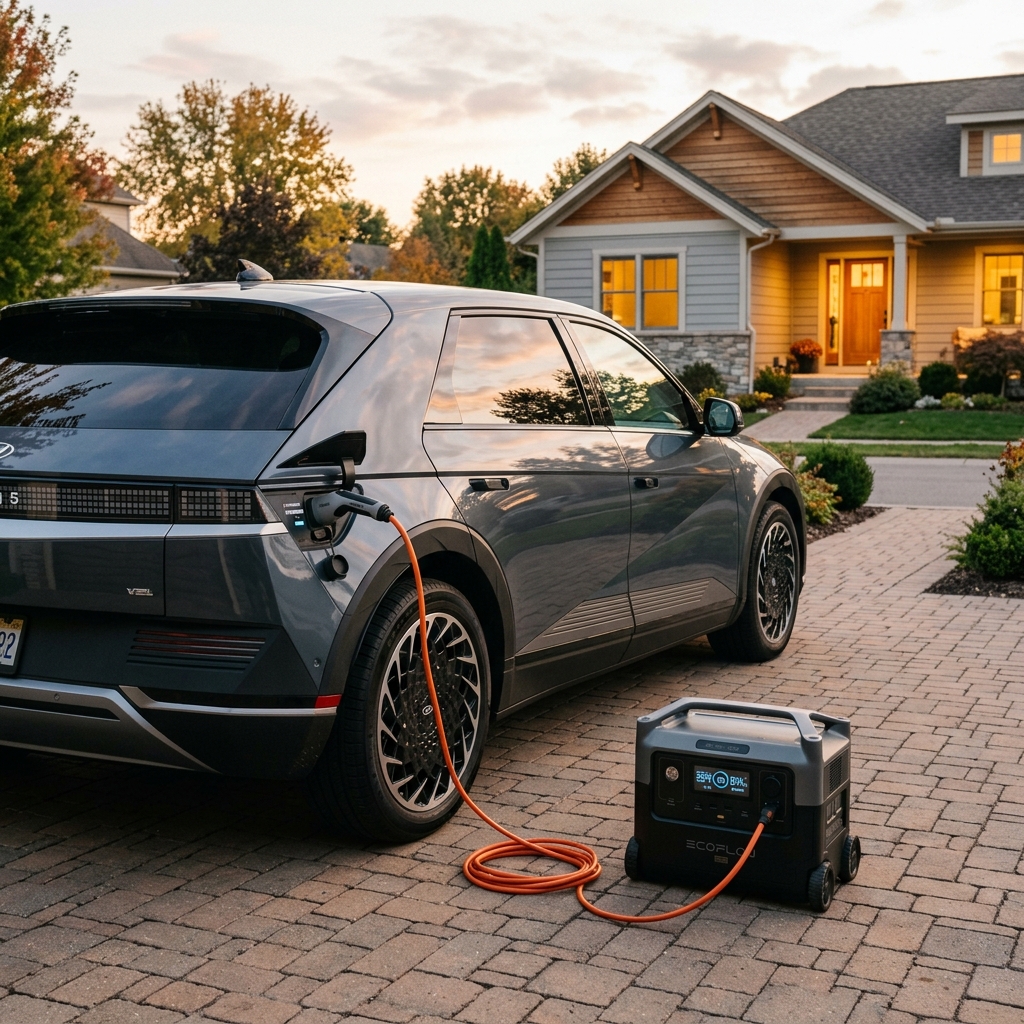
Direct answer: Electric vehicles boast 60kWh to 100kWh batteries with V2L power. Can your car replace a dedicated portable power station for home emergency backup? Compare vampire drain, indoor safety, UPS speed, and the hybrid strategy.
Editorial note: WhichWatts is an independent comparison site. Prices, availability, specifications, and retailer promotions change frequently. Check the live product table and retailer page before buying.
Vehicle-to-Load (V2L) vs Portable Power Station: Can Your EV Power Your Home in 2026?
If you own a modern electric vehicle—such as a Hyundai Ioniq 5/6, Kia EV6/EV9, BYD Seal, MG4, Volvo EX90, or Ford F-150 Lightning—you have a colossal battery parked in your driveway.
With traction pack capacities ranging from 60 kWh to over 100 kWh, an average electric car stores enough electricity to power a typical domestic household for three to five days. Furthermore, with Vehicle-to-Load (V2L) functionality, your car can output continuous 230V or 120V pure sine wave AC power (typically 2,200W to 3,600W) through an exterior charging port adapter or internal 3-pin socket.
This prompts an obvious question for emergency preparedness and off-grid living: Why spend £1,500 to £3,500 on a 2kWh–4kWh portable power station when you already have a 77,000Wh battery sitting on your driveway?
The theoretical logic is compelling, but real-world emergency power is defined by engineering nuances. When you examine idle vampire drain, indoor accessibility, transfer switch compatibility, and uninterruptible power supply (UPS) speeds, the comparison reveals crucial trade-offs.
This guide provides an honest, technical comparison between EV V2L and portable power stations, and introduces the Hybrid Strategy that delivers the best of both worlds.
At a Glance: EV V2L vs Portable Power Station
| Specification / Factor | Electric Vehicle V2L (e.g. Kia EV6 / Ioniq 5) | Portable Power Station (e.g. EcoFlow / Bluetti / Anker) |
|---|---|---|
| Battery Capacity | 58 kWh – 100 kWh (Massive) | 1 kWh – 5 kWh (Expandable to 15kWh+) |
| Continuous AC Output | 2.2 kW – 3.6 kW (Up to 9.6kW on Ford Lightning) | 1.8 kW – 4.0 kW (Up to 6kW+ split-phase) |
| Equipment Cost | "Free" (Included with vehicle purchase) | £800 – £3,200 |
| Idle System Power Draw ("Vampire") | 250W – 450W continuously ⚠️ | 10W – 25W continuously ✅ |
| Indoor Usability | Prohibited (Outdoor vehicle only) ❌ | 100% Indoor Safe (Whisper-quiet) ✅ |
| UPS Switchover (<20ms) | None (Manual plug-in and vehicle setup) ❌ | Automatic (<10ms to 20ms) ✅ |
| Weather / Security Hazard | High (Cables through open windows/doors in storms) | None (Sits safely beside appliances) |
| Mobility During Outage | Lost if car is driven away | Fully independent home backup |
The Hidden Reality: V2L Inverter Idle Draw ("Vampire Drain")
The single biggest operational shock for homeowners using V2L during an outage is vehicle system overhead.
In a dedicated portable power station, the internal battery management system (BMS) and low-power pure sine wave inverter consume approximately 12W to 20W just staying awake. If you only plug in a 60W CPAP machine or a 120W refrigerator, 85% to 90% of the drained battery power goes directly into running your appliance.
In an electric vehicle, the traction battery operates at 400V or 800V DC. To deliver standard 230V AC through a V2L port, the car cannot simply turn on a tiny inverter. It must engage "Utility Mode" or "Camp Mode", which energizes:
- High-voltage safety contactors and isolation monitoring loops.
- The vehicle's main telematics, central microprocessors, and sensor arrays.
- Liquid cooling pumps and BMS thermal management circuits.
- Active dashboard displays and cabin computers.
The Math: Running a Refrigerator for 24 Hours
A standard domestic fridge-freezer draws around 120W when running and cycles on roughly 35% of the time, consuming approximately 1.2 kWh to 1.5 kWh per day.
- On a Portable Power Station: The fridge consumes 1.4 kWh +
0.35 kWh inverter idle overhead = **1.75 kWh total battery drain**. A 2,048Wh station handles this comfortably for over 24 hours. - On an EV with V2L: The car's background systems draw roughly 300W continuously (7.2 kWh per day) just keeping the vehicle awake, plus the fridge's 1.4 kWh = 8.6 kWh total battery drain!
While an 8.6 kWh drain is easily handled by a 77 kWh battery, burning 7.2 kWh of high-voltage battery capacity purely to power computers in an unmoving car is remarkably inefficient. In prolonged grid outages where every kilowatt-hour counts, vehicle idle overhead is a substantial factor.
1. Indoor Safety and Cold Weather Cable Routing
A portable power station can sit in your hallway, bedroom, or kitchen. It emits zero fumes, produces minimal fan noise under modest loads (<30 dB), and sits directly adjacent to the devices you need to keep alive:
- Bedroom Medical Devices: A CPAP user can plug straight into a portable station on their nightstand.
- Home Office: Laptops, monitors, and Wi-Fi routers plug into a neat desk setup.
With an EV, the power source is locked on your driveway or in a detached garage:
- During severe winter blizzards, torrential rainstorms, or heatwaves, running high-current extension cables from an outdoor car through a cracked door, patio slider, or open window compromises your home's thermal seal.
- Draughts, rain ingress, and security risks from unlocked ground-floor windows become immediate issues during a storm.
- In freezing conditions, heavy extension cords become stiff, trip hazards multiply in dark hallways, and ground moisture near outdoor connectors poses safety concerns.
2. Emergency Outage Response: UPS vs Manual Deployment
How quickly does each system respond when the lights suddenly go out?
The Portable Power Station (Automated UPS)
Quality power stations (such as the EcoFlow Delta 3, Bluetti AC180, and Anker Solix C1000) feature automated Uninterruptible Power Supply (UPS) pass-through. You can leave the unit plugged permanently between the wall socket and your critical hardware:
- When grid power fails, the internal relay switches from mains to battery in under 20 milliseconds.
- Desktop computers, NAS servers, security systems, and medical ventilators never flicker or reset.
The EV V2L Experience (Manual Deployment)
An EV cannot act as an automatic UPS:
- When grid failure occurs, all home electronics instantly turn off.
- You must locate a torch, put on shoes, and go outside to the car in the dark.
- You must insert the V2L discharge adapter into the car's charging port, turn on the ignition, navigate the touchscreen menu to enable "V2L / Utility Mode", set discharge limits (e.g. stop at 20% battery), and run heavy extension reels into the house.
- Total setup time: 10 to 20 minutes in the cold.
3. The Mobility Dilemma
The fundamental disadvantage of relying entirely on your car for home backup is that your backup system has wheels:
- What happens if a family member needs to drive to a pharmacy, buy emergency groceries, check on relatives, or commute during an extended multi-day regional blackout?
- The moment the car leaves the driveway, your home's refrigerator, Wi-Fi, and lights shut off completely.
- If a storm evacuation order is issued, you want maximum vehicle range to travel. Discharging 20kWh into your home could leave you short on driving range when charging stations along highway corridors are without power.
The Ultimate Solution: The Hybrid Strategy
Rather than viewing EV V2L and portable power stations as rivals, the most effective approach for homeowners in 2026 is The Hybrid Strategy:
[ 77kWh Electric Vehicle (Driveway) ]
                │
                │ High-Power 1,800W AC Charge (45–60 mins)
                ▼
[ 1kWh – 2kWh Portable Power Station (Indoors) ]
                │
                │ Whisper-Quiet, <20ms UPS, Zero Vampire Drain
                ▼
[ Critical Indoor Loads: Fridge, CPAP, Wi-Fi, Lights ]
How the Hybrid Strategy Works:
- Keep a 1kWh to 2kWh Portable Station Indoors: The lightweight station sits quietly in your home, providing clean UPS power to your fridge, medical devices, and Wi-Fi without running cables outside.
- Eliminate Vampire Drain: When running indoors, the portable station burns almost zero standby power, giving you maximum runtime for low-draw appliances.
- Use the EV as an Emissions-Free Rapid Generator: When the portable battery eventually drains after 12 to 24 hours, take it out to the car (or run a single heavy lead for one hour). Plug the power station directly into the EV's V2L port.
- Recharge at 1,800W–2,400W in 60 Minutes: Using the station's rapid AC charging, a 2kWh battery refills from 0% to 100% in under an hour.
- Turn the EV Off: Disconnect the power station and bring it back inside. Turn off the EV to eliminate all vehicle vampire drain.
With this method, your EV's 77kWh battery serves as an inexhaustible, quiet, petrol-free fuel tank that can refill your indoor emergency battery over 35 times—providing weeks of off-grid resilience without running cords through windows 24/7.
Summary Checklist: Which Fits Your Needs?
Rely Solely on EV V2L if:
- You already own a V2L-compatible vehicle and outages in your area are rare (<1 per year).
- You only need emergency power for an outdoor camping trip or remote tailgating.
- You are comfortable stringing extension cords into your house during emergencies.
- You do not rely on sensitive medical equipment (CPAP) that requires instant UPS switchover.
Buy a Dedicated Portable Power Station if:
- You rent an apartment or flat with no private driveway access to your car.
- You need uninterruptible <20ms power protection for a home office or medical equipment.
- You want silent, indoor emergency power without leaving vehicles unlocked or windows cracked.
- Your car is frequently away from home during work or family commutes.
- You want to pair backup power with portable solar panels.
Frequently Asked Questions
Will running V2L degrade my electric vehicle's battery warranty?
No. Standard V2L usage draws between 2kW and 3.6kW, which is negligible compared to the 150kW+ loads the battery experiences during highway acceleration or DC fast charging. Most manufacturers (Hyundai, Kia, Ford, MG) officially support V2L without impacting battery warranties, provided official adapters are used.
Can I plug my EV V2L port into my home's main electrical panel?
You cannot directly connect an EV V2L adapter to a standard wall socket (this is an illegal "suicide cord" hazard). However, an electrician can install a manual transfer switch (MTS) and generator inlet box. When grid power drops, you can connect your EV to the inlet box to energize dedicated household lighting and fridge circuits safely without backfeeding the grid.
Does V2L drain the EV's 12V auxiliary battery?
In properly implemented "Utility Mode" or V2L mode, the car's high-voltage DC-DC converter continuously tops up the internal 12V auxiliary battery from the main traction pack, preventing the 12V battery from dying during operation.