Direct answer: Before you order a plug-in solar kit: the RCD type your consumer unit needs, the electrical check to make first, and the one-kit rule. Plus where to mount it, the 28-day DNO notification and what a battery can add.
Editorial note: WhichWatts is an independent comparison site. Prices, availability, specifications, and retailer promotions change frequently. Check the live product table and retailer page before buying.
Buying Plug-in Solar in the UK: Three Checks Before You Order, and the Notification After
The kit is the easy part. The installation it lands in is what decides whether it is safe and compliant, and the UK's electrical safety charity has published advice that most buyers never see before they order.
Electrical Safety First's guidance on plug-in solar panels makes five points. Three of them are checks worth making before you spend anything.
Check one: your consumer unit's RCD type
Electrical Safety First recommends that households have at least a Type A bidirectional RCD protecting the circuits intended for use with plug-in solar panels. It notes unresolved concerns about the potential impact of plug-in solar on certain RCDs, and states plainly that homes with Type AC RCDs should not use plug-in solar systems without first upgrading to a minimum Type A bidirectional RCD on those circuits.
If you do not know which type your consumer unit has, that is precisely the situation the next check covers.
Check two: have the electrics assessed before you buy
The charity recommends that households have their electrical installation assessed by a competent electrician registered with a competent persons scheme before purchasing or using a plug-in solar system — particularly in older properties, or where the condition of the installation and the type of protective devices is unknown.
"Plug-in" describes the connection, not the state of the wiring it connects to.
Check three: one kit per home, and no adaptors
- One system per household. Only a single plug-in solar system is permitted per home, because installing multiple units could reduce the effectiveness of protective devices.
- Never connect through adaptors. Extension leads, cable reels, multiway adaptors, travel adaptors and plug-in RCD adaptors should not be used with a plug-in solar kit; they can overheat, become overloaded and add risk.
Where you buy it matters too
Electrical Safety First urges shoppers to buy from reputable high street retailers and their online shops, and to avoid third-party sellers on online marketplaces — those platforms are currently not legally responsible for the safety of goods sold through them, which leaves room for substandard versions that may not meet the interim product specification.
That specification is the compliance test a kit has to be built against; our guide to the rules sets out what it is and where the 800W limit comes from.
Where you mount it changes what it earns
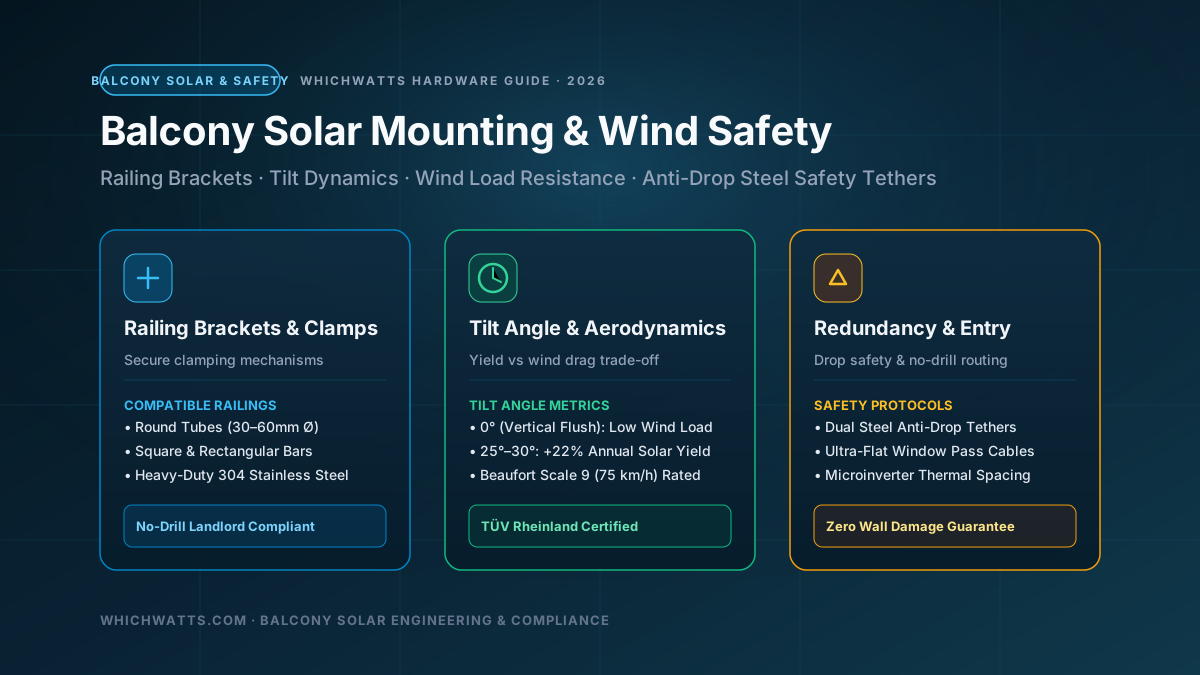
The government's impact assessment models a kit tilted at around 30° facing south at £110 a year, and a vertical wall or balcony fixing at £70 a year — from 690 kWh and 378 kWh of annual generation respectively. Mounting position is the biggest variable under your own control, and the figures, and the gap between them, are broken down here.
The paperwork: notify your DNO within 28 days
Once a compliant, type-tested kit is commissioned, the connection is a notification rather than an application: the owner or installer informs the distribution network operator and provides the commissioning information. G98 covers equipment up to and including 16A per phase — under 3.68kW — and National Grid's single-premises guidance states the deadline directly: notify the DNO within 28 days of commissioning.
Keep the commissioning details. Compliance remains the owner's responsibility, and the equipment has to be able to demonstrate that it meets the requirements.
Capturing what the house cannot use
The impact assessment's own numbers show the size of the opportunity. Of the 690 kWh a tilted kit generates, 428 kWh is modelled as used in the home, leaving 262 kWh a year that a battery could shift to the evening; for a vertical kit the equivalent surplus is 106 kWh of 378.
What that surplus is actually worth — and why no battery can exceed it — is covered in the balcony battery guide.
Sources and limits
- Electrical Safety First: plug-in solar panels — safety advice
- DESNZ, Plug-in solar: impact assessment
- Plug-in Solar Device Interim Product Specification, version 2
- National Grid: Micro-generation single (G98)
- ENA: Connecting generation to the electricity networks
This page reports published guidance and should not be read as electrical or legal advice. If you are unsure about your installation, the advice above is to have it assessed by a registered competent electrician.