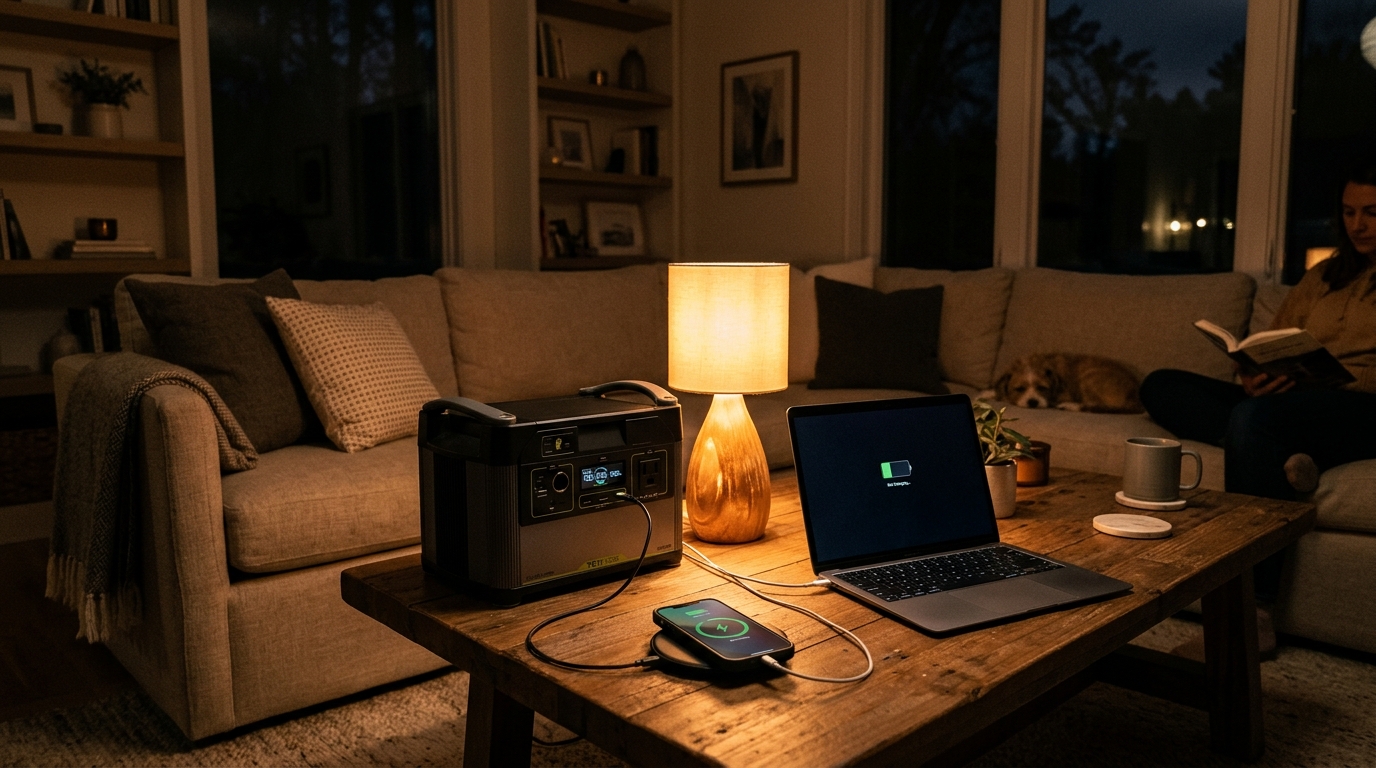
Direct answer: A pragmatic, no-nonsense blackout survival plan for everyday families. Learn why modern LiFePO4 battery power stations make petrol generators obsolete, how to budget power for 72 hours, and how to keep fridges, WiFi, and boilers running.
Editorial note: WhichWatts is an independent comparison site. Prices, availability, specifications, and retailer promotions change frequently. Check the live product table and retailer page before buying.
Prepping for Non-Preppers: The Pragmatic 72-Hour Blackout Survival Guide
When most people hear the word "prepper," they imagine camouflaged survivalists stocking nuclear fallout bunkers with decades of dehydrated rations and military gear.
For the average family, suburban homeowner, or remote professional, that subculture feels foreign, extreme, and completely disconnected from daily life.
Yet, real-world events over the past few winters—from severe named storms (such as Storm Arwen, Babet, and Henk) downing power lines across the UK, to winter freezes crippling regional US electrical grids, to localized substation transformer fires—have delivered an unmistakable wake-up call: our modern lives are 100% dependent on continuous electrical power, and the public grid is not infallible.
When the power cuts at 8:00 PM on a freezing November evening, you do not need a survival bunker. You need:
- Your WiFi and smartphones working so you can contact loved ones and receive emergency updates.
- Your kitchen fridge and freezer staying cold so £300+ of perishable groceries do not rot.
- Your gas central heating combi boiler running so your radiators prevent hypothermia and burst pipes.
- Clean, safe lighting so your children or elderly family members do not suffer dangerous falls in the dark.
This is practical emergency preparedness for normal people.
This comprehensive guide cuts through apocalyptic paranoia and outlines a rational, modern 72-hour blackout plan—anchored by clean, silent lithium (LiFePO4) portable power stations that require zero petrol, emit zero fumes, and operate completely safely inside your living room.
                    THE PRAGMATIC 72-HOUR HOME RESILIENCE PYRAMID

                               ▲  [ LEVEL 4: COMFORT & PRODUCTIVITY ]
                              / \  • Remote Work PC, Monitor & Coffee Machine
                             /   \ • Mini Air Fryer / Electric Hotplate Meals
                            /─────\
                           /       \  [ LEVEL 3: THERMAL PRESERVATION ]
                          /         \ • Gas Combi Boiler Circulation Pump & Ignition
                         /           \ • Heated Electric Blankets (45W - 65W)
                        /─────────────\
                       /               \  [ LEVEL 2: FOOD & HEALTH RESILIENCE ]
                      /                 \ • Refrigerator / Freezer Compressor Cycles
                     /                   \ • Medical Hardware: CPAP Machines, Monitors
                    /─────────────────────\
                   /                       \  [ LEVEL 1: SURVIVAL CORE (FIRST 24H) ]
                  /                         \ • Fibre ONT & WiFi Router (Continuous)
                 /                           \ • Smartphone & Torch Recharging
                /─────────────────────────────\ • 12 Litres Clean Drinking Water / Person
1. Why Modern Battery Power Stations Killed the Petrol Generator
For decades, the standard response to a blackout was buying a noisy, 5kW petrol generator from a hardware store. For the non-prepper, petrol generators present four massive friction points that often cause them to fail precisely when an emergency strikes:
| Feature / Consideration | Traditional Petrol / Gas Generator | Modern LiFePO4 Portable Power Station |
|---|---|---|
| Indoor Operation & Carbon Monoxide | ❌ Lethal indoors. Must run at least 20ft away from doors and windows due to deadly CO exhaust fumes. | ✅ 100% Zero Emissions. Completely safe to operate directly in your living room, bedroom, or kitchen. |
| Noise Profile | ❌ 75 dB to 95 dB. Sounds like a loud lawnmower, causing severe noise fatigue and advertising your backup power to the entire neighbourhood. | ✅ 0 dB to 35 dB. Whisper-quiet fan cooling; can sit on a desk or nightstand without waking a sleeping baby. |
| Fuel Storage & Shelf Life | ❌ Volatile fuel. Unleaded petrol goes stale in 3 to 6 months, gumming up carburetors unless stabilized and cycled regularly. | ✅ Zero fuel. Stored electrical energy ready at the push of a button; retains 80%+ charge for over 12 months in storage. |
| Maintenance & Servicing | ❌ Requires regular oil changes, spark plug replacements, pull-cord servicing, and carburetor cleanings. | ✅ Zero maintenance. Solid-state electronics with 3,000 to 4,000+ cycle LiFePO4 batteries (10+ year lifespan). |
| Electronics Safety (THD) | ⚠️ Cheap generators produce dirty modified sine waves (THD > 10%) that fry sensitive laptop and combi boiler motherboards. | ✅ Pure Sine Wave (THD < 3%). Cleaner and more stable electrical delivery than typical public utility mains. |
For suburban households and apartment dwellers without outdoor sheds, fuel storage permits, or mechanical maintenance hobbies, a portable battery generator like an EcoFlow DELTA 2 Max or Anker SOLIX C1000 transforms emergency prep from a stressful chore into a simple household appliance that you plug in and forget until you need it.
2. The 72-Hour Household Power Budget: What Do You Actually Need?
Most emergency planners recommend preparing for 72 hours (3 days). Why? Because across major Western power disruptions, regional emergency repair crews and distribution network operators (DNOs) typically restore 95% of grid substations within 48 to 72 hours.
To survive a 72-hour blackout comfortably, you do not need to power your electric induction hob, power shower, or tumble dryer. You simply need to budget for your Critical Life & Connectivity Loads:
| Household Appliance | Power Draw (Watts) | Daily Run Strategy | 24-Hour Energy Budget | 72-Hour Energy Budget |
|---|---|---|---|---|
| Fibre ONT & WiFi Router | 12W – 20W | Running continuously (24 hrs/day) | ~360 Wh | ~1,080 Wh |
| Smartphones & Tablets (Family of 4) | 15W per device | 1 full charge per person per day | ~160 Wh | ~480 Wh |
| Kitchen Refrigerator / Freezer | 60W – 100W (average cycling) | Compressor cycles on/off ~35% of time | ~750 Wh | ~2,250 Wh |
| Gas Combi Boiler (Circulation Pump) | 90W – 130W | 30 mins every 2 hours to keep home warm | ~450 Wh | ~1,350 Wh |
| Living Room LED Floor Lamp / Lantern | 8W – 12W | 5 hours evening lighting | ~50 Wh | ~150 Wh |
| Work Laptop & Monitor | 45W – 80W | 4 hours remote work / emergency comms | ~240 Wh | ~720 Wh |
| Total Baseline Daily Energy Requirement | — | — | ~2,010 Wh / Day | ~6,030 Wh (3 Days) |
Daily Energy Allocation (2,010 Wh Total):
┌────────────────────────────────────────────────────────┐
│ Refrigerator / Food Cold Chain: 750 Wh (37.3%)         │
│ Heating (Combi Boiler Cycling): 450 Wh (22.4%)         │
│ WiFi Router & Continuous Comms: 360 Wh (17.9%)         │
│ Laptop & Telework:             240 Wh (11.9%)         │
│ Mobile Device Charging:        160 Wh (8.0%)          │
│ LED Evening Lighting:           50 Wh (2.5%)          │
└────────────────────────────────────────────────────────┘
Sizing Your Battery Solution:
- The 1kWh Tier (Basic 24-Hour Lifeline): A 1,000Wh battery—such as the Anker SOLIX C1000 or Jackery Explorer 1000 v2—handles a full day of fridge cycling, phones, lighting, and WiFi, or multiple days of pure comms and lighting.
- The 2kWh Tier (The Sweet Spot for 48–72 Hours): A 2,000Wh battery—such as the EcoFlow DELTA 2 Max or Bluetti AC200L—provides a massive safety buffer. By duty-cycling your fridge (plugging it in for 45 minutes every 2 hours) and running your combi boiler in bursts, a single 2kWh unit comfortably stretches across 48 to 72 hours.
- The Expandable 4kWh–6kWh Tier (True Whole-House Comfort): Units like the EcoFlow DELTA Pro series or Bluetti AC300/AC500 with expansion batteries allow full continuous operation without rationing, even running small microwave ovens and electric kettles.
3. The Non-Prepper’s Five Pillars of Household Resilience
Electricity is vital, but true emergency readiness rests on four accompanying pillars: Water, Food, Warmth, and Comms. Here is the zero-fuss, non-fanatical approach to each:
Pillar 1: Water (3 Litres per Person per Day)
You do not need 55-gallon blue drums cluttering your garage.
- Buy two 12-litre BPA-free water containers with spigots or store three 6-packs of 2L mineral water bottles in the bottom of your pantry.
- Keep a simple gravity water filter (like a LifeStraw or Sawyer Mini) in your cupboard. If municipal water pressure drops or a boil-water notice is issued, you can filter tap water safely.
Pillar 2: Food (Pantry Rotation, Not Military Rations)
Skip the overpriced "30-Day Survival Buckets" of freeze-dried powdered stew.
- Instead, adopt the "Store What You Eat, Eat What You Store" method.
- Simply keep an extra two-week buffer of standard canned goods, pasta, rice, jarred sauces, tinned tuna, peanut butter, and ready-to-eat soups.
- Ensure you have a manual, non-electric can opener.
Pillar 3: Warmth (Without Relying on Open Flames)
During winter power cuts, indoor temperature drops fast.
- If you have a gas central heating combi boiler, you can power its electrical pump via your power station (using a dedicated fused spur lead or transfer switch). A modern gas boiler uses less than 120W of electricity to generate 24kW of heat!
- For targeted warmth, use Low-Wattage 12V / 230V Electric Heated Blankets (drawing only 45W–60W). Heating a person under a blanket consumes 95% less battery energy than attempting to heat an entire room with a 2,000W space heater.
Pillar 4: Lighting (Ditch Dangerous Wax Candles)
- Never use wax candles. Open flames are the leading cause of residential house fires during storm blackouts.
- Keep two rechargeable LED lanterns (such as the camping lights built into the Anker SOLIX C800 Plus) and a couple of USB-rechargeable headlamps. Headlamps keep your hands completely free to cook or care for kids.
Pillar 5: Communications & Cash
- Download offline maps of your local area on Google Maps or Apple Maps ahead of severe weather forecasts.
- Keep £100 to £200 in small cash notes in an envelope. During widespread regional power outages, chip-and-pin card readers and ATM networks fail instantly; cash is the only payment method grocery stores and corner shops can accept.
4. Top Recommended Portable Power Stations for Pragmatic Home Backup
Here are the best tested portable power stations in 2026 for everyday homeowners seeking reliable emergency backup without technical headaches:
1. Best Overall 2kWh Workhorse: EcoFlow DELTA 2 Max
- Capacity: 2,048 Wh (expandable up to 6,144 Wh with smart extra batteries)
- AC Output: 2,400W pure sine wave (4,800W surge)
- Chemistry & Longevity: LiFePO4 cells rated for 3,000+ full cycles (10 years of daily use)
- Recharge Speed: 0% to 80% in just 43 minutes via AC mains
- Why It Wins: Exceptional app control, ultra-fast charging when grid power briefly flickers back on, and enough continuous inverter capacity to run heavy kitchen appliances, fridges, and combi boilers effortlessly.
- 👉 Check Live Price on EcoFlow | Compare $/Wh Rankings
2. Best Heavy-Duty Value: Bluetti AC200L
- Capacity: 2,048 Wh (expandable to 8,192 Wh with B300 packs)
- AC Output: 2,400W continuous (Power-lifting mode up to 3,600W)
- Port Selection: 4x 230V AC sockets, 1x 48V/8A DC expansion port, 100W USB-C PD
- Why It Wins: Built like an industrial tank with whisper-quiet low-draw fan profiles. Handles harsh inductive motor surges from older chest freezers and sump pumps without breaking a sweat.
- 👉 Check Live Price on Bluetti | Read Sizing Guide
3. Best Compact 1kWh Family Unit: Anker SOLIX C1000
- Capacity: 1,056 Wh (expandable to 2,112 Wh)
- AC Output: 1,800W pure sine wave (2,400W SurgePad)
- Weight: 12.9 kg (compact enough to be carried with one hand)
- Why It Wins: Ultra-compact footprint fits neatly in a kitchen cupboard or home office. Features hyper-fast 58-minute AC charging and an industry-leading 5-year full manufacturer warranty.
- 👉 Check Live Price on Anker | View Home Office UPS Guide
4. Best Grab-and-Go Emergency Option: Jackery Explorer 1000 v2
- Capacity: 1,070 Wh
- AC Output: 1,500W pure sine wave
- Weight: 10.8 kg
- Why It Wins: Streamlined, clutter-free physical interface with no confusing menu trees. Push one button, and power flows. Outstanding for less tech-savvy family members.
- 👉 Check Live Price on Jackery
5. Recharging Strategies: What Happens After 72 Hours?
If a major weather event knocks out power for 4 to 6 days, how do you recharge your battery station without utility mains?
                               THREE RECHARGE PATHS

[ Foldable 200W-400W Solar Panels ] ──> Free daylight sun (4 to 6 hrs in clear weather)
[ Vehicle 12V Port / EV V2L Port  ] ──> Car alternator or EV battery (100W to 3,000W)
[ Rapid Top-Up at Neighbor's AC   ] ──> 0 to 80% in 50 minutes at an unaffected area
- Foldable 200W–400W Solar Panels: The cleanest, most self-sufficient recharge method. Modern bifacial folding solar panels (from brands like EcoFlow, Bluetti, and Anker) fold into a briefcase. If the storm clears and sun emerges, set them up on your patio or lawn to inject 150W to 350W of continuous free power directly back into your battery.
- Car Cigarette Lighter (12V / 10A DC): Every portable power station includes a 12V car charging cable. While slow (supplying ~100W to 120W), running your car engine during an essential grocery run can inject 200Wh to 300Wh of top-up power back into the battery.
- EV Vehicle-to-Load (V2L): If you drive an electric car with V2L (such as a Hyundai Ioniq 5/6, Kia EV6, MG4, or Ford F-150 Lightning), you have a massive 60kWh to 90kWh battery on your driveway. You can plug your portable power station into the car's 3-pin V2L socket and recharge it to 100% in under an hour.
- Opportunistic AC Top-Up: Unlike a 50kg petrol generator, a 12kg portable battery station can be tossed into your car boot and recharged at a friend's house, an open workplace, or an unaffected public community centre in just 50 to 60 minutes.
6. The 15-Minute Maintenance Routine (Set It & Forget It)
The beauty of modern Lithium Iron Phosphate (LiFePO4) chemistry is its remarkable charge retention. You do not need to obsess over your gear every weekend. Follow this simple twice-yearly routine:
- Check Battery Level Twice a Year: When the clocks change in spring and autumn, plug your power station in and verify it is between 80% and 90% charge. LiFePO4 cells lose less than 1% to 2% of charge per month in room-temperature storage.
- Store in Temperate Living Spaces: Never store lithium batteries in an uninsulated, freezing garden shed or damp cellar. Keep the unit in a hallway cupboard, utility room, or under your bed where temperatures remain between 10°C and 25°C.
- Verify Cable Storage: Keep all necessary cables—your 3-pin AC kettle lead, USB-C phone cables, and a heavy-duty 5m extension reel—stored inside the unit's travel bag or neatly taped to the top handle. In pitch darkness, you do not want to go rummaging through random junk drawers for a phone lead.
Helpful Next Steps & Tools
- Estimate your exact household runtime with our interactive Power Station Sizing Calculator.
- Calculate solar replenishment potential with our Solar Harvest & Panel Calculator.
- Review current battery pricing, discount codes, and £/Wh rankings in our Live Price Comparison Table.
- Explore our detailed winter heating strategy in the Winter Power Cut Preparedness Guide.
- Considering connecting directly to your breaker box? Read our Manual Transfer Switch Installation Guide.
Frequently Asked Questions
How long will a 2,000Wh power station keep my fridge running?
A modern domestic A-rated or B-rated combi fridge-freezer consumes between 600Wh and 900Wh over a 24-hour period. Because a refrigerator compressor only runs for 15 to 25 minutes each hour, a 2,000Wh battery station (like the EcoFlow DELTA 2 Max or Bluetti AC200L) will power your fridge continuously for 2 to 3 days. If you practice "duty cycling"—turning the fridge on for 45 minutes every 2 hours—you can stretch this runtime to 4 to 5 days while keeping food below the 4°C food-safety threshold.
Is it really safe to run a portable power station indoors?
Yes, 100%. Portable power stations use chemical battery cells (LiFePO4) connected to solid-state digital inverters. They do not combust fuel, generate zero exhaust gases, emit zero carbon monoxide, and produce no sparks. They are just as safe to operate in your living room or bedroom as a laptop or cordless vacuum cleaner.
Can a portable battery station power an electric kettle or microwave?
Yes, provided the power station's inverter is rated for at least 1,800W to 2,400W continuous output. A standard domestic electric kettle draws roughly 2,000W to 3,000W; however, boiling a mug of water takes only 90 seconds, consuming a mere 35Wh of energy. Alternatively, low-wattage 800W travel kettles or 700W microwave ovens run smoothly on compact 1kWh power stations.
Why shouldn't I just buy a cheap petrol generator instead?
While a cheap petrol generator has a lower initial purchase price, its total cost of ownership and friction are much higher: you must store volatile, hazardous petrol in approved jerrycans, rotate the fuel every 3 to 6 months before it varnishes, service engine oil and spark plugs, and run long extension cords through open windows (letting in freezing winter air). Most critically, petrol generators produce deadly carbon monoxide and cannot be used by renters or apartment dwellers. A LiFePO4 battery station requires zero fuel, zero servicing, runs silently inside, and lasts for over 10 years.