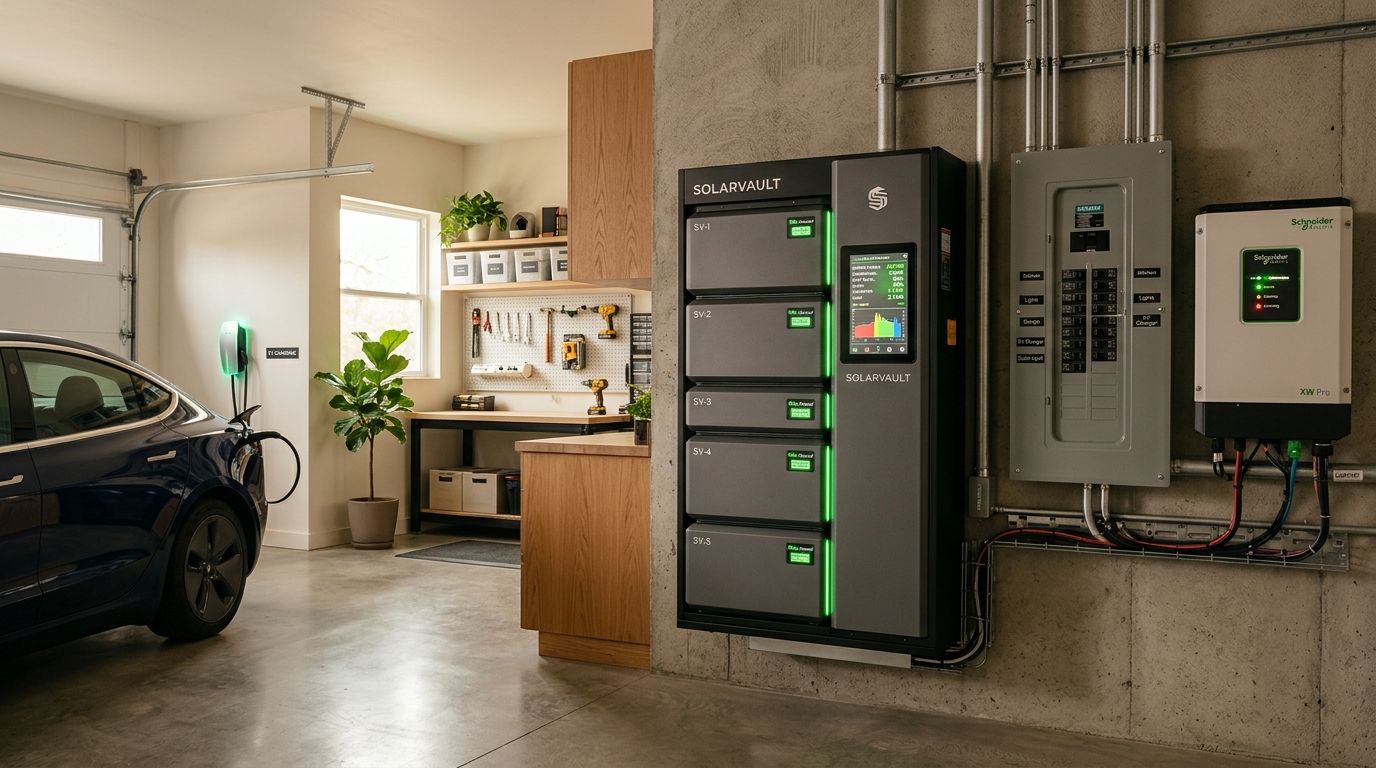
Direct answer: Discover how much battery storage your specific home actually needs. Realistic blackout sizing blueprints for 1-2 bed flats, 3-4 bed suburban semis, and large detached family homes.
Editorial note: WhichWatts is an independent comparison site. Prices, availability, specifications, and retailer promotions change frequently. Check the live product table and retailer page before buying.
Backup Power Sizing by Property Type: Flats vs Semi-Detached vs Large Family Houses
When power grid emergencies strike, the energy requirements of a 1-bedroom city flat are radically different from a 3-bedroom suburban semi-detached house or a 5-bedroom detached rural property.
One size does not fit all:
- An urban apartment tenant cannot store a heavy 80kg battery cabinet, cannot drill exterior walls, and primarily needs to protect communications, small refrigeration, and low-wattage cooking.
- A suburban family in a semi-detached house needs to keep a gas combi boiler running to prevent radiators from freezing, keep a tall family fridge-freezer cold, and power home office networks.
- A large detached home or multi-generational property often features multiple refrigeration units, electric induction cooking, medical hardware, and potentially high-draw basement sump pumps.
This guide provides tailored, real-world sizing blueprints by property type, detailing realistic energy budgets, inverter thresholds, physical footprint constraints, and recommended hardware configurations for each home profile in 2026.
                       PROPERTY SIZING SPECTRUM (2026)

   [ PROFILE A: APARTMENTS & FLATS ]
   • Capacity: 768Wh - 1,056Wh | Inverter: 1,000W - 1,800W
   • Weight: 8kg - 13kg (Compact Grab-and-Go)
   • Core: WiFi, Phones, Apartment Fridge, Induction Plate

   [ PROFILE B: 3-4 BED SEMI-DETACHED SUBURBAN HOME ]
   • Capacity: 2,048Wh - 4,096Wh | Inverter: 2,000W - 2,400W
   • Weight: 22kg - 45kg (Wheeled / Modular)
   • Core: Combi Boiler Central Heating, Family Fridge, Microwave, Telework

   [ PROFILE C: LARGE DETACHED & MULTI-GENERATIONAL ESTATE ]
   • Capacity: 6,000Wh - 15,000Wh | Inverter: 4,000W - 6,000W
   • Weight: 50kg - 100kg+ (Heavy-Duty / Split-Phase MTS Integration)
   • Core: Whole-House Critical Panel, Sump Pump, Multiple Freezers, Medical
Profile A: 1 to 2 Bedroom City Flats & Apartments
The Environmental Constraints:
Apartment dwellers and flat tenants have strict physical and legal boundaries:
- Zero Petrol / Fumes Permitted: Combustion generators are strictly prohibited.
- Limited Storage Space: Hardware must stow under a kitchen counter, inside a wardrobe, or beneath a home office desk.
- Portability: If an evacuation is ordered, a single person must be able to carry the unit down several flights of stairs.
The 24–48 Hour Energy Budget:
| Essential Appliance | Running Watts | Daily Hours | Daily Energy (Wh) |
|---|---|---|---|
| Apartment Under-Counter Fridge | 50W | 7 hours (30% duty cycle) | 350 Wh |
| Fibre Router & ONT | 12W | 24 hours (continuous) | 288 Wh |
| Smartphones & Tablets (x2) | 20W | 2 hours | 40 Wh |
| Single-Burner Induction Hob | 700W | 15 mins (heating soup/water) | 175 Wh |
| LED Desk Lamp / Reading Light | 8W | 5 hours | 40 Wh |
| Total Daily Energy Requirement | — | — | ~893 Wh / Day |
Recommended Hardware & Configuration:
- Target Battery Size: 768Wh to 1,056Wh
- Target Inverter Limit: 1,000W to 1,800W pure sine wave
- Top Picks:
- Anker SOLIX C1000 (1,056Wh, 1,800W AC, 12.9kg, hyper-fast 58-minute recharge).
- Bluetti AC70 (768Wh, 1,000W AC with 2,000W power lifting, compact cube).
- EcoFlow River 2 Pro (768Wh, ultra-light 7.8kg, excellent grab-and-go portability).
Profile B: 3 to 4 Bedroom Semi-Detached Suburban Family Homes
The Environmental Constraints:
The classic suburban semi-detached home houses a family of 3 to 5 people:
- Central Heating Is Mandatory: When winter storms hit, radiators must circulate hot water from the gas combi boiler to protect children and prevent burst water pipes.
- Large Cold Storage: A tall 70/30 family fridge-freezer holds hundreds of pounds worth of family food that cannot be allowed to thaw.
- Dual Telework Demands: Both parents may need to maintain laptops, monitors, and WiFi connectivity for remote employment during regional disruptions.
The 48–72 Hour Energy Budget:
| Essential Appliance | Running Watts | Daily Hours | Daily Energy (Wh) |
|---|---|---|---|
| Tall Family Fridge-Freezer | 85W | 8 hours (33% duty cycle) | 680 Wh |
| Gas Combi Boiler (Pump & Ignition) | 110W | 5 hours (intermittent morning/evening) | 550 Wh |
| Fibre WiFi Hub & Powerline Adapters | 20W | 24 hours | 480 Wh |
| Smartphones & Tablets (x4) | 40W | 3 hours | 120 Wh |
| Work Laptops & Monitors (x2) | 120W | 6 hours | 720 Wh |
| Living Room LED Lighting | 25W | 5 hours | 125 Wh |
| 700W Microwave (Reheating meals) | 1,000W input | 10 mins | 166 Wh |
| Total Daily Energy Requirement | — | — | ~2,841 Wh / Day |
Sizing Strategy: The Base + Expansion Module Approach:
A single 2kWh battery covers 24 to 36 hours. To achieve true 72-hour resilience without rationing, pair a 2kWh base power station with one modular plug-in expansion battery:
$$\text{Total Capacity} = 2,048\text{Wh Base} + 2,048\text{Wh Extra Battery} = \mathbf{4,096\text{Wh Total Storage}}$$
Recommended Hardware & Configuration:
- Target Battery Size: 2,048Wh (expandable up to 4kWh–6kWh)
- Target Inverter Limit: 2,400W continuous pure sine wave
- Top Picks:
- EcoFlow DELTA 2 Max + Extra Battery (4,096Wh combined, 2,400W AC, fast 80-minute recharge, whisper-quiet low load noise).
- Bluetti AC200L + B300 Expansion (5,120Wh combined, 2,400W continuous, commercial-grade LFP cells).
Profile C: Large Detached, Multi-Generational & Rural Homesteads
The Environmental Constraints:
Large detached homes (2,500+ sq ft) present complex electrical demands:
- Subpanel or Transfer Switch Integration: Running loose extension cables across 5 bedrooms is impractical. Homeowners prefer connecting directly to the consumer unit via a manual transfer switch (MTS).
- Secondary Freezers & Utility Pumps: Often feature an additional chest freezer in the garage, a basement sump pump to prevent flooding, and electric driveway gates.
- High Inverter Demands: Must handle simultaneous inductive surges from multiple motors without tripping.
The 72-Hour Energy Budget:
| Essential Appliance | Running Watts | Daily Hours | Daily Energy (Wh) |
|---|---|---|---|
| Primary American-Style Fridge-Freezer | 120W | 8 hours (cycling) | 960 Wh |
| Garage Chest Freezer | 90W | 6 hours (cycling) | 540 Wh |
| Gas/Oil Central Heating Controls & Pumps | 140W | 6 hours | 840 Wh |
| Basement Sump Pump (Storm cycles) | 700W | 1.5 hours total (cycling) | 1,050 Wh |
| Whole-Home Network / Mesh WiFi / PoE Cameras | 45W | 24 hours | 1,080 Wh |
| Family Phones, Tablets & 3x Laptops | 150W | 4 hours | 600 Wh |
| Kitchen Air Fryer or Instant Pot Meal | 1,400W | 20 mins | 466 Wh |
| Ground Floor LED Downlights | 60W | 5 hours | 300 Wh |
| Total Daily Energy Requirement | — | — | ~5,836 Wh / Day |
Sizing Strategy: Heavy-Duty Modular Home Power
For a large detached home, standard 1kWh–2kWh units are insufficient. Homeowners require heavy commercial-grade systems featuring 4,000W to 6,000W inverters and 6kWh to 15kWh of modular LiFePO4 storage, paired with a generator inlet Commando socket.
Recommended Hardware & Configuration:
- Target Battery Size: 6,000Wh to 12,000Wh
- Target Inverter Limit: 4,000W to 6,000W (with 120V/240V split-phase capability)
- Top Picks:
- EcoFlow DELTA Pro 3 (4,096Wh base expandable to 48kWh, 4,000W continuous pure sine wave, 120V/240V dual-voltage output, dedicated 30A Commando transfer switch port).
- Anker SOLIX F3800 (3,840Wh base expandable to 26.9kWh, built-in 6,000W AC inverter, native EV charging support, integrated transfer switch compatibility).
Property Type Comparison Matrix
| Property Profile | Typical Floor Area | Recommended Capacity | Recommended Inverter | Transfer Switch Ready? | Estimated System Cost |
|---|---|---|---|---|---|
| 1–2 Bed Flat | 450 – 850 sq ft | 768Wh – 1,056Wh | 1,000W – 1,800W | No (Extension cords only) | £399 – £699 |
| 3–4 Bed Semi | 1,100 – 1,800 sq ft | 2,048Wh – 4,096Wh | 2,400W | Optional (Inlet or cords) | £1,099 – £2,199 |
| Large Detached | 2,200 – 4,500+ sq ft | 6,000Wh – 12,000Wh | 4,000W – 6,000W | ✅ Highly Recommended | £3,200 – £6,500+ |
Helpful Next Steps & Tools
- Model your custom household energy audit with our Power Station Sizing Calculator.
- Calculate solar replenishment potential with our Solar Harvest & Panel Calculator.
- Review current battery pricing, discount codes, and £/Wh rankings in our Live Price Comparison Table.
- Explore our dedicated Apartment Blackout Guide.
- Connect your battery to your breaker panel with our Manual Transfer Switch Guide.
Frequently Asked Questions
Can I place a high-capacity power station in a cold uninsulated garage?
While LiFePO4 batteries can safely discharge power in temperatures down to -20°C, you must never charge standard lithium batteries below 0°C (32°F). Charging frozen lithium cells causes permanent lithium plating and short circuits. If you keep your power station in an unheated garage, select models with built-in internal PTC heating pads (such as the EcoFlow DELTA Pro 3 or Anker F3800) or keep the unit inside the insulated house envelope.
Should I buy one large 4kWh unit or two 2kWh units?
If you live in a multi-storey house, two modular 2kWh units offer much greater physical flexibility: you can keep one upstairs to power home office gear and lighting, while placing the second unit in the kitchen to power the fridge and combi boiler. However, if you plan to connect your backup power directly into your home's consumer unit via a manual transfer switch, a single centralized large unit is far more convenient.
How much money do I save on electricity bills by having a home battery?
If you enroll in dynamic time-of-use tariffs (such as Octopus Agile or Economy 7 in the UK), you can schedule your power station to charge from the mains at 3:00 AM when electricity is cheap (e.g. 7p to 12p per kWh) and discharge during peak evening hours (4:00 PM to 8:00 PM when electricity costs 30p+ per kWh). Cycling a 4kWh battery daily can save between £280 and £420 per year on peak energy costs, helping offset the initial purchase price.