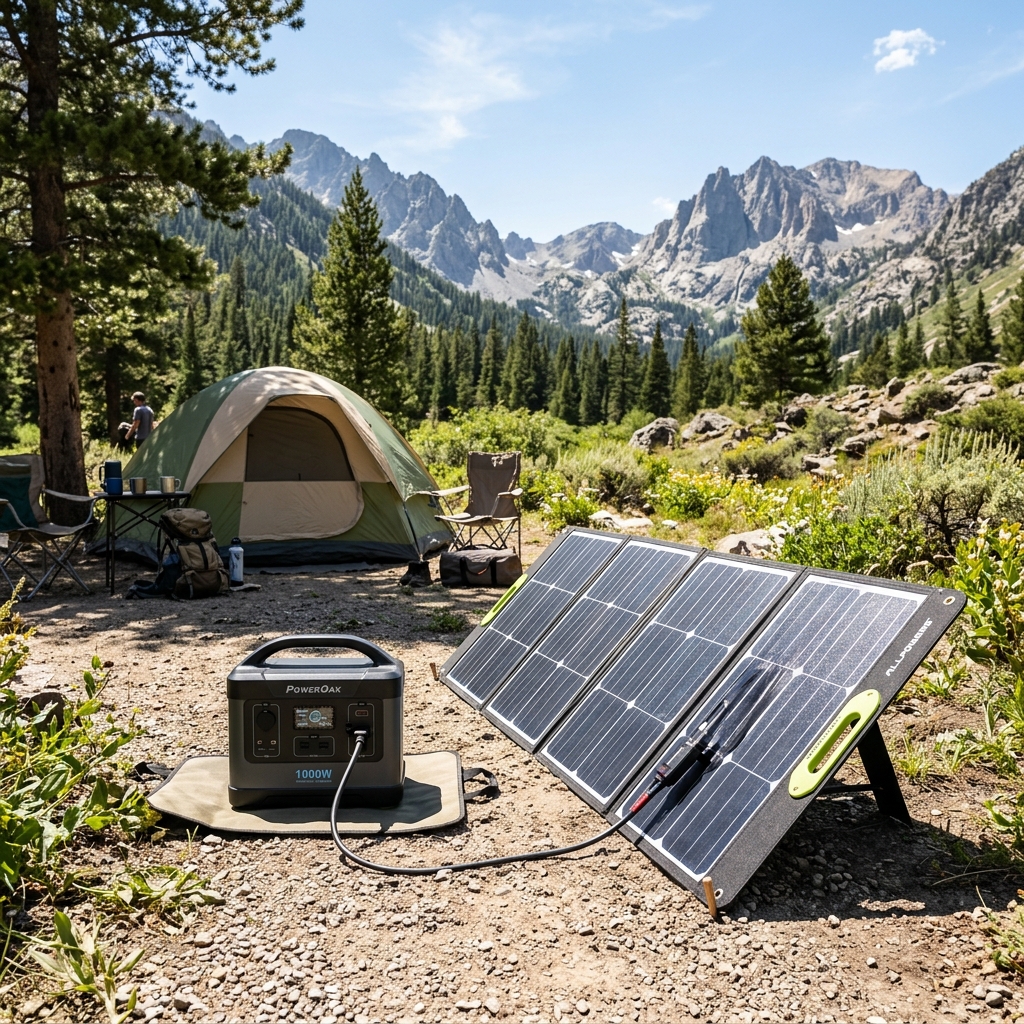
Direct answer: Match a 1000-watt output and solar input to your loads, panels, and recharge window before buying a bundle.
Editorial note: WhichWatts is an independent comparison site. Prices, availability, specifications, and retailer promotions change frequently. Check the live product table and retailer page before buying.
1000-Watt Portable Power Stations with Solar Charging
A 1000-watt label usually describes the inverter's continuous AC output, but it says nothing about how much energy the battery stores or how fast the sun can refill it. A station with 1000W output and a small battery can run a heater for a short burst and then need a long recharge, while a larger battery with a modest solar input can take all day to recover. Understanding the three separate numbers is the difference between a useful setup and an expensive frustration.
Output, storage, and solar input are three different numbers
| Spec | What it tells you | Common confusion |
|---|---|---|
| Continuous output (W) | Sustained watts the inverter can supply | Not the peak or surge rating |
| Capacity (Wh) | Stored energy, and therefore runtime | Advertised, not necessarily delivered at the AC outlet |
| Solar input (W) | Maximum watts the controller accepts | Limited by panel voltage, current, and range |
Matching panels to the station means checking the voltage and current limits of the charge controller, not simply adding up the panel wattage number on the box. A panel string that exceeds the input voltage ceiling can be unsafe, while panels that under-deliver will make recharge times far longer than the marketing image suggests.
A practical sizing sequence
- List the appliances, their running watts, and their startup surge.
- Confirm the station's continuous output has headroom above the largest load you will run at once.
- Estimate daily watt-hours and the realistic daylight available at your location and season.
- Compare the solar input limit with the panels you can actually deploy, then estimate recharge time.
- Verify the exact panel and connector compatibility from the manual before ordering a bundle.
Think in days, not just in watts
A 1000W station can feel powerful for a short time, but off-grid value comes from how the energy budget closes over a full day. If you use 800Wh daily and the solar input only recovers 300Wh on a cloudy day, the battery slowly runs down no matter how capable the inverter looks. Budget for poor weather and decide what you will do on the worst day, not the best one.
Bottom line
Use the solar calculator to test a panel scenario, the power station calculator for the battery budget, and the comparison chart to sort current models by cost per watt-hour. Confirm the exact output, capacity, and solar input from the manufacturer page before buying, and treat bundled panels as a claim to verify rather than a solved pairing.