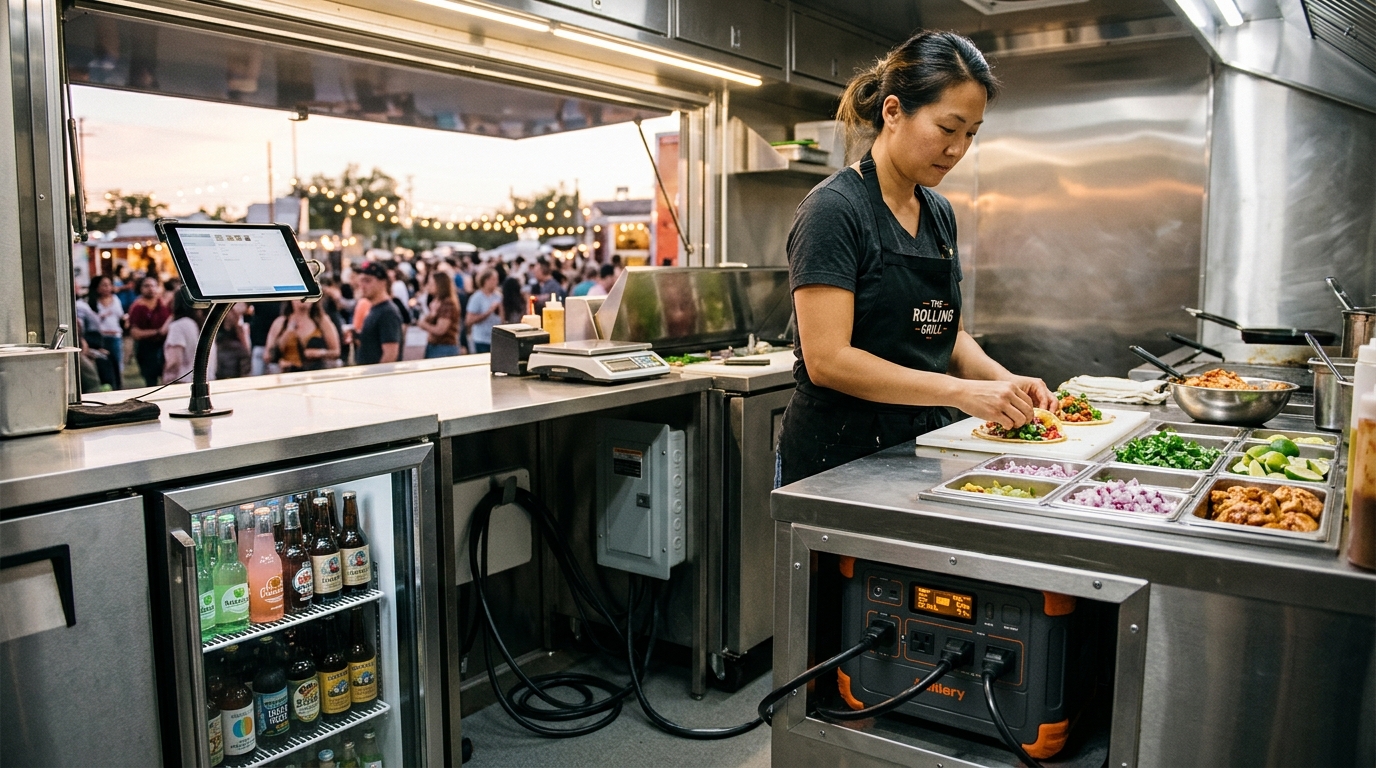
Direct answer: Can a battery replace the generator on a food truck? Audit the real service-day load, allow for fridge and fan surge, and see where cooking appliances push you back to propane or a much larger bank.
Editorial note: WhichWatts is an independent comparison site. Prices, availability, specifications, and retailer promotions change frequently. Check the live product table and retailer page before buying.
Powering a Food Truck with a Portable Power Station: A Service-Day Sizing Guide
A food truck is one of the hardest mobile electrical loads to run from a battery, not because the technology is weak, but because the menu decides everything. A trailer selling coffee, pastries and cold drinks has a very different load profile from one running a griddle, a fryer and a commercial espresso machine at the same time.
That distinction matters before you spend anything. A portable power station can remove generator noise and fumes from the service window, but only for the loads it can actually start and carry. This guide separates the two, builds a realistic eight-hour audit, and shows where the battery stops being the right tool.
What a Power Station Can and Cannot Run
Food truck loads fall into two groups:
- Service loads: fridges, freezers, LED lighting, exhaust fans, water pumps, card terminals, tablets, a small espresso machine or kettle. These run for hours at modest wattage, which is exactly what a battery is good at.
- Cooking loads: griddles, fryers, induction hobs, ovens and warming drawers. These draw 1,500W to 3,500W each while they are on, and often run for hours. That is an energy problem as much as a power problem.
| Load | Typical running draw | Startup surge | Practical on a battery? |
|---|---|---|---|
| LED lighting | 30–80W | None | Yes |
| POS tablet and card reader | 10–30W | None | Yes |
| Display fridge | 100–200W | 2–3× running | Yes, with output headroom |
| Chest freezer | 80–150W | 2–3× running | Yes, with output headroom |
| Exhaust fan | 100–300W | 2–3× running | Yes |
| Water pump | 50–150W | 2–3× running | Yes |
| Espresso machine | 1,200–2,000W | Low | Only with enough continuous output |
| Kettle | 1,500–2,000W | None | Per boil, not continuously |
| Griddle or hot plate | 1,500–3,000W | None | Usually no |
| Fryer | 2,000–3,000W | None | Usually no |
| Induction hob | 1,800–3,500W | None | Usually no |
The figures are typical ranges, not guarantees. Read the nameplate on your own appliances: a "2,000W" griddle may draw more, and a fridge's locked-rotor surge can be several times its running wattage for a second or two.
Watts and Watt-Hours Are Two Different Tests
A power station has to pass both:
- Continuous output (W) must exceed the total running wattage of everything switched on at once, plus enough surge capacity to start the largest motor. If two fridges, an exhaust fan, lights and a kettle add up to 2,300W, a 1,800W station will trip even if its battery is full.
- Capacity (Wh) determines how long that load can run. A 5,000Wh station with a 1,000W inverter still cannot run a 2,000W griddle.
Most 2kWh to 5kWh portable stations offer roughly 1,800W to 3,600W of continuous AC output, with higher surge ratings. Larger expandable systems reach 6,000W or more. Check the voltage too: a 120V station is not a substitute for a 240V appliance, and plug adapters do not change that.
Build an Eight-Hour Load Audit
Start with what actually runs during a service, not with the biggest appliance on the truck. The table below is an example for a small trailer doing coffee, cold food and light cooking. Duty cycle is the share of the service the appliance is actually drawing power.
| Load | Running W | Hours on | Duty cycle | Energy (Wh) |
|---|---|---|---|---|
| Prep fridge | 120 | 8 | 50% | 480 |
| Drinks fridge | 80 | 8 | 40% | 256 |
| LED lighting | 50 | 8 | 100% | 400 |
| Exhaust fan | 100 | 8 | 100% | 800 |
| Water pump | 60 | 2 | 100% | 120 |
| POS and card reader | 25 | 8 | 100% | 200 |
| Kettle | 1,800 | 0.5 | 100% | 900 |
| Total | 3,156Wh |
That is the energy delivered to the appliances. The battery has to store more than that, because the inverter loses energy as heat and a lithium pack should not be run to absolute zero.
Apply the Runtime Formula and a Buffer
Use this as a working estimate:
Usable energy = rated Wh × inverter efficiency × usable depth of discharge
For a LiFePO4 station, assume about 0.85 for the inverter and 0.9 for usable capacity, giving roughly 0.765. To deliver the 3,156Wh above:
3,156 ÷ 0.765 = about 4,126Wh of rated capacity
Then add a reserve for cold weather, battery ageing and the fact that duty cycles vary:
4,126 × 1.2 = about 4,950Wh
So this trailer needs roughly a 5kWh station, or two smaller units, to finish an eight-hour service without recharging. A 2kWh unit is not "close enough"; it would run out before the lunch rush ended.
The same formula works in reverse for runtime. A 5,000Wh station carrying a 400W average load gives:
5,000 × 0.765 ÷ 400 = about 9.5 hours
Cooking Is the Line Item That Changes Everything
Add one griddle to the audit and the answer changes by an order of magnitude. A 1,800W griddle running four hours uses 7,200Wh. A 2,500W fryer running three hours uses 7,500Wh. Run both across a service and you are at 14.7kWh before fridges, lights or coffee are counted.
That is why most food trucks with a full cooking line still use propane for heat and a generator or shore power for the rest. A 19kWh to 20kWh lithium bank can be built from expandable stations, but it is heavy, expensive, slow to recharge and usually needs a fixed inverter and transfer switch rather than a wheeled unit.
If you want to move cooking onto electricity, do it deliberately: one low-power induction hob at a time, a strict duty cycle, and a bank sized from measured energy use rather than the nameplate. Do not assume a 3,600W station can run a 3,000W fryer just because the numbers are close; continuous ratings, derating in heat, and simultaneous loads all eat into that margin.
Sizing Tiers for Food Trucks
| Station size | What it realistically covers | Recommended models | Typical use |
|---|---|---|---|
| 1–2kWh | Lights, card reader, phone, small fan, no fridge | Anker SOLIX C1000 (1,056Wh), EcoFlow DELTA 2 Max (2,048Wh) | Card-only trailer, prep vehicle, very short pitches |
| 3–5kWh | Fridges, display chiller, exhaust fan, water pump, small espresso | EcoFlow DELTA Pro (3,600Wh / 3,600W), Anker SOLIX F3800 (3,840Wh / 6,000W), Bluetti AC300 + B300S (3,072Wh) | Coffee & cold-food trailer, juice bar, dessert trailer |
| 6–10kWh | Service loads plus light induction heating, panini grills or warmers | EcoFlow DELTA Pro Ultra (6kWh–12kWh), Bluetti AC500 + 2× B300S (6,144Wh), Pecron E3600LFP + EP3800-48V (6,912Wh) | Larger commercial food trailer, double battery bank |
| 12kWh+ | Heavy commercial cooking (electric fryers, continuous griddles) | Custom dual Anker F3800 setup or fixed commercial lithium bank | Heavy culinary kitchen (propane strongly recommended for heat) |
Top Recommended Power Stations for Food Trailers
Choosing commercial equipment means looking for three specific specs: continuous output above 3,000W, rapid AC charging under 2.5 hours, and rugged wheels or modular stacking. These four systems lead the commercial mobile food market:
- EcoFlow DELTA Pro & DELTA Pro 3 (3,600Wh – 7,200Wh): The industry benchmark for mobile caterers. Delivers 3,600W continuous output (surge to 7,200W) to handle compressor spikes from commercial refrigeration and exhaust hoods without tripping. Features luggage-style wheels for rolling into commissary kitchens for fast 1,800W–3,000W AC recharging.
- Anker SOLIX F3800 (3,840Wh / 6,000W output): The powerhouse choice for high-draw trailers. Its massive 6,000W pure sine wave inverter can run a commercial refrigeration bank, water heater, and exhaust fan simultaneously. Features a direct 32A/EV power outlet for seamless integration with a transfer switch.
- Bluetti AC300 & AC500 Modular Systems (3,072Wh – 18,432Wh): Ideal for balancing trailer weight distribution. The heavy battery modules (B300 / B300S) separate from the inverter head unit, allowing you to secure battery weight low over the trailer axles.
- Pecron E3600LFP & F3000LFP (3,072Wh / 3,600W): Excellent cost-per-watt-hour value for independent food traders on a tight setup budget. Delivers heavy-duty commercial wattage at some of the lowest $/Wh ratios in the industry.
Recharging Between Services
A battery only solves half the problem; the other half is getting it full before the next service.
- Shore power at the commissary is the most reliable option. A 3kWh station with a 1,800W charger needs about 1.7 hours at full rate, or 2 to 2.5 hours in practice once the charge taper is counted.
- Solar is a top-up, not a primary source for a food truck. A 400W panel might deliver 1.2kWh to 1.6kWh on a good day, which covers a fridge and lights but not a 5kWh service day.
- Alternator charging through a 12V socket is limited to roughly 100W to 200W. A dedicated DC-to-DC charger can reach 500W to 1,000W while driving. Idling the engine for hours to recharge is inefficient and often prohibited.
- Pass-through operation varies by model. Some stations can run loads while charging; others cannot, or reduce output. Check the manual before planning a shoreline-and-battery setup.
Installation, Safety and Compliance
A food truck is a commercial kitchen, so the electrical work has to meet a higher bar than a camping setup.
- Never backfeed a panel with a male-to-male cable. Use a proper generator inlet and a transfer switch installed by a qualified electrician. The transfer switch must isolate the vehicle from the grid.
- Use RCD/GFCI protection on outdoor and wet-area circuits, and keep cables rated for the current. Do not daisy-chain extension leads.
- Secure the battery so it cannot slide or tip while driving. Keep it away from grease, flames and direct heat, and do not block its ventilation.
- Respect weather and temperature limits. An IP-rated unit can handle rain splashes, but LiFePO4 should not be charged below 0°C without a heating function.
- Check local rules. Fire codes, health inspections, gas safety and insurance requirements vary by city and country. A battery does not remove the need for ventilation if you also cook with propane.
Frequently Asked Questions
Can a portable power station run a food truck fryer?
Usually not. A fryer draws 2,000W to 3,000W continuously, and a service can consume 7kWh or more from that appliance alone. You need a very large bank and inverter, or propane. Check the fryer nameplate and add the rest of the truck's simultaneous load before deciding.
Can I plug a power station into my truck's 240V panel?
Only through a properly installed inlet and transfer switch, never with a backfeeding cable. The station also has to supply the voltage and continuous power the panel expects. Have an electrician confirm the setup and the station's bonding arrangement.
How long does it take to recharge a 5kWh station?
At a 1,800W AC input, expect roughly three hours from empty in ideal conditions, and longer in practice. A 3,000W input cuts that to about two hours. Solar is much slower and should be treated as a top-up.
Can I run the truck while the battery is charging?
Some stations support pass-through power, but the behaviour and output limits differ between models. Confirm it in the manual, and do not exceed the station's output rating just because it is plugged into shore power.
Amazon price checks: portable power stations · commercial fridges. As an Amazon Associate, WhichWatts earns from qualifying purchases.