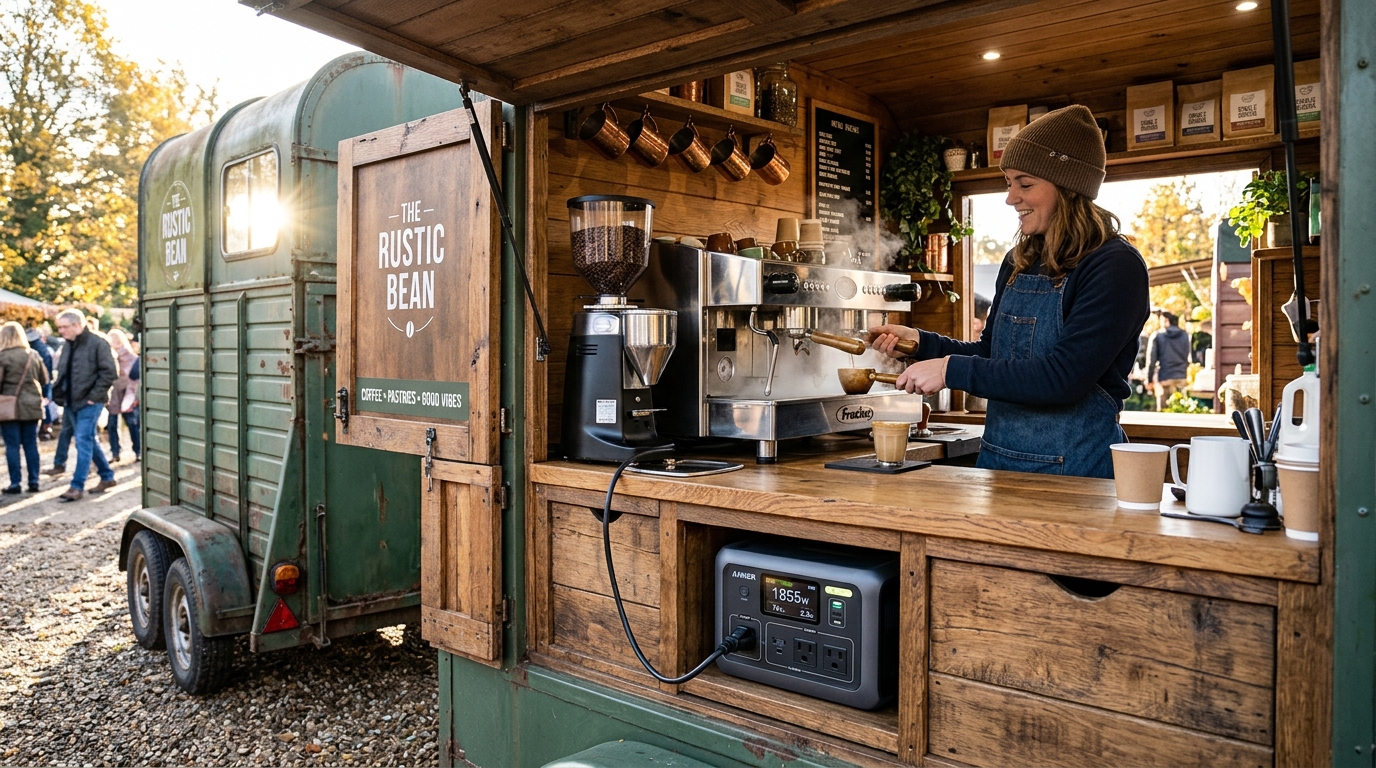
Direct answer: The espresso machine decides the battery size in a coffee van. Measure warm-up and steam demand, build a six-hour load audit, and plan charging around real pitches rather than hopeful solar maths.
Editorial note: WhichWatts is an independent comparison site. Prices, availability, specifications, and retailer promotions change frequently. Check the live product table and retailer page before buying.
Coffee Van Power: Running an Espresso Machine, Fridge and Lights from a Portable Power Station
A coffee van looks like a small electrical load until the espresso machine wakes up. The grinder, fridge, lights and card reader together might draw a few hundred watts. The machine's boiler can draw 1,200W to 2,400W on its own, and it cycles constantly to hold temperature and produce steam.
That single appliance decides whether a 2kWh station is enough or whether you need a 5kWh bank. This guide shows how to measure the real demand, build a six-hour service audit, and choose a charging plan that survives a full pitch without a generator.
Start With the Espresso Machine, Not the Menu
Espresso machines are resistive loads: there is no big startup surge like a fridge compressor, but the heating element draws its full rated wattage whenever it is on. The number that matters is not the boiler's peak rating alone, but how often it cycles during service.
- Warm-up can take 15 to 30 minutes at or near full power. A 1,600W machine warming for 25 minutes uses roughly 670Wh before the first shot.
- Steam is the heaviest continuous demand. Steaming milk for a run of drinks can keep the element on for minutes at a time.
- Brewing a shot draws relatively little; the pump and electronics are minor compared with the boiler.
- Standby between customers still costs energy if the boiler is held at temperature.
A plug-in energy monitor on the machine for a typical week is worth more than any rule of thumb. Record kWh per service and divide by the number of drinks to get a real energy cost per cup.
Check Power, Voltage and Waveform
Three specifications decide whether a station can run the machine at all:
- Continuous AC output must exceed the machine's rated draw plus everything else running at the same time. A 1,600W machine plus a 300W grinder plus a 150W fridge is already 2,050W; a 1,800W station will not carry it.
- Voltage must match. A 230V machine needs a 230V station; a 120V machine needs 120V. Adapters do not convert voltage.
- Pure sine wave output is required. Modified sine wave inverters can cause controllers, pumps and electronics to run hot or misbehave.
Commercial machines sometimes specify a 15A or 20A circuit. A portable station with a standard outlet may not be rated for that current even if its wattage looks sufficient, so check the outlet rating as well as the inverter.
Build a Six-Hour Load Audit
Here is an example for a van doing a six-hour lunch and afternoon service with a single-group machine, a small fridge, a grinder and LED lighting. The duty cycle is the share of the service the appliance is actually drawing power.
| Load | Running W | Hours on | Duty cycle | Energy (Wh) |
|---|---|---|---|---|
| Espresso machine (warm-up plus service) | 1,600 | 6 | 30% | 2,880 |
| Coffee grinder | 300 | 1 | 50% | 150 |
| Under-counter fridge | 70 | 6 | 50% | 210 |
| Water pump | 60 | 1 | 100% | 60 |
| LED lighting | 30 | 6 | 100% | 180 |
| POS tablet and card reader | 15 | 6 | 100% | 90 |
| Total | 3,570Wh |
The espresso machine accounts for four-fifths of the total. If your machine is smaller, or you switch the boiler down between rushes, the number falls quickly. If you run a high-volume service with constant steaming, it rises.
Apply the Formula and Add a Reserve
Use the same energy formula as any other off-grid system:
Usable energy = rated Wh × inverter efficiency × usable depth of discharge
For LiFePO4, assume about 0.85 for the inverter and 0.9 for usable capacity, giving roughly 0.765. To deliver 3,570Wh:
3,570 ÷ 0.765 = about 4,667Wh of rated capacity
Add 15% to 25% for cold mornings, battery ageing and days when the machine cycles more than expected. That points to a 5kWh to 6kWh bank for this example.
If you run a 1,200W machine and manage steam carefully, a 3kWh to 4kWh station may be enough. The difference is not small, which is why measuring the machine matters more than copying someone else's van build.
Sizing Tiers for Coffee Vans
| Station size | What it suits | Recommended models | Watch-outs |
|---|---|---|---|
| 1.5–2kWh | Small mobile cart, low-watt 1,200W pod machine, no fridge | Bluetti AC200L (2,048Wh / 2,400W), EcoFlow DELTA 2 Max (2,048Wh) | Very tight for a full service; zero headroom for unexpected steam cycles |
| 3–4kWh | 1-group commercial machine, fridge, commercial grinder & lights | EcoFlow DELTA Pro (3,600Wh / 3,600W), Jackery Explorer 3000 Pro (3,024Wh) | Solid 4–5 hour pitch; manage initial warm-up from shore power |
| 5–6kWh | 2-group machine, dual fridges, high-volume event pitches | Anker SOLIX F3800 (3,840Wh + expansion), Bluetti AC300 + 2× B300S (6,144Wh) | Professional van standard; provides full 6–8 hour pitch independence |
| 8–10kWh | High-output dual machines, festival pitches, non-stop service | EcoFlow DELTA Pro Ultra with expansion batteries | Heavy setup; allocate payload and secure floor brackets |
Top Power Stations for Mobile Coffee Vans & Baristas
Operating a commercial espresso machine off a battery requires an inverter with high thermal headroom so boiler element cycles don't cause voltage dip. Here are the top tested options for coffee vans:
- EcoFlow DELTA Pro / DELTA Pro 3 (3,600Wh – 7,200Wh): The favorite of UK and European mobile baristas. Its 3,600W pure sine wave inverter carries commercial single and dual-group boilers easily. Fast 2,900W AC charging means you can fully recharge during a lunchtime pitch transition or at the commissary in under 2 hours.
- Anker SOLIX F3800 (3,840Wh / 6,000W output): With 6,000W continuous output, the F3800 can run your espresso machine heating element, commercial grinder, and milk fridge at the exact same moment with zero risk of tripping. Expandable up to 26.9kWh for multi-day weekend food festivals.
- Bluetti AC200L & AC300 Series (2,048Wh – 6,144Wh): Renowned for ultra-durable LiFePO4 chemistry (3,500+ cycles) and rapid solar/alternator DC input. The AC200L is ideal for low-wattage 1-group machines, while the modular AC300 allows you to tuck expansion batteries into low-profile benches.
- Jackery Explorer 2000 Plus & 3000 Pro (2,042Wh – 3,024Wh): Quiet operation and compact form factor make Jackery ideal for boutique horsebox conversions where equipment is visible to customers at the counter.
Plan Charging Around the Pitch
A coffee van usually has three charging opportunities, and they are not equally useful:
- Shore power at a commissary or overnight base is the backbone. A 5kWh bank with a 1,800W input needs about 2.8 hours at full rate, or three to four hours in practice. A 3,000W input brings that closer to two hours.
- Alternator charging while driving can add meaningful energy between pitches, but a 12V socket is limited to roughly 100W to 200W. A dedicated DC-to-DC charger can reach 500W to 1,000W. Do not idle the engine for hours just to charge.
- Solar is a supplement. A 400W to 600W array might add 1.2kWh to 2kWh on a good day, which covers the fridge and lights but not a busy espresso service. Shade, panel angle and short winter days reduce that further.
If you serve from a fixed pitch all day, ask the site whether shore power is available and what current it supplies. Many markets and event organisers have strict rules about generators and cabling, and a battery avoids both the noise complaint and the exhaust.
Installation and Safety in a Wet, Hot Space
A coffee van combines water, steam, heat and vibration, which is a demanding environment for any battery.
- Keep the station dry and ventilated. Mount it where splashes from the sink or steam wand cannot reach it, and do not enclose it in a sealed cupboard while it is charging.
- Separate water from electricity. Route cables above floor level where possible, use RCD/GFCI protection, and never plug in with wet hands.
- Secure the unit for travel. A 5kWh station can weigh 40kg or more; it needs a restrained base, not a shelf it can slide off.
- Mind the heat. Espresso machines and griddles radiate heat. Keep the battery away from the machine's body and out of direct summer sun.
- Check the rules. Insurance, fire safety and food-business inspections may require certified wiring and periodic testing. A portable station does not exempt the van from those requirements.
Frequently Asked Questions
How many espresso shots can a 5kWh battery make?
There is no fixed number, because warm-up, steam and boiler cycling dominate. A machine that uses 3.5kWh across a service might make 80 drinks; the same battery might make half that if it is constantly steaming. Measure kWh per service with an energy monitor rather than relying on a shots-per-kWh figure.
Can I run an espresso machine from a 2kWh power station?
Only if the machine's continuous draw, the grinder and the fridge fit inside the station's output rating, and only for a short service. A 2kWh battery has roughly 1.5kWh of usable energy after inverter losses, which a 1,600W machine can consume in under an hour of element-on time.
Can I charge the battery while driving?
Yes, with the right input. A standard 12V socket is slow and may be limited to 100W to 200W. A dedicated DC-to-DC charger wired to the vehicle's electrical system can deliver 500W to 1,000W, but it should be installed properly with fusing and cable protection.
Do I need a pure sine wave inverter?
Yes. Espresso machines, grinders and fridges all contain motors or electronics that expect a clean sine wave. Modified sine wave output can cause overheating, noise and unreliable operation.
Amazon price checks: espresso machines · portable power stations. As an Amazon Associate, WhichWatts earns from qualifying purchases.