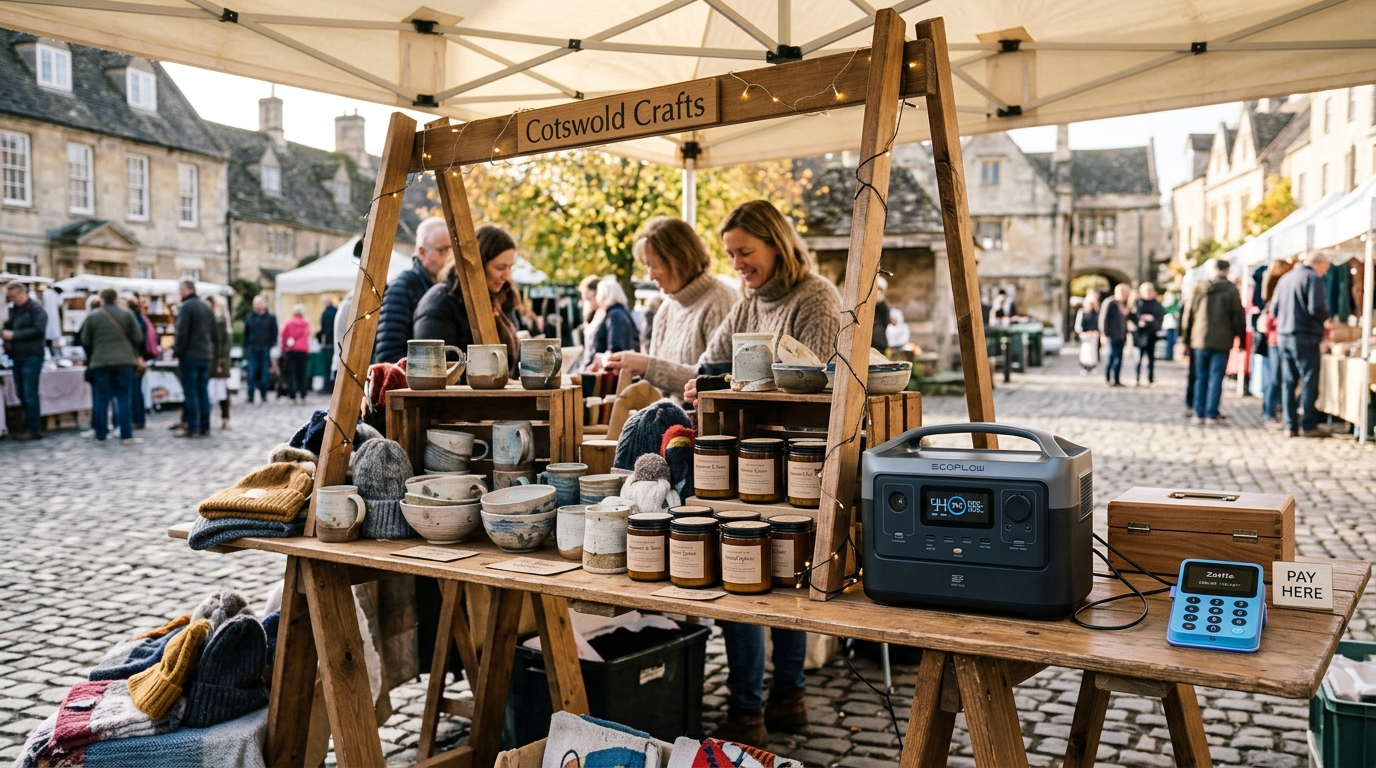
Direct answer: Lights, a card reader and a kettle need far less power than a griddle. Build a two-day market audit, pick the right battery size, and stay on the right side of venue rules and British weather.
Editorial note: WhichWatts is an independent comparison site. Prices, availability, specifications, and retailer promotions change frequently. Check the live product table and retailer page before buying.
Market Stall Power: Sizing a Portable Power Station for a Weekend of Markets and Pop-Ups
Market stalls have a wide range of electrical needs. A craft stall selling prints needs enough power for LED lights, a card reader and a phone. A food stall selling hot drinks and bacon rolls needs a kettle, a griddle or a hot plate, and possibly a fridge. Those two stalls should not buy the same battery.
The good news is that most market loads are modest and predictable. The bad news is that the heaviest appliance, usually a kettle or griddle, can dwarf everything else. This guide builds a two-day audit, shows the maths, and covers the venue rules that catch traders out.
Separate the Stall Into Three Load Groups
Thinking in groups makes sizing much easier:
- Always-on loads: LED lighting, card reader, phone, small radio. These run for the whole market day and are cheap in energy terms.
- Short-burst loads: kettle, coffee machine, hot-water urn. High wattage, but only on for minutes at a time.
- Continuous cooking loads: griddle, hot plate, fryer, warming drawer. High wattage for hours, and the group most likely to make a battery impractical.
A 1kWh station can handle the first group for a weekend. The second group pushes you to 2kWh or more. The third group can push you past 8kWh, at which point propane or a generator often makes more sense, subject to venue rules.
What a Typical Stall Actually Draws
| Load | Typical running draw | Notes |
|---|---|---|
| LED strip or spotlights | 20–50W | Often the largest always-on load |
| Card reader and phone | 5–20W | Charging is intermittent |
| Small display fridge | 60–100W | Compressor cycles, 30–50% duty |
| Kettle | 1,500–2,000W | Per boil, typically 2–4 minutes |
| Hot-water urn | 1,500–2,500W | Cycles to hold temperature |
| Griddle or hot plate | 1,500–2,500W | Continuous while cooking |
| Fryer | 2,000–3,000W | Continuous while cooking |
| Radio or speaker | 10–30W | Minor |
Check the nameplate on your own equipment. A domestic kettle rated at 3,000W will trip a 2,000W station instantly, even if it only runs for two minutes.
Build a Two-Day Market Audit
Here is an example for a craft and hot-drinks stall trading six hours on Saturday and six on Sunday, with no cooking apart from a kettle. The audit covers both days.
| Load | Running W | Total hours | Duty cycle | Energy (Wh) |
|---|---|---|---|---|
| LED lighting | 40 | 12 | 100% | 480 |
| Card reader and phone | 15 | 12 | 100% | 180 |
| Kettle | 1,500 | 0.5 | 100% | 750 |
| Small display fridge | 60 | 12 | 40% | 288 |
| Total | 1,698Wh |
That is the energy delivered to the appliances. Apply the same efficiency and reserve factors used for any lithium system.
Apply the Formula and Size the Battery
Usable energy = rated Wh × inverter efficiency × usable depth of discharge
Assume 0.85 for the inverter and 0.9 for usable LiFePO4 capacity, giving roughly 0.765. To deliver 1,698Wh:
1,698 ÷ 0.765 = about 2,220Wh of rated capacity
Add 20% for a cold weekend, battery ageing and a busier-than-expected Sunday:
2,220 × 1.2 = about 2,664Wh
A 2.5kWh to 3kWh station covers this stall comfortably. A 1kWh unit would be running on empty by Sunday lunchtime. A 5kWh unit would work but adds weight and cost for capacity the stall does not need.
If you remove the fridge and kettle, the same stall drops to about 660Wh delivered, or roughly 1kWh rated with reserve. That is the difference between a lights-and-card-reader stall and one selling hot drinks.
When Cooking Changes the Answer
Add a 1,800W griddle running two hours on each day:
1,800W × 4 hours = 7,200Wh
That is more than four times the entire two-day load above. With inverter losses and reserve, you are looking at a 14kWh bank, which is heavy, expensive and slow to recharge from a domestic socket.
For a hot-food stall, the realistic options are usually:
- Propane for cooking, with a small battery for lights, card reader and fridge.
- A generator, where the venue allows it and you can site it safely away from customers and fumes.
- A large fixed lithium bank if you trade regularly and have reliable overnight charging.
Do not buy a 3kWh station expecting it to run a griddle for a full market day. It will not, and the overload protection will make that clear at the worst possible moment.
Sizing Tiers for Market Stalls
| Station size | What it covers | Recommended models | Typical stall |
|---|---|---|---|
| 0.5–1kWh | LED display lights, card reader, phone, tablet | Jackery Explorer 500 / 1000 Plus, EcoFlow River 2 Pro (768Wh), Anker SOLIX C800 | Craft, art, jewellery, fashion, prints, bookstalls |
| 1–2.5kWh | The above plus travel kettle, mini fridge, sampling hot plate | EcoFlow DELTA 2 Max (2,048Wh), Bluetti AC200L (2,048Wh), Anker SOLIX C1000 | Farmers markets, cheese & chilled produce, cakes, tea & coffee tasting |
| 3–6kWh | High-draw equipment, commercial soup kettles, heated display | EcoFlow DELTA Pro (3,600Wh), Bluetti AC300 + B300 (3,072Wh–6,144Wh), Pecron E3600LFP | Pop-up street food stall, burger or crepe stall with single electric unit |
| 8kWh+ | Continuous heavy electric cooking (griddle, fryer) | Fixed commercial bank or dual Anker F3800 units | Full commercial cooking (gas preferred where permitted) |
Best Market Stall Power Stations by Trader Type
- For Craft, Art & Non-Food Stalls (Under 1.5kWh):
- Jackery Explorer 500 & 1000 Plus: Lightweight (6kg to 14kg), compact, and completely silent. Fits neatly under a display table with enough USB and AC ports to run fairy lights and card readers for a 12-hour weekend market.
- EcoFlow River 2 Pro (768Wh): Uses long-lasting LiFePO4 cells (3,000+ cycles) and recharges from 0% to 100% in just 70 minutes from a domestic wall plug, making Saturday-to-Sunday turnaround effortless.
- For Produce, Sampling & Hot Drinks Stalls (0.75kWh – 2.5kWh):
- Anker SOLIX C1000 (1,056Wh) & C800 (768Wh): The C1000's SurgePad technology carries up to 2,400W peak, so a 1,500W travel kettle will not trip its 1,800W inverter. The smaller C800 is rated 1,200W (1,600W SurgePad), so check the kettle's nameplate against it. Both sit in a drop-proof unibody frame with an integrated ambient light bar.
- Bluetti AC200L (2,048Wh / 2,400W): The sweet spot for chilled display cabinets and sampling hot plates. Runs display chillers all day with substantial reserve capacity for mobile heating.
- For High-Output Pop-Ups & Event Catering (3kWh+):
- EcoFlow DELTA Pro & Pecron E3600LFP: Commercial heavy-hitters with 3,600W inverters capable of handling high-duty cycle equipment where venue noise rules forbid petrol generators.
Recharging Overnight
A weekend market usually means charging between days, not during them.
- A 2.5kWh station with a 1,800W charger refills from empty in about 1.4 hours at full rate, or closer to two hours in practice.
- A domestic socket may be limited to 13A in the UK or 15A in the US. That is enough for a 1,800W to 3,000W charger, but check the circuit is not shared with other heavy loads.
- Venue power is not guaranteed. Ask the organiser in advance what current is available, whether it is metered, and whether you need your own RCD protection.
- Solar is not a reliable market-day recharge source in winter, and panels left unattended at a stall are a security risk. Treat solar as an overnight top-up at home or at a campsite.
If you trade both days and cannot recharge overnight, buy two smaller batteries and rotate them rather than one large unit you cannot refill.
Venue Rules, Weather and Safety
Market stalls operate in public spaces, which brings rules that do not apply to a home backup setup.
- Generators are often banned or restricted. Many town-centre markets prohibit them outright because of noise and fumes. A battery is usually welcome, but check the organiser's terms.
- Electrical testing may be required. In the UK, many venues ask for PAT testing of portable equipment and a risk assessment. Insurance policies may also require it.
- Use RCD/GFCI protection on any outdoor circuit, keep cables covered and rated for the current, and do not daisy-chain extension leads.
- Protect against rain and heat. Use an IP-rated station or a rain cover that still allows ventilation. Do not leave a battery in direct summer sun or in a car overnight in freezing conditions.
- Secure it overnight. A 2.5kWh station is a valuable, portable item. Lock it away or take it home; do not leave it in an unattended gazebo.
- Lift safely. A 2.5kWh LiFePO4 station can weigh 25kg to 30kg. Use two people or a trolley, and keep the handles and cables in good condition.
A Simple Market-Day Checklist
- Charge the station to 100% the night before, and check the state of charge again before leaving.
- Test the kettle, lights and card reader at home, not at the stall.
- Pack the correct cables and a spare extension lead rated for the load.
- Confirm the venue's rules on generators, PAT testing and RCD protection.
- Keep the station off the ground in wet weather and away from cooking heat.
- At close, switch off the inverter before unplugging appliances, then recharge overnight.
Frequently Asked Questions
How long will a 1kWh power station last at a market?
For lights, a card reader and phone charging, a 1kWh station can cover a two-day weekend with energy to spare. Add a kettle and a small fridge and it will likely run out on the first day. The load audit, not the headline capacity, gives the answer.
Can I leave a power station in my car between markets?
Only within its temperature limits. LiFePO4 should not be charged below 0°C, and a car interior can exceed 50°C in summer sun. Bring the unit indoors between markets and let it reach room temperature before charging.
Can I run a griddle from a 3kWh station?
A 3kWh station has roughly 2.3kWh of usable energy after inverter losses, which a 1,800W griddle consumes in about 1.3 hours. It may run one appliance briefly, but it will not cover a full market day of cooking. Use propane or a generator where permitted, or size a much larger bank.
Do I need PAT testing for a power station at a UK market?
Many venues and insurers ask for PAT testing of portable electrical equipment, and some require a risk assessment. A new station may not need testing immediately, but check the organiser's requirements before the event. Keep receipts and the manual.
Amazon price checks: LED stall lights · portable power stations. As an Amazon Associate, WhichWatts earns from qualifying purchases.