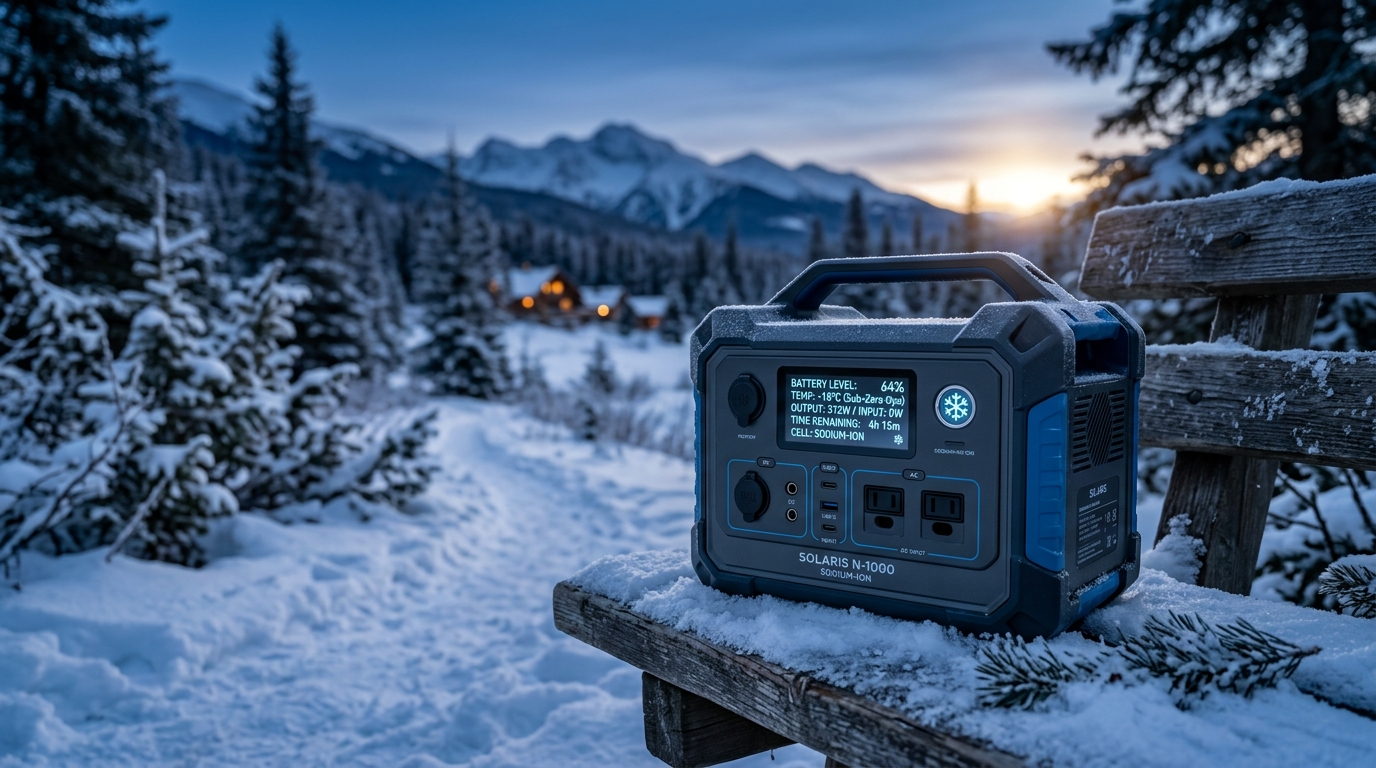
Direct answer: Can sodium-ion battery power stations replace LiFePO4? Discover how Na-ion solves sub-zero cold charging down to -20°C, reduces raw material costs, and compares on cycle life and energy density.
For the past five years, Lithium Iron Phosphate (LiFePO4 / LFP) has been the undisputed king of portable power stations. It brought 3,000+ cycle lifespans, thermal stability, and peace of mind over older nickel-manganese-cobalt (NMC) chemistries.
However, in 2026, a groundbreaking alternative is hitting commercial shelves: Sodium-Ion (Na-ion) battery power stations.
Pioneered by cell manufacturers including CATL, HiNa Battery, and Faradion, and integrated into consumer generators by brands like Biwatt, Bluetti, and others, sodium-ion technology promises to solve lithium's biggest Achilles' heel: sub-zero cold-weather performance and volatile raw material supply chains.
This guide breaks down how sodium-ion batteries work, how they perform down to -20°C (-4°F) and lower, how their cost per watt-hour stacks up against LiFePO4, and whether you should consider one for your next power station.
What is a Sodium-Ion Battery?
At an electrochemical level, sodium-ion batteries operate almost identically to lithium-ion batteries. Both rely on a "rocking chair" mechanism where ions shuttle back and forth between a cathode and an anode during charge and discharge cycles.
The fundamental difference lies in the charge carrier:
- Lithium-Ion (Li+): Relies on lithium ions, which are exceptionally small and lightweight, yielding high gravimetric energy density.
- Sodium-Ion (Na+): Uses sodium ions derived from abundant table salt precursors ($Na_2CO_3$). Sodium ions are approximately 30% larger and heavier than lithium ions, but the chemistry requires zero lithium, zero cobalt, and zero nickel.
In addition, sodium does not alloy with aluminum at low potentials. This means sodium-ion cells can use inexpensive, lightweight aluminum foil current collectors for both the positive and negative electrodes, whereas lithium cells require heavier, expensive copper foils on the anode side.
The Cold-Weather Superpower: -20°C Charging Without Heating Pads
The single most frustrating limitation of LiFePO4 portable power stations is cold-weather charging.
If you attempt to charge a standard LiFePO4 battery below 0°C (32°F), metallic lithium plates permanently onto the graphite anode instead of intercalating. This causes severe capacity degradation and creates microscopic dendrites that can pierce the separator and short-circuit the cell. Consequently, modern power stations employ Battery Management Systems (BMS) that strictly refuse charging current when ambient temperatures hit freezing. While some premium units include built-in heating pads, those heaters consume 50W–100W of your precious solar or battery power just to warm the cells before charging can even begin.
Sodium-ion cells completely eliminate this freezing bottleneck:
- Direct Sub-Zero Charging: Sodium-ion cells can charge safely at temperatures down to -20°C (-4°F) without lithium plating or dendrite formation.
- Sub-Zero Discharge: While LiFePO4 batteries suffer up to a 40–50% voltage sag and capacity drop when discharged at -10°C, sodium-ion cells maintain over 90% of their rated capacity at -20°C and can discharge power down to -40°C (-40°F).
- Zero Waste Preheating: In freezing winter weather, mountain overlanding, ski trips, or unheated garages, you can plug in a solar panel or wall charger and immediately start charging the battery pack.
Head-to-Head Comparison: Sodium-Ion vs LiFePO4 vs NMC
Here is how sodium-ion compares to the dominant chemistries in the portable power station industry:
| Specification / Attribute | Sodium-Ion (Na-ion) | Lithium Iron Phosphate (LiFePO4) | Ternary Lithium (NMC) |
|---|---|---|---|
| Cell Energy Density | 145 – 165 Wh/kg | 160 – 190 Wh/kg | 220 – 280 Wh/kg |
| Sub-Zero Charging | Down to -20°C (-4°F) ✅ | 0°C (32°F) minimum (needs heaters) ❌ | 0°C (32°F) minimum ❌ |
| Discharge Temp Range | -40°C to +60°C | -20°C to +55°C | -20°C to +50°C |
| Cycle Life (to 80% Capacity) | 3,000 – 4,000+ cycles | 3,500 – 5,000+ cycles | 500 – 1,000 cycles |
| Thermal Runaway Temp | ~260°C – 300°C (Extremely Safe) | ~270°C (Extremely Safe) | ~150°C – 210°C (Vulnerable) |
| 0V Complete Discharge Safety | Safe (Can ship/store at 0V) ✅ | Damaged if drained below ~2.0V ❌ | Damaged if drained below ~2.5V ❌ |
| Raw Material Scarcity | Negligible (Abundant Salt) ✅ | Medium (Lithium dependent) ⚠️ | High (Cobalt & Nickel dependent) ❌ |
| Projected Cost/Wh at Scale | Lowest ($35–$50/kWh cell level) | Medium ($55–$75/kWh cell level) | Highest ($80–$110/kWh cell level) |
The 0V Storage & Transport Safety Advantage
Another unique engineering benefit of sodium-ion power stations is 0-Volt depth-of-discharge stability.
Because lithium-ion cells use copper anode foils, draining a lithium battery down to 0 volts causes the copper to dissolve into the electrolyte, causing permanent internal short circuits when recharged. For this reason, lithium power stations must always be shipped and stored with a 30% to 50% state of charge.
Because sodium-ion cells use aluminum current collectors on both terminals, they can be discharged all the way to 0.0 volts without causing any electrochemical degradation.
- Complete Transport Safety: A power station discharged to 0V has zero stored chemical energy, virtually eliminating the hazard of fire during shipping, airline transit, or long-term warehouse storage.
- No "Bricking" Risk: If you leave a sodium-ion power station in your attic or cabin for two years and the parasitic BMS drain pulls the pack to zero, the battery will not "brick." Simply plug it into the wall and it recharges normally.
What Are the Trade-Offs?
While sodium-ion holds tremendous promise, there are real-world trade-offs you must understand before making a purchase:
1. Slightly Higher Weight and Bulk
Sodium ions are physically larger than lithium ions. First-generation commercial sodium-ion power stations exhibit an energy density of approximately 145–160 Wh/kg compared to 175–190 Wh/kg for the latest generation LiFePO4 cells. In practice, a 1,000Wh sodium-ion power station will weigh about 1.5 to 2.5 kg (3 to 5 lbs) more than an equivalent 1,000Wh LiFePO4 station.
2. Sloping Discharge Voltage Curve
LiFePO4 batteries feature an exceptionally flat discharge voltage plateau, which makes power delivery consistent but state-of-charge (SoC) estimation notoriously tricky for battery monitors. Sodium-ion has a sloping discharge curve (from ~4.0V down to ~1.5V per cell). While this gives the digital battery display pinpoint percentage accuracy, it requires the internal DC-to-DC converters and inverters to handle a wider input voltage range.
3. Early Supply Chain Premium
While sodium carbonate (raw salt) is vastly cheaper than battery-grade lithium carbonate, sodium-ion manufacturing lines are still ramping up global scale compared to the multi-gigawatt gigafactories producing LiFePO4 cells. In 2026, retail pricing for sodium-ion units is roughly at parity with premium LiFePO4 models, though cost per watt-hour is projected to decrease sharply by 2027–2028.
Who Should Buy a Sodium-Ion Power Station in 2026?
A sodium-ion portable power station is the ideal choice if your use case falls into any of the following categories:
- Winter Campers & Skiers: If you camp in below-freezing temperatures, you can charge your battery straight from portable solar panels outside without bringing the unit into a heated tent first.
- Unheated Garage & Shed Backup: Many homeowners store emergency power stations in detached garages or sheds. During freezing winter storms, standard LFP units cannot accept solar or generator power until their cells are heated above freezing. Sodium-ion units charge immediately.
- Overlanders & Ice Fishermen: Extreme climate resilience down to -20°C ensures that vehicle fridges, communication radios, and diesel heaters stay powered in deep winter.
- Set-It-and-Forget-It Emergency Storage: If you tend to forget to top up your backup battery every 6 months, sodium's tolerance for deep discharge provides unmatched durability.
For general indoor home office backup, moderate-climate RV travel, or users prioritizing the lowest possible carry weight, a mature LiFePO4 portable power station remains an outstanding and cost-effective choice.
Frequently Asked Questions
Can sodium-ion batteries catch fire or explode?
Sodium-ion batteries are inherently among the safest battery chemistries ever tested. Their thermal runaway onset temperature is high (~260°C to 300°C), and under mechanical crush, puncture, or short-circuit tests, they do not release oxygen rapidly like NMC cells. Furthermore, because they can be discharged to 0V, they can be rendered completely inert for transport.
How long does a sodium-ion power station last?
Most commercial sodium-ion cells entering power stations in 2026 are rated for 3,000 to 4,000 complete charge and discharge cycles before degrading to 80% of original capacity. For average users cycling the station 150 times per year, that translates to over 20 years of usable operational lifespan.
Can I charge a sodium-ion power station with existing solar panels?
Yes. The battery chemistry inside the unit does not alter the external solar input specifications. As long as your solar panel array complies with the power station's MPPT input voltage (V) and current (A) ratings, any standard monocrystalline or bifacial solar panel will charge a sodium-ion unit seamlessly.
How does sodium-ion compare to solid-state batteries?
Solid-state batteries focus on maximizing energy density (often exceeding 350 Wh/kg) while using solid ceramic/sulfide electrolytes, making them ultralight but very expensive. Sodium-ion focuses instead on cold-weather resilience, abundant low-cost raw materials, and rapid charging, making it a budget-friendly and climate-hardened technology.