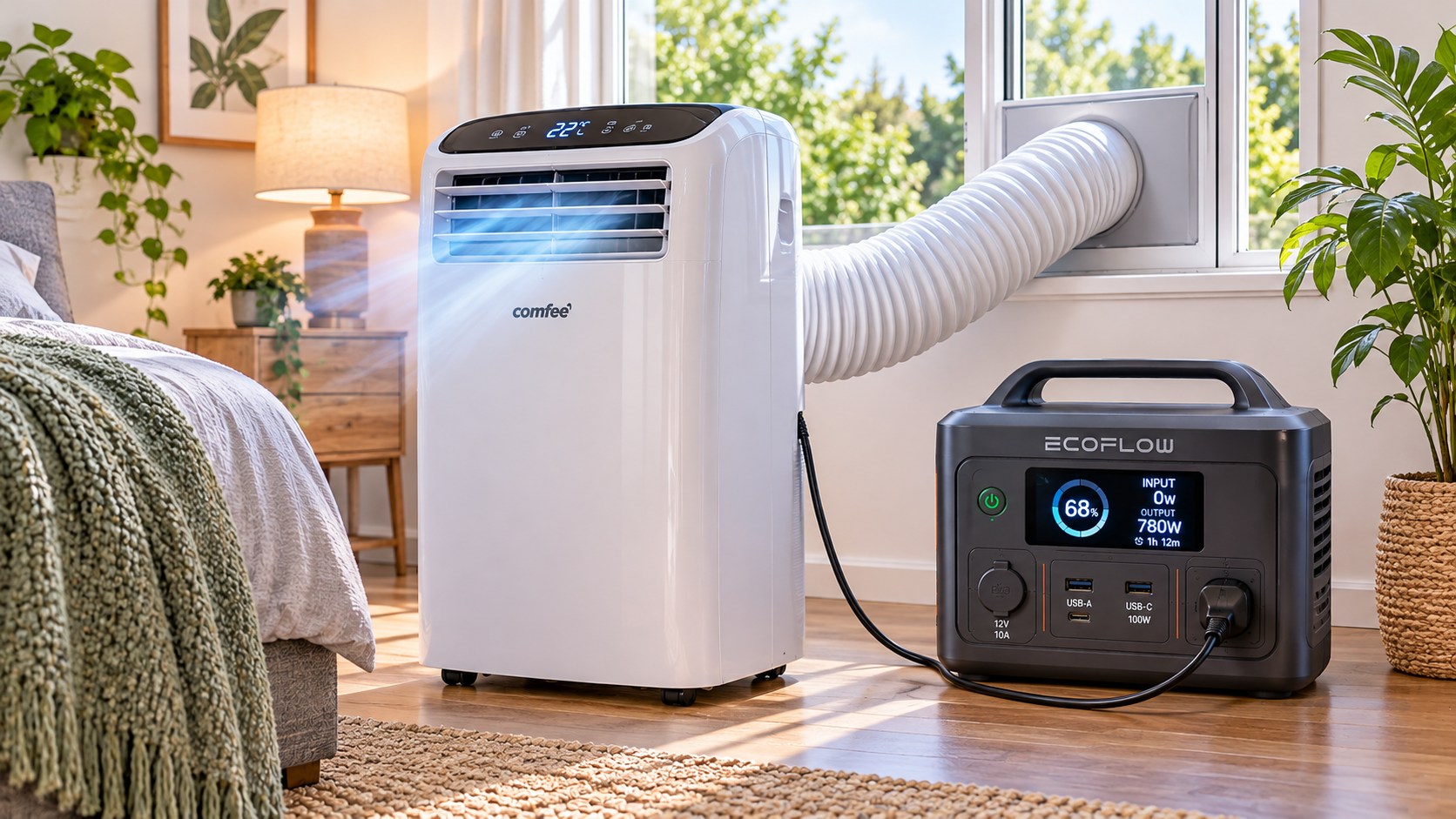
Direct answer: Short runs only. A 10,000 BTU portable AC draws about 1,280 W and cycles at 50–70%, so a 3.6 kWh station lasts under four hours and an eight-hour night needs roughly 7.5 kWh of rated capacity.
Editorial note: WhichWatts is an independent comparison site. Prices, availability, specifications, and retailer promotions change frequently. Check the live product table and retailer page before buying.
Can a Power Station Run a Portable Air Conditioner Overnight?
Air conditioning is the hardest common household load to move onto a battery after heating. It combines a compressor (with startup surge) and long runtimes, and portable units are less efficient than window models of the same claimed capacity.
You can run a portable AC from a large power station for a few hours. Getting through a whole night is a different budget entirely, and this guide shows where the line falls.
The short answer
A 3.6 kWh station will run a 10,000 BTU portable AC for roughly 3–4 hours, not eight. An eight-hour overnight run at 60% duty needs about 5.8 kWh delivered, which means roughly 7.5 kWh of rated capacity. For a short outage or a bedroom cool-down, a 2–4 kWh station is viable; for all-night cooling, a generator or fixed battery is the realistic option.
How much power does a portable AC use?
Portable units are rated in BTU (cooling capacity) and draw roughly their SACC rating divided by their CEER efficiency. At the US federal minimum efficiency, that gives:
| Portable AC size | Typical draw at minimum efficiency | Startup surge (approx.) |
|---|---|---|
| 8,000 BTU | 1,100 W | 2,000–2,500 W |
| 10,000 BTU | 1,280 W | 2,300–2,800 W |
| 12,000 BTU | 1,430 W | 2,600–3,200 W |
| 14,000 BTU | 1,580 W | 3,000–3,500 W |
Two caveats. First, more efficient units draw less than the federal floor; check the label. Second, a portable unit is significantly less efficient than a window unit of the same capacity — an 8,000 BTU window model at current standards draws around 530 W, versus about 1,100 W for a portable at the minimum. If you have the choice, the window unit is far kinder to a battery.
Duty cycle: the number that decides runtime
A compressor does not run continuously. Once the room reaches the setpoint it cycles, typically 50–70% of the time in normal summer conditions. That is why measured energy use is lower than watts × hours.
For planning: 1,280 W × 60% = about 770 Wh per hour. Hot, humid, poorly insulated rooms push that towards 100%; a small, shaded room pulls it down.
How long will a power station run a portable AC?
Using 1,200 W at 60% duty (720 Wh per hour) and the standard 0.765 usable factor:
| Station size | Usable energy | Runtime at 60% duty | Runtime at full duty |
|---|---|---|---|
| 500 Wh | 383 Wh | 0.5 h | 0.3 h |
| 1,000 Wh | 765 Wh | 1.1 h | 0.6 h |
| 2,000 Wh | 1,530 Wh | 2.1 h | 1.3 h |
| 3,600 Wh | 2,754 Wh | 3.8 h | 2.3 h |
| 5,000 Wh | 3,825 Wh | 5.3 h | 3.2 h |
Eight hours at 60% duty is 5,760 Wh delivered. Divide by 0.765 and you need 7,529 Wh rated — a 7.5 kWh bank, before any reserve.
What the inverter has to survive
- Compressor surge. Startup draw is typically 2–3× running watts for a second or two. A station with a 1,800 W continuous / 2,400 W surge rating may start an 8,000 BTU unit but not a 12,000 BTU one.
- Continuous rating. The compressor runs for long stretches; the inverter must sustain the running watts, not just the surge.
- Simultaneous loads. AC plus fridge plus lights can push a 2 kWh station over its limit.
- Heat derating. In a hot room, the station's own inverter derates. Do not site it in direct sun or beside the AC's exhaust.
- Voltage. A 120 V portable AC needs a 120 V station; a 230 V unit needs 230 V. Adapters do not convert voltage.
Which power stations suit a portable AC?
| Station | Capacity / continuous output | Realistic use |
|---|---|---|
| EcoFlow DELTA 2 Max | 2,048 Wh / 2,400 W | About 2 hours at 60% duty |
| Bluetti AC200L | 2,048 Wh / 2,400 W | About 2 hours; 8,000 BTU units |
| EcoFlow DELTA Pro 3 | 4,096 Wh / 3,600 W | About 4 hours; handles 12,000 BTU surge |
| Anker SOLIX F3800 | 3,840 Wh / 6,000 W | About 4 hours with surge headroom |
| Bluetti AC500 + B300S | 3,072 Wh per battery / 5,000 W | Expandable; add batteries for longer nights |
For a full night, plan on two or three batteries, or a different cooling strategy.
Cooling with less battery
- Use a fan first. A 50 W fan uses roughly 4% of the energy of a portable AC and often makes a bedroom bearable.
- Cool one room, not the house. Close doors, cover windows, and run the AC only where you sleep.
- Pre-cool before the outage. If a storm is forecast, drop the room temperature while mains power is still on.
- Shade the unit and the room. An AC in direct sun works harder; so does a station.
- Choose a window unit if you can. Same BTU, roughly half the watts.
FAQ
Can a 2 kWh station run a portable AC overnight?
No. Two kWh delivers about two hours at 60% duty. An eight-hour night needs roughly 7.5 kWh of rated capacity.
How many BTU can a power station run?
Continuous output is the limit: a 2,400 W station can run a 12,000 BTU portable at its 1,430 W draw, but startup surge may still trip it. A 3,600 W station with a 7,200 W surge rating is the safer match.
Why does the AC trip the station at startup?
Compressor inrush is 2–3× running watts. If the station trips only when the compressor starts, the surge rating is too low — or other loads are already using headroom.
Is a fan cheaper than AC on a battery?
Far cheaper. A typical fan draws 30–70 W, so the same battery that runs an AC for three hours can run a fan for days.
Amazon price checks: portable air conditioners · portable power stations. As an Amazon Associate, WhichWatts earns from qualifying purchases.
Sources
- ENERGY STAR: room air conditioners
- US Department of Energy: room air conditioners
- HVACBase: portable AC draw at federal minimum efficiency
- EnergySage: air conditioner running watts by type