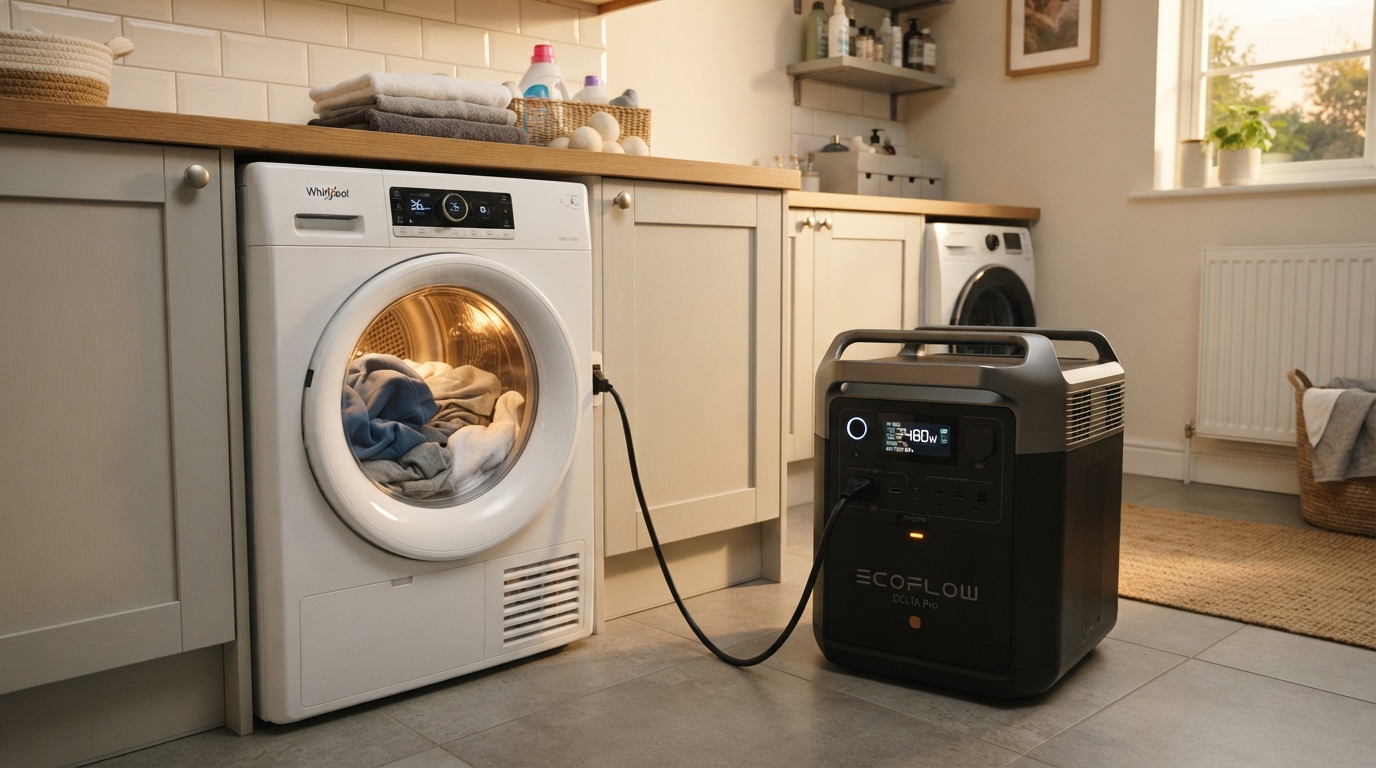
Direct answer: Not a vented or condenser dryer: a full load uses about 4.7–5.2 kWh and draws 2,600 W while heating. A heat-pump dryer uses 1.4–2.5 kWh at 600–850 W, which a 2–3 kWh station can run for one load.
Editorial note: WhichWatts is an independent comparison site. Prices, availability, specifications, and retailer promotions change frequently. Check the live product table and retailer page before buying.
Can a Power Station Run a Tumble Dryer? Vented vs Heat Pump
Tumble dryers are the highest-energy laundry appliance by a wide margin, and the type of dryer matters more than the size of the battery. A heat-pump dryer can use a third of the energy of a condenser model for the same load. That difference decides whether a power station is viable at all.
This guide uses measured UK appliance data rather than nameplate guesses, because dryer labels and real cycles vary enormously.
The short answer
A vented or condenser dryer is not realistic on a portable power station. A full 8 kg load uses roughly 4.7–5.2 kWh and the machine draws about 2,600 W while heating, so you need a 6 kWh+ bank and a 2,600 W+ inverter for a single load. A heat-pump dryer uses 1.4–2.5 kWh at 600–850 W, which a 2–3 kWh station can run for one load.
US electric dryers are usually 240 V and 5,000 W+, so a 120 V portable station cannot run them at all.
How much energy does a tumble dryer use?
| Dryer type | Typical draw | Energy per full 8 kg load |
|---|---|---|
| Heat pump | 600–850 W | 1.4–2.5 kWh |
| Condenser | 2,500–2,800 W | 4.7–5.2 kWh |
| Vented | 2,500–3,000 W | 5.0–5.3 kWh |
The UK National Energy Action monitoring report lists heat-pump models at 1.4–2.12 kWh per full load and condenser models at 4.71–5.21 kWh; a vented Hotpoint measured 5.02 kWh. The most efficient heat-pump dryers can dry a full 8–9 kg load in under 1.7 kWh. A UK government assessment puts the annual gap at 225 kWh for heat-pump dryers versus 564 kWh for condensing models.
How many loads can a power station dry?
Using 4.8 kWh per vented/condenser load and 2.0 kWh per heat-pump load, with the standard 0.765 usable factor:
| Station size | Usable energy | Vented/condenser loads | Heat-pump loads |
|---|---|---|---|
| 1,000 Wh | 765 Wh | 0 | 0.4 |
| 2,000 Wh | 1,530 Wh | 0 | 0.8 |
| 3,600 Wh | 2,754 Wh | 0.5 | 1.4 |
| 5,000 Wh | 3,825 Wh | 0.8 | 1.9 |
| 7,500 Wh | 5,738 Wh | 1.2 | 2.9 |
That table is the whole argument: even a 5 kWh station cannot finish one full condenser load, and one full load needs about 6.3 kWh of rated capacity. A heat-pump dryer needs roughly 2.6 kWh rated per load.
Power is a separate test
- Continuous output. A 2,600 W condenser dryer needs a 2,600 W+ inverter. Many 2 kWh stations are 2,400 W and will trip.
- Heating element. Resistive, no surge, but it runs for most of the cycle.
- Startup. The drum motor surges briefly; small compared with the heater.
- Ventilation and heat. A dryer in a small room raises ambient temperature; the station's inverter derates in heat.
- Voltage. 240 V dryers need a 240 V supply; a 120 V station cannot run one, whatever its watt-hour rating.
Which power stations suit a dryer?
| Station | Capacity / continuous output | Verdict |
|---|---|---|
| Anker SOLIX C1000 | 1,056 Wh / 1,800 W | Heat-pump dryer for part of a load only |
| EcoFlow DELTA 2 Max | 2,048 Wh / 2,400 W | One small heat-pump load |
| Bluetti AC200L | 2,048 Wh / 2,400 W | One heat-pump load, no condenser |
| EcoFlow DELTA Pro 3 | 4,096 Wh / 3,600 W | One heat-pump load with reserve |
| Anker SOLIX F3800 | 3,840 Wh / 6,000 W | Can power a 2,600 W condenser, but not for a full load |
The F3800 example is worth understanding: it has the power for a condenser dryer but not the energy for a full cycle. Both tests matter.
Drying without the dryer
- Air-dry. A rack or line uses zero battery energy; a heated room or dehumidifier uses far less than a dryer.
- Extra spin. A faster spin removes water mechanically, cutting any drying energy that follows.
- Dry in batches by fabric. Light synthetics finish long before heavy cottons.
- Ventilate. Drying indoors without ventilation adds moisture and can cause damp; open a window or use a dehumidifier.
FAQ
Can any power station run a tumble dryer?
A large one can power a condenser dryer, but the energy per load is the blocker: a full 8 kg load uses about 4.7–5.2 kWh, needing roughly 6.3 kWh of rated capacity. Heat-pump dryers are the only type that fits a portable station's energy budget.
Heat pump vs vented — how much energy is the difference?
Roughly a third. Measured UK examples put heat-pump dryers at 1.4–2.1 kWh per full load and vented/condenser models at 4.7–5.2 kWh.
How long does a 5 kWh station run a dryer?
About 0.8 of a full condenser load, or roughly two heat-pump loads. A condenser cycle needs around 2.5 hours and 4.8 kWh, so 5 kWh falls just short.
Can I run a washer and dryer at once?
No on a portable station. The pair can exceed 4,500 W and 6 kWh per combined cycle. Run the wash, then air-dry.
Amazon price checks: heat pump dryers · portable power stations. As an Amazon Associate, WhichWatts earns from qualifying purchases.
Sources
- National Energy Action: appliance monitoring report (dryer measurements)
- UK government: household tumble dryers options assessment
- National Energy Action: cost to run electrical items