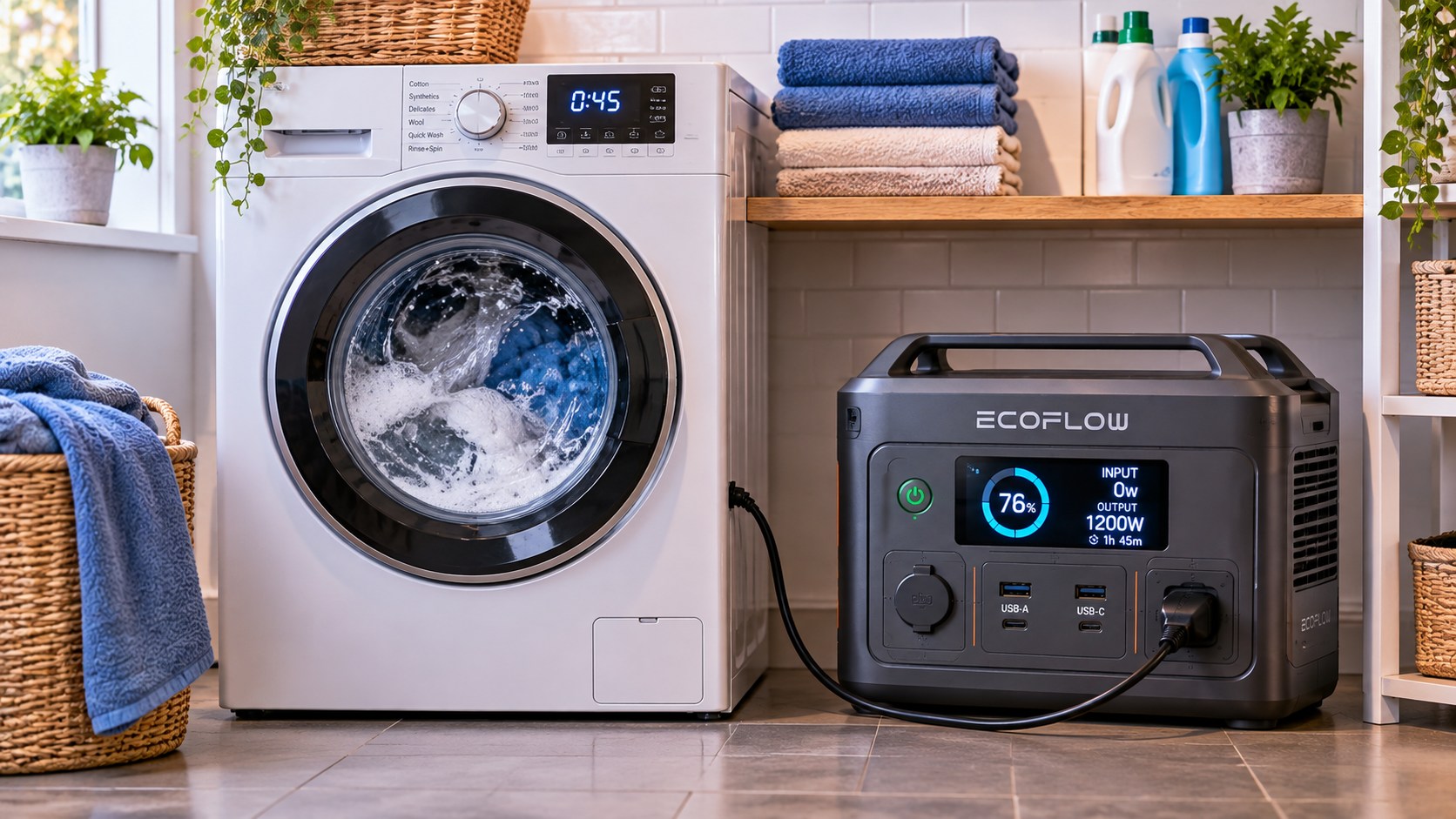
Direct answer: Yes for a cold cycle on a 1 kWh station. Hot washes need about 2,300 W while the heater runs and 1.2–1.8 kWh per cycle, so a 2 kWh station covers one hot load and a 3.6 kWh unit two.
Editorial note: WhichWatts is an independent comparison site. Prices, availability, specifications, and retailer promotions change frequently. Check the live product table and retailer page before buying.
Can a Power Station Run a Washing Machine? Cold vs Hot Cycles
A washing machine is two appliances in one: a small motor that turns the drum, and a large heating element that warms the water. The motor is easy for a battery. The heater is the reason most washing machines trip small power stations.
Whether you can wash clothes in an outage therefore depends less on the battery's capacity than on the wash temperature and the inverter's continuous rating.
The short answer
A cold or 30 °C cycle will run from a 1 kWh station with a 1,800 W inverter, using roughly 0.4–0.6 kWh. A 60 °C cotton wash draws about 2,300 W while heating and uses around 1.5 kWh, so it needs a 2,400 W+ station and a 2 kWh battery for one load. A 3.6 kWh station covers two hot washes or five cold ones.
How much power does a washing machine use?
European energy labels rate machines on the Eco 40–60 programme, which is a lightly loaded mixed cycle. Real hot washes use considerably more.
| Cycle | Typical energy | Typical peak draw |
|---|---|---|
| Quick 30 °C | 0.15–0.25 kWh | 500–2,300 W while heating |
| Eco 40–60 | 0.40–0.60 kWh | 2,000–2,300 W while heating |
| Cotton 40 °C | 0.8–1.0 kWh | 2,000–2,300 W while heating |
| Cotton 60 °C | 1.3–1.6 kWh | 2,000–2,300 W while heating |
A UK monitoring study found that 90% of wash cycles used less than 1 kWh and half used less than 0.5 kWh, with an average of 166 kWh per household per year across 284 cycles. That sounds modest — and it is — but the peak draw is what the inverter sees, and the heater is on for much of a hot cycle.
US machines differ: 120 V models often heat more slowly, and 240 V dryers cannot run from a 120 V station at all.
How long will a power station run a washing machine?
Counted in cycles rather than hours, using 0.55 kWh for a cold wash and 1.5 kWh for a 60 °C wash:
| Station size | Usable energy | Cold washes | 60 °C washes |
|---|---|---|---|
| 500 Wh | 383 Wh | 0–1 | 0 |
| 1,000 Wh | 765 Wh | 1 | 0 |
| 2,000 Wh | 1,530 Wh | 3 | 1 |
| 3,600 Wh | 2,754 Wh | 5 | 1–2 |
| 5,000 Wh | 3,825 Wh | 7 | 2–3 |
These assume nothing else is running. A wash cycle lasts 1–3.5 hours, so the fridge and lights will take their share too.
The inverter test: heating is the load
- Heating element. A 2,300 W element exceeds the 1,800 W continuous output of many compact stations. If the machine heats water, the station must be rated above that.
- Spin surge. The drum motor surges briefly at the start of a spin, typically 2–3× its running draw, but that is small compared with the heater.
- Cold wash bypasses the problem. At 20–30 °C the heater is off or reduced, so the load falls to a few hundred watts.
- Simultaneous loads. Washer plus kettle plus microwave will trip almost any portable station.
- Voltage. A 230 V machine needs a 230 V station; a 120 V machine needs 120 V.
Which power stations suit a washing machine?
| Station | Capacity / continuous output | What it runs |
|---|---|---|
| Anker SOLIX C1000 | 1,056 Wh / 1,800 W | Cold or 30 °C cycles only |
| EcoFlow DELTA 2 Max | 2,048 Wh / 2,400 W | One 60 °C wash, or three cold |
| Bluetti AC200L | 2,048 Wh / 2,400 W | One hot wash with headroom |
| EcoFlow DELTA Pro 3 | 4,096 Wh / 3,600 W | Two hot washes or five cold |
| Anker SOLIX F3800 | 3,840 Wh / 6,000 W | Hot washes plus other loads |
Check the machine's connection rating on its label or manual. A "2,300 W" figure is the heater, not the whole cycle.
Washing smarter in an outage
- Wash cold. Most everyday loads do not need 60 °C, and the energy difference is roughly threefold.
- Use a quick cycle. A 30-minute 30 °C wash uses a fraction of a cotton cycle.
- Fill the drum. One full load beats two half loads.
- Skip the dryer. Air-dry on a rack; a dryer is a far bigger load than the wash.
- Run it while the sun is out if you have solar, so the battery refills afterwards.
FAQ
Can a 1 kWh station run a wash cycle?
Yes for a cold or 30 °C cycle, using about 0.4–0.6 kWh. It cannot heat water at 60 °C because the 2,300 W element exceeds a typical 1,800 W inverter.
Cold or hot wash — how much energy is the difference?
A 60 °C cotton cycle uses roughly 1.4–1.6 kWh, against 0.4–0.6 kWh for Eco 40–60 and less for a quick cold wash. Heating the water is most of the difference.
Why does the spin cycle trip the station?
Spin surge is brief but can be 2–3× the motor's running draw. If the station is already close to its limit, the spin pushes it over. Try a lower spin speed.
Can I run a washer and dryer together?
Not realistically on a portable station. A washer plus a condenser dryer can exceed 4,500 W and several kWh per load; run them one at a time, or air-dry.
Amazon price checks: washing machines · portable power stations. As an Amazon Associate, WhichWatts earns from qualifying purchases.
Sources
- National Energy Action: appliance monitoring report
- National Energy Action: cost to run electrical items
- Energy Saving Trust: saving energy with your washing machine
- In The Wash: average energy per wash cycle