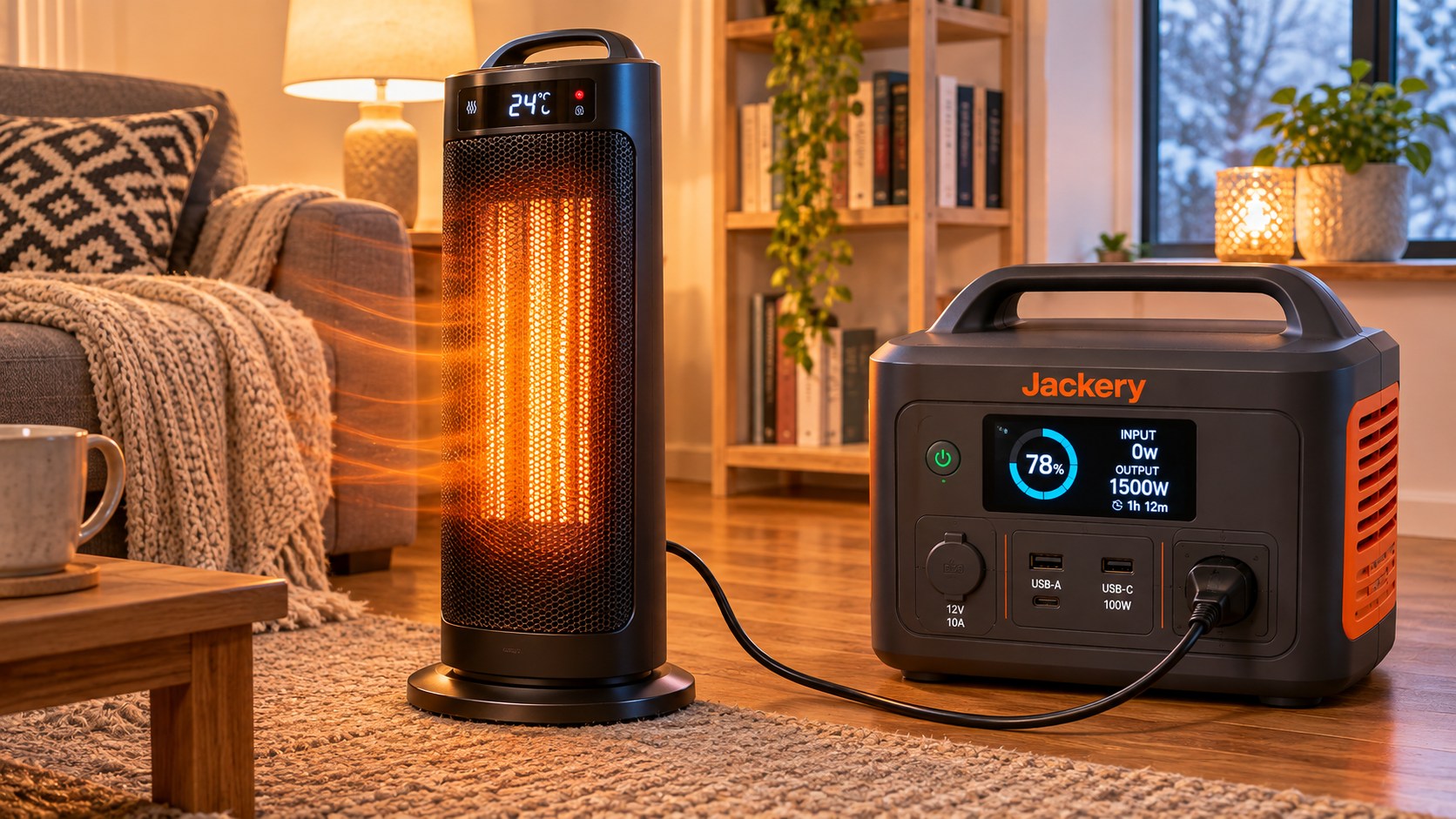
Direct answer: Technically yes, practically no. A 1,500 W heater uses 1.5 kWh an hour, so a 1 kWh station lasts about 31 minutes and a 3.6 kWh station under two hours. Batteries are the most expensive way to make heat.
Editorial note: WhichWatts is an independent comparison site. Prices, availability, specifications, and retailer promotions change frequently. Check the live product table and retailer page before buying.
Can a Power Station Run a Space Heater? (And Why It Drains So Fast)
A space heater is the simplest load in the house: a resistive element that turns electricity into heat. There is no compressor, no startup surge and no duty cycle to argue about. That simplicity is exactly why it is such a poor match for a battery.
Every watt-hour you put in comes out as heat — but you need a lot of watt-hours. This guide shows the runtime, the inverter limits, and the alternatives that make more sense in an outage.
The short answer
A power station can run a space heater, but only for a short time. A 1,500 W heater draws 1.5 kWh every hour, so a 1 kWh station gives about 31 minutes and a 3.6 kWh station about 1 hour 50 minutes. A 2,000 W heater needs a 2,000 W continuous inverter; many mid-size stations cap at 1,800 W and trip immediately.
How much energy does a space heater use?
Most full-size plug-in heaters are 1,500 W on high. Smaller personal heaters are 400–800 W; large workshop or fan heaters reach 2,000–3,000 W.
| Heater | Rating | Energy per hour | Energy for 4 hours |
|---|---|---|---|
| Personal heater | 400–800 W | 0.4–0.8 kWh | 1.6–3.2 kWh |
| Standard space heater | 1,500 W | 1.5 kWh | 6.0 kWh |
| Large fan heater | 2,000 W | 2.0 kWh | 8.0 kWh |
| Workshop heater | 3,000 W | 3.0 kWh | 12.0 kWh |
Unlike an air fryer or a fridge, there is no thermostat duty cycle to soften that: in a cold room the element runs continuously until the room reaches the setpoint. A thermostat may cycle once it is warm, but the planning figure should assume full draw.
How long will a power station run a space heater?
Using the standard 0.765 usable factor:
| Station size | Usable energy | Runtime at 1,500 W | Runtime at 2,000 W |
|---|---|---|---|
| 500 Wh | 383 Wh | 15 min | 11 min |
| 1,000 Wh | 765 Wh | 31 min | 23 min |
| 2,000 Wh | 1,530 Wh | 61 min | 46 min |
| 3,600 Wh | 2,754 Wh | 1 h 50 | 1 h 23 |
| 5,000 Wh | 3,825 Wh | 2 h 33 | 1 h 55 |
A 5 kWh station costing several thousand pounds buys two and a half hours of 1.5 kW heat. That is the economic case against battery heating in one line.
Why heaters trip mid-size stations
- Continuous rating. A 2,000 W heater needs 2,000 W continuous. Many 1–2 kWh stations are rated 1,800 W and will shut down.
- No surge headroom needed — but no slack either. The heater sits right at the limit for its whole run, which is harder on the inverter than a brief kettle boil.
- Simultaneous loads. Heater plus fridge plus lights is easily 2,500 W.
- Extension leads. A heater on a long reel lead can overheat the cable, even if the station copes.
Which power stations can run a heater?
| Station | Capacity / continuous output | Realistic heater runtime |
|---|---|---|
| EcoFlow DELTA Pro 3 | 4,096 Wh / 3,600 W | About 2 hours at 1,500 W |
| Anker SOLIX F3800 | 3,840 Wh / 6,000 W | About 2 hours at 1,500 W |
| Bluetti AC500 + B300S | 3,072 Wh per battery / 5,000 W | About 1.5 hours per battery |
| EcoFlow DELTA 2 Max | 2,048 Wh / 2,400 W | About 1 hour at 1,500 W |
| Bluetti AC200L | 2,048 Wh / 2,400 W | About 1 hour at 1,500 W |
None of these is a good way to heat a room for a night. They are listed because people ask, and because a short burst of heat while you fix a boiler is a legitimate use.
Better ways to stay warm on a battery
- Electric blanket. 40–150 W instead of 1,500 W, and it heats you rather than the room. An eight-hour night costs roughly 0.2–0.5 kWh.
- Heat the person, not the room. Heated gilet, hot water bottle, blankets, warm clothing.
- Seal the room. Draught excluders and window film reduce the heat you need in the first place.
- Use gas where it is safe. A propane or paraffin heater must be used with ventilation and a carbon monoxide alarm; never indoors in a sealed room.
- Run the central heating from a generator if you need whole-room heat for hours. A battery is the wrong tool.
FAQ
How long will a 2 kWh station run a 1,500 W heater?
About 61 minutes at full draw, assuming 90% depth of discharge and 85% inverter efficiency. In a cold room, expect the heater to run continuously rather than cycle.
Why does my 2,000 W heater trip the station?
The inverter's continuous rating is probably 1,800 W or lower. Peak or surge ratings do not cover a heater that draws 2,000 W for an hour.
What is the cheapest way to heat a room in a blackout?
Heating one person with a blanket or heated clothing uses a fraction of the energy. For whole-room heat, a fuel-based heater or generator is far cheaper per kWh than a battery.
Can I run a heater and a fridge at the same time?
Only on a large station. A 1,500 W heater plus a 150 W fridge plus lights is around 1,700 W, which is at or beyond the limit of many 2 kWh units.
Amazon price checks: electric blankets · portable power stations. As an Amazon Associate, WhichWatts earns from qualifying purchases.
Sources
- US Department of Energy: small space heaters
- US Department of Energy: electric resistance heating
- EcoFlow: space heater wattage and running cost