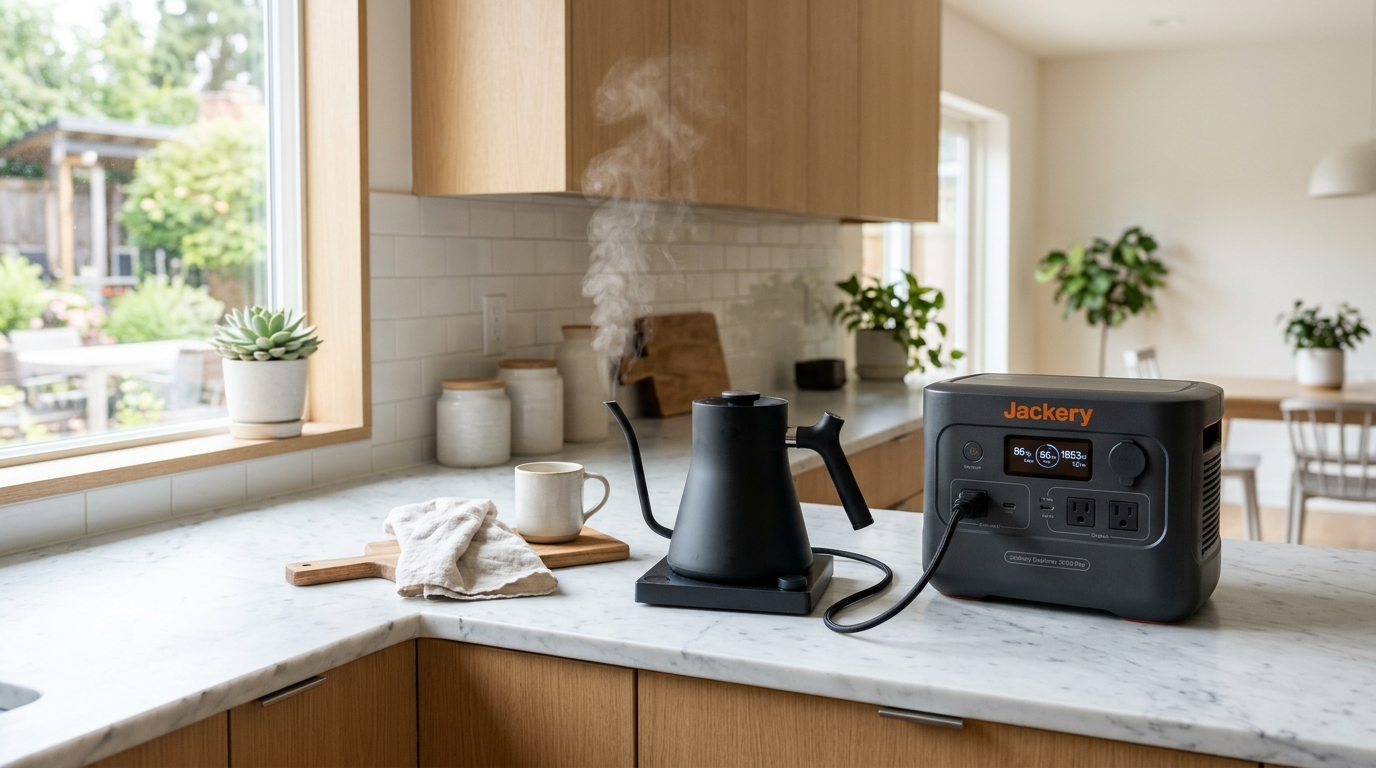
Direct answer: Yes, if the inverter can carry the kettle. A 1 kWh station boils roughly three full kettles or twelve mugs; a 3,000 W fast-boil kettle needs a station rated 3,000 W continuous, which rules out most 1–2 kWh units.
Editorial note: WhichWatts is an independent comparison site. Prices, availability, specifications, and retailer promotions change frequently. Check the live product table and retailer page before buying.
Can a Power Station Run a Kettle? Boils per Charge Explained
A kettle is the classic "small appliance, big number" problem. It runs for two to four minutes, so the energy per cup is tiny — but it draws 1,500 W to 3,000 W while it does it. Whether a power station can run a kettle therefore depends on two separate tests: can the inverter supply the wattage, and does the battery hold enough watt-hours for the number of boils you want?
This guide answers both, with the sums shown. All runtimes are planning estimates based on nameplate ratings and the same 0.765 usable-energy factor used across WhichWatts; they are not lab measurements.
The short answer
A 1,500 W travel kettle will run from almost any 1 kWh station with a 1,800 W or better inverter. A standard 2,200–3,000 W kitchen kettle needs a station whose continuous AC output meets or exceeds the kettle's rating — peak or "SurgePad" figures do not count. A 1 kWh battery boils about three full kettles (or twelve mugs); a 2 kWh battery about seven full kettles.
How much energy does a kettle actually use?
Heating water is predictable physics: raising one litre from about 15 °C to 100 °C takes roughly 0.1 kWh, and real kettles land close to that because the element sits in the water.
| Kettle type | Typical rating | Time for 1 litre | Energy per litre |
|---|---|---|---|
| Travel kettle | 500–1,000 W | 6–12 min | 0.10–0.12 kWh |
| Standard UK kettle | 2,200–3,000 W | 2.5–4 min | 0.10–0.12 kWh |
| US 120 V kettle | 1,000–1,500 W | 5–8 min | 0.10–0.13 kWh |
A measured study of 1 litre boils found 0.11 kWh, matching the theoretical figure, and a European assessment puts average consumption at about 0.12 kWh per litre. Per boil, that works out at roughly 0.03 kWh for a mug, 0.05–0.06 kWh for two mugs, and 0.17–0.20 kWh for a full 1.7 litre kettle.
The counter-intuitive part: a lower-wattage kettle does not use much less energy. It just takes longer. Wattage changes the time and the inverter requirement, not the kWh.
Watts vs watt-hours: the two tests
Test one — continuous output. The station's AC inverter must supply the kettle's full rating while it heats. A 3,000 W kettle on a 2,400 W inverter will trip even at 100% battery. Manufacturers sometimes advertise a higher "peak" or surge rating; that is designed for motor startup and is not a continuous rating.
Test two — capacity. Usable energy is rated watt-hours × 0.85 inverter efficiency × 0.9 depth of discharge, or roughly × 0.765. A 1,000 Wh station therefore delivers about 765 Wh to the kettle.
How long will a power station run a kettle?
Using 0.20 kWh for a full 1.7 litre boil and 0.063 kWh for a 0.5 litre boil:
| Station size | Usable energy | Full boils (1.7 L) | Mug boils (0.5 L) |
|---|---|---|---|
| 500 Wh | 383 Wh | 1–2 | 6 |
| 1,000 Wh | 765 Wh | 3–4 | 12 |
| 2,000 Wh | 1,530 Wh | 7 | 24 |
| 3,600 Wh | 2,754 Wh | 13 | 43 |
| 5,000 Wh | 3,825 Wh | 19 | 60 |
Those are continuous-boiling counts. In real use you also run lights, a router or a fridge from the same battery, so treat them as an upper bound.
Why your kettle trips the station
- Continuous rating, not peak. A 2,000 W kettle on a 1,800 W station trips, full stop. Peak ratings last seconds; a boil lasts minutes.
- Simultaneous loads. Kettle plus microwave plus heater can exceed the inverter even if each works alone.
- Voltage. A 230 V kettle needs a 230 V station. Plug adapters do not convert voltage, and a 120 V station cannot supply a 230 V element.
- Modified sine wave. Resistive heating does not need pure sine wave, but the station's protection circuitry may still object to the inrush. Pure sine wave is the safe default.
- Bad connection. A long, thin extension lead adds voltage drop and heat. Plug the kettle directly into the station.
Which power stations can actually run a kettle?
| Station | Capacity / continuous output | Kettle it suits |
|---|---|---|
| EcoFlow DELTA Pro 3 | 4,096 Wh / 3,600 W (7,200 W surge) | Any 3,000 W kettle, with capacity for 13 full boils |
| Anker SOLIX F3800 | 3,840 Wh / 6,000 W | 3,000 W kettle and simultaneous loads |
| Bluetti AC500 + B300S | 3,072 Wh per battery / 5,000 W | 3,000 W kettle; expandable for more boils |
| EcoFlow DELTA 2 Max | 2,048 Wh / 2,400 W | 2,200 W kettles; not a 3,000 W fast-boil |
| Bluetti AC200L | 2,048 Wh / 2,400 W | 2,200 W kettles, seven full boils |
| Anker SOLIX C1000 | 1,056 Wh / 1,800 W | 1,500 W travel kettle only |
If your kettle is 3,000 W, the honest answer is that you need a 3.6 kWh-class station or larger. If you mostly boil one or two mugs, a 1,500 W travel kettle plus a 1 kWh station is the cheaper, lighter combination.
How to boil less energy
- Boil only what you need. A full 1.7 litre boil costs roughly three times a two-mug boil.
- Use a travel kettle. 500–1,000 W draws fit far more stations, at the cost of a slower boil.
- Insulate the mug, not the kettle. A flask keeps the heat you already paid for.
- Use gas for big batches. If you are boiling litres for cooking, a camping stove uses far less battery energy.
FAQ
Will a 1,000 W power station run a 3,000 W kettle?
No. The inverter's continuous rating is below the kettle's draw, so it will trip or shut down. You need a station rated at least 3,000 W continuous, such as a DELTA Pro 3, F3800 or AC500.
How many cups of tea can a 1 kWh battery make?
About twelve mugs from a 0.5 litre boil, or three to four full 1.7 litre kettles. That assumes the station is dedicated to the kettle and starts at 100%.
Why does my kettle trip the station when the battery is full?
Capacity is not the issue; instantaneous power is. Check the kettle's rating plate against the station's continuous AC output, then add anything else running at the same time.
Can I run a kettle while the station is charging?
Only if the model supports pass-through output, and only within its output limit. Many stations reduce or stop AC output while fast-charging; check the manual before relying on it.
Is a lower-wattage kettle cheaper to run?
Barely. A 1,500 W kettle takes about twice as long as a 3,000 W one for the same volume, so the energy is similar. It is much easier on a battery, though.
Amazon price checks: travel kettles · portable power stations. As an Amazon Associate, WhichWatts earns from qualifying purchases.
Sources
- Journal of Thermal Analysis and Calorimetry: measured energy to boil 1 litre
- Fraunhofer ISI: Electric kettles energy-saving potentials
- EnergyGuide: electricity used by a kettle
- US Department of Energy: estimating appliance energy use
Keep planning
- Size the load with the power station calculator
- Compare cost per watt-hour across stations
- Read the market-stall power guide, which runs the same kettle maths for a two-day stall
- Browse stations by capacity