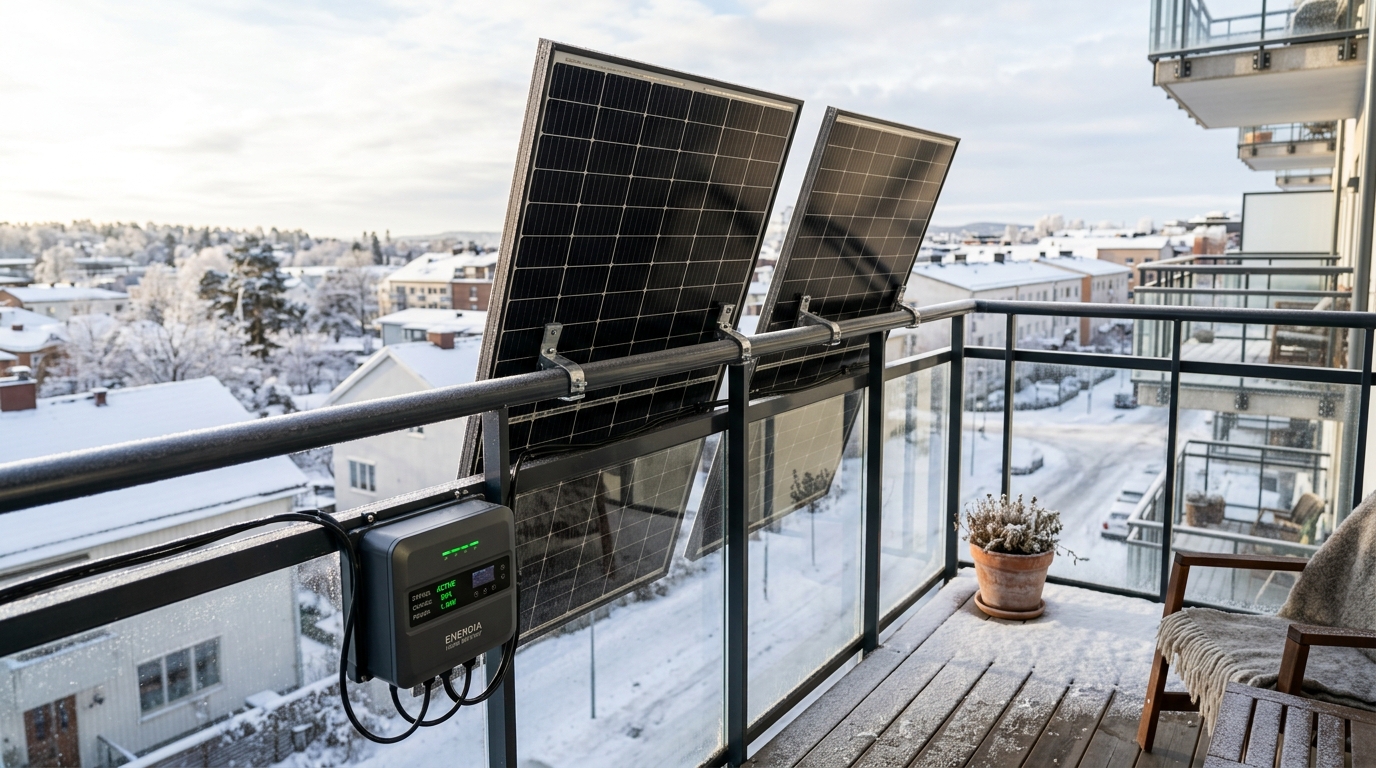
Direct answer: Why LiFePO4 cells refuse to charge below 0°C, the real difference between discharge and charge temperature limits, how internal pre-heaters work, and how to safely store power stations in cold UK garages and sheds.
Editorial note: WhichWatts is an independent comparison site. Prices, availability, specifications, and retailer promotions change frequently. Check the live product table and retailer page before buying.
Cold Weather and Sub-Zero Battery Care: Charging, Storage, and Protecting Winter Capacity
When winter temperatures dip below freezing, portable power stations and home backup batteries enter their most vulnerable operating window. A battery that powered appliances flawlessly all summer can suddenly refuse to charge from solar panels or mains power on a frosty December morning, flash an error icon on its LCD display, or appear to lose 20% to 30% of its runtime.
This behaviour is not a defect — it is an active safety intervention by the unit's Battery Management System (BMS) to prevent permanent, catastrophic cell destruction.
This comprehensive guide covers the electrochemistry of sub-zero lithium storage, the critical difference between charging and discharging thresholds, how self-heating pads function, and practical rules for keeping battery systems healthy in unheated garages, outdoor sheds, and camper vans.
The Chemistry Problem: Lithium Plating Below 0°C
Almost all modern premium power stations and home energy storage units use Lithium Iron Phosphate (LiFePO4 / LFP) chemistry due to its exceptional cycle life (3,000 to 5,000+ cycles) and thermal stability. However, LiFePO4 has a distinct operational constraint in sub-zero environments:
During normal charging above 0°C (32°F), lithium ions travel smoothly through the liquid electrolyte and intercalate (insert themselves) neatly into the layers of the graphite anode.
When cell temperatures drop below 0°C:
- Electrolyte Viscosity Increases: The liquid electrolyte thickens, slowing ionic mobility.
- Diffusion Resistance Surges: Lithium ions cannot insert themselves into the graphite anode fast enough to match the incoming charge current.
- Metallic Lithium Plating: Excess ions accumulate on the surface of the anode as pure, solid metallic lithium.
Critical Warning: Lithium plating causes permanent capacity fade and forms microscopic needle-like crystals called dendrites. Over repeated sub-zero charging cycles, dendrites can pierce the porous polymer separator, causing a direct internal short circuit, irreversible cell failure, and potential thermal runaway.
For this reason, every reputable BMS will strictly cut off charging whenever internal cell temperatures drop below 0°C (32°F), regardless of whether you plug into mains AC or 500W of winter solar.
Charging vs Discharging: Two Very Different Temperature Limits
A widespread misconception among new power station owners is that cold weather prevents a battery from running altogether. In reality, discharging is far more tolerant than charging:
| Operation | Safe Temperature Range | What Happens Outside This Range |
|---|---|---|
| Discharging (Powering Loads) | -20°C to 50°C (-4°F to 122°F) | Below -20°C, internal resistance spikes; voltage sags under heavy loads. |
| Charging (AC Mains, Car, Solar) | 0°C to 45°C (32°F to 113°F) | Below 0°C, the BMS strictly cuts off charging to prevent lithium plating. |
| Recommended Storage | 10°C to 25°C (50°F to 77°F) | Storing below -10°C or above 40°C accelerates calendar aging. |
If your power station has sat overnight in a sub-zero shed at -3°C, it can still power your router, emergency lighting, or a kettle. Discharging extracts lithium ions from the anode back to the cathode, a reaction that does not cause plating. In fact, running a moderate load (100W–300W) generates internal resistive heat (Joule heating), naturally warming the cells from the inside out.
However, if you connect solar panels or an AC charger while the cells remain at -3°C, the unit will power your loads (pass-through) but will show 0W input and refuse to replenish the battery until the cell core reaches at least 1°C to 3°C.
Apparent Capacity Loss: Where Did My Watt-Hours Go?
If your 1,000Wh power station delivers only 780Wh to 820Wh when powering appliances in a near-freezing room, do not panic. This is temporary, reversible capacity loss.
Cold temperatures increase internal cell resistance (impedance). When a heavy inverter load draws current against elevated internal resistance, it causes voltage sag. The BMS constantly monitors cell voltages; when voltage dips below the low-voltage cutoff threshold, the BMS shuts down the inverter to protect the chemistry — even though chemical energy remains inside.
Once the power station is brought into a heated room (around 20°C) and allowed to warm up for 4 to 6 hours, that "missing" 15% to 20% capacity fully returns.
Self-Heating Technology: How Premium Units Handle Winter
To solve sub-zero charging bottlenecks, newer flagship models (such as the EcoFlow DELTA Pro Ultra, Anker SOLIX F3800, and Bluetti AC200L) incorporate built-in self-heating PTC pads:
- When plugged into AC mains or incoming solar at sub-zero temperatures, the BMS diverts 100% of the input power directly to silicone heating elements wrapped around the battery pack.
- The LCD display will indicate a pre-heating status (often flashing a thermometer or flame icon).
- Once the heating pads bring internal cell temperatures safely above 5°C, the BMS switches power to the charging circuit and begins normal charging.
If your power station lacks internal heating pads, you must never use direct blowtorches, heat guns, or hot surfaces against the battery shell. Instead, insulate the unit with an insulated thermal wrap or neoprene jacket, run a modest 50W–100W DC load to warm it from within, or bring it into the heated living space.
Winter Storage & Outage Preparation Checklist
To ensure your power station remains 100% dependable during winter storms and freeze events:
- Keep Storage at 50%–70% SoC: If storing for several weeks, never leave the battery at 0% (risk of parasitic drain dropping cells below recovery voltage) or 100% (elevated mechanical stress on the cathode).
- Elevate Off Concrete Floors: Concrete conducts cold rapidly. Store the power station on a wooden pallet, workbench, or rubber mat.
- Cycle Every 3 to 6 Months: Follow the routine in our six-month readiness guide: discharge down to 20%, recharge to 80% at room temperature, and verify port operation.
- Pre-Warm Before Storms: If severe winter gales or ice storms are forecast, bring your unit into the main dwelling 24 hours in advance so the cells are at room temperature and ready to take a rapid full top-up.
Compare winter-ready models with built-in thermal management in our price comparison table or size your winter backup needs with the power station sizing calculator.
Compare Cold-Weather & Self-Heating Power Stations
Check live manufacturer pricing, winter bundles, and current discount codes:
FAQ
Can I leave my portable power station in an unheated garage during winter?
Yes, for discharging and general storage, provided temperatures stay above -10°C. However, you should not charge the unit while it is at or below 0°C unless it features internal heating pads. For best longevity and instant emergency availability, store it in an insulated indoor utility cupboard.
Why does my power station show 0W solar input on cold sunny winter mornings?
Your solar panels may be outputting healthy voltage, but if the power station's internal battery temperature sensor reads 0°C (32°F) or below, the BMS blocks the charging circuit to prevent metallic lithium plating. Once the ambient temperature rises or the unit warms up, charging resumes automatically.
Does cold weather permanently damage lithium batteries?
Discharging or storing a lithium battery in sub-zero temperatures does not cause permanent chemical damage, although it temporarily reduces usable capacity. However, attempting to force charge a lithium cell below 0°C without BMS protection causes irreversible lithium plating and permanent damage.
Can I wrap my power station in a blanket while using it?
You can insulate the battery compartment when the unit is in a freezing location, but you must ensure all cooling intake fans, exhaust vents, and inverter louvres remain completely unobstructed. Covering vents causes inverter overheating and automatic thermal shutdown.