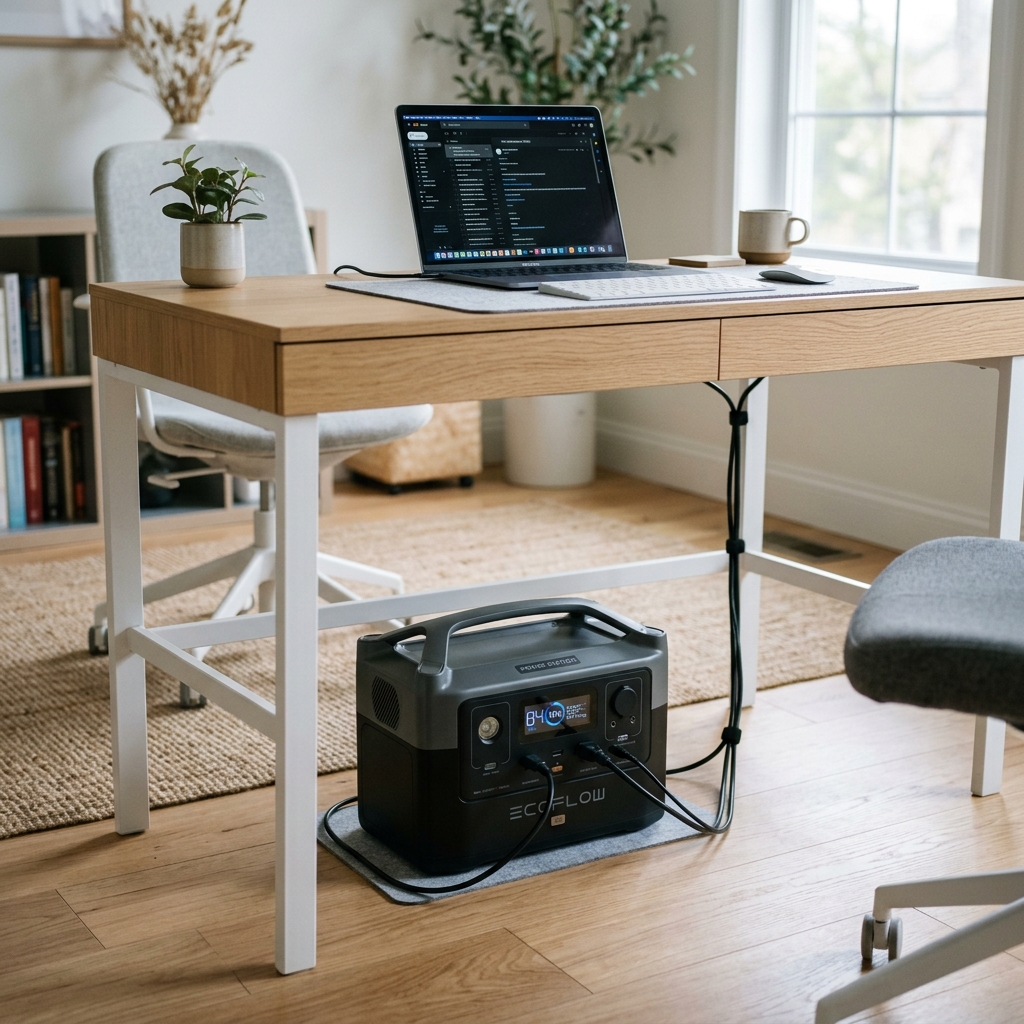
Direct answer: Compare fan noise, UPS behaviour, output, and charging limits before running a power station in a bedroom, office, or flat.
Editorial note: WhichWatts is an independent comparison site. Prices, availability, specifications, and retailer promotions change frequently. Check the live product table and retailer page before buying.
Quiet Portable Power Stations for Indoor Use
Noise from a portable power station usually comes from two places: the cooling fan and the inverter. Both change with load, temperature, and state of charge, which is why a single advertised decibel figure rarely tells the whole story. A unit can be nearly silent while topping up a phone, then become clearly audible when charging quickly or running a fridge, so the real question is not is it quiet, but is it quiet at the loads and charge rates you will actually use.
Why indoor use raises the bar
- You are more likely to notice a fan in a bedroom, office, or flat than on a campsite where background noise already exists.
- Continuous loads such as a fridge, computer, router, or medical device keep the inverter warm and the fan running longer than a short phone charge would.
- Fast charging is often noisier than slow charging, so a unit with selectable charge speed gives you a quieter overnight option.
- Battery chemistry and case design affect how much heat must be moved, but the fan strategy is an engineering choice you cannot fully predict from a spec sheet alone.
What to compare before buying
| Check | Why it matters |
|---|---|
| Continuous output with headroom | A unit running near its limit stays hot and loud |
| Documented noise at your load | A best-case decibel number is not a real-world promise |
| UPS or pass-through behaviour | Matters if the unit feeds equipment that cannot drop power |
| Ventilation and placement | A fan needs clearance; a sealed corner runs hotter |
| Warranty and certification | Essential for sensitive or medical equipment |
A practical buying checklist
- Confirm the continuous AC output covers your load with comfortable headroom, so the inverter is not pinned near its ceiling.
- Look for documented noise behaviour at the loads and charge rates you will actually use, not just a marketing figure.
- Check whether the unit can act as a UPS or pass-through supply, and whether that matters for your equipment.
- Verify ventilation clearances, operating temperature range, and whether the manual permits the indoor placement you have in mind.
- Prefer a certified unit with a documented warranty and service path if it will run sensitive or essential equipment.
Placement matters as much as the unit
Even the quietest station gets louder in a stuffy cupboard with no airflow. Give the fan room to breathe, keep the intake and exhaust clear, and test the unit at the wall distance where it will actually sit. If the room is used for sleep, consider whether a slow-charge setting, or moving the charging session to daytime, solves the problem better than chasing a lower decibel number.
Bottom line
For outage planning, start with the sizing calculator, then compare continuous output and runtime in the price comparison table. Do not assume a covered outlet makes a station waterproof or safe for damp indoor areas, and treat noise as something to verify in your own space rather than to trust from a headline.