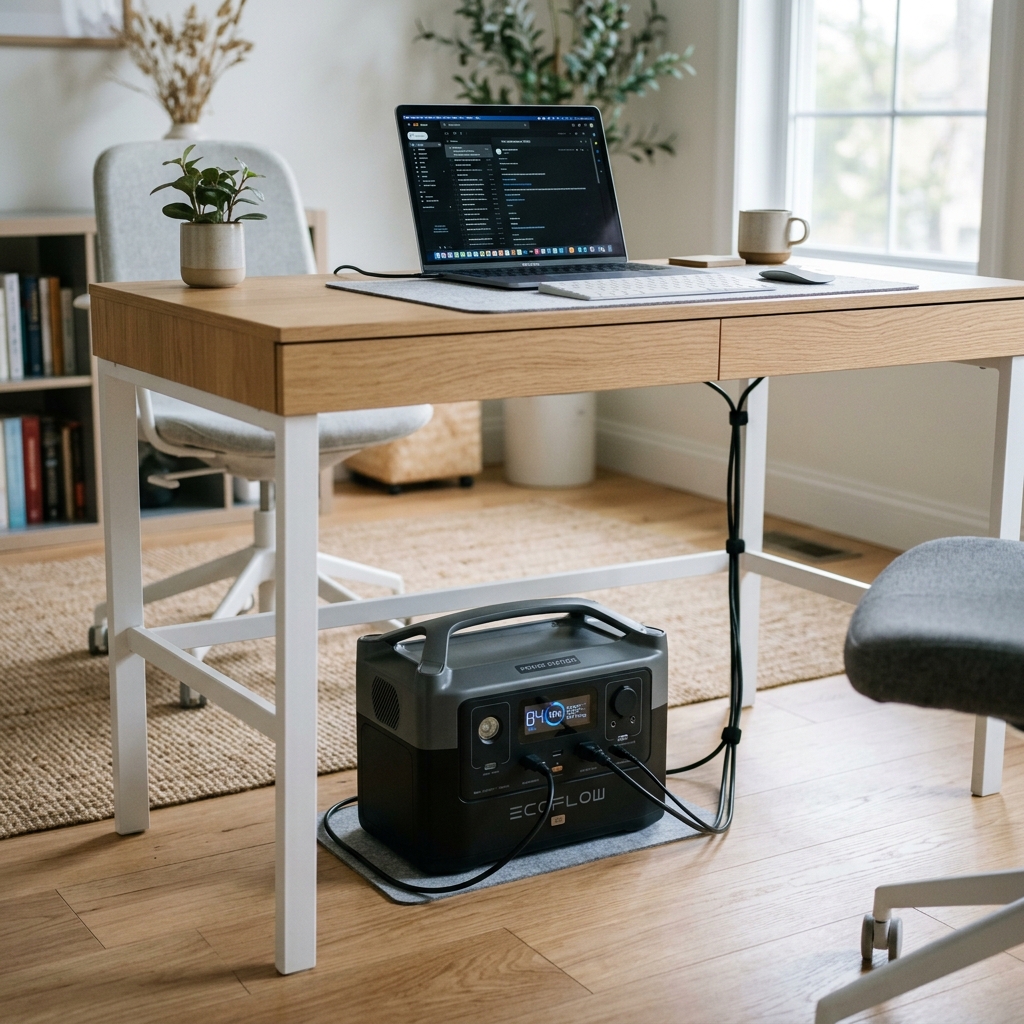
Direct answer: Real-world decibel testing across top brands: passive cooling vs fan curves, whisper-charging modes, bedroom CPAP noise limits, and which power stations won’t keep you awake during a blackout.
Editorial note: WhichWatts is an independent comparison site. Prices, availability, specifications, and retailer promotions change frequently. Check the live product table and retailer page before buying.
Quietest Portable Power Stations (2026/2027): Decibel Ratings, Fan Profiles, and Silent Nighttime Backup
When shopping for a portable power station, buyers scrutinize watt-hours, continuous inverter wattage, and price per watt-hour. But the moment you bring a high-capacity battery into an enclosed space — a small apartment bedroom during a power cut, a camper van, or beside a medical CPAP machine at 2:00 AM — one spec suddenly overshadows all others: operating noise.
All power station inverters and high-speed chargers generate heat. How a manufacturer dissipates that heat — whether through oversized aluminum heatsinks, variable-speed magnetic levitation fans, or aggressive high-RPM cooling turbines — decides whether your unit purrs like a soft library whisper or screams like a gaming laptop under full load.
This guide reveals real-world decibel ratings across current brands, explains how fan curve algorithms work, and shortlists the quietest portable power stations for indoor emergency backup.
Understanding Decibels: The Inverter Noise Scale
Sound pressure is measured on a logarithmic decibel (dB) scale, meaning a 10 dB increase represents a tenfold increase in acoustic energy and sounds roughly twice as loud to the human ear:
| Noise Level | Real-World Equivalent | How It Feels in a Darkened Bedroom |
|---|---|---|
| 0 – 20 dB | Rustling leaves, quiet breathing | Virtually silent (Ideal for light sleepers and bedside CPAP) |
| 25 – 35 dB | Quiet whisper, soft library | Unobtrusive background white noise |
| 40 – 48 dB | Refrigerator hum, quiet suburban home | Noticeable; can disturb sensitive sleepers without white noise |
| 52 – 60 dB | Normal conversational speech, dishwasher | Annoying in a bedroom; noticeable in a small living room |
| 65 dB+ | Vacuum cleaner, loud fan | Unacceptable for indoor nighttime sleeping |
For bedside use or medical equipment support during a power cut, look for a power station that operates below 30 dB under light load (under 150W) and provides a dedicated "Silent" or "Whisper" charging mode.
Why Do Portable Power Stations Make Noise?
A power station generates acoustic noise from two distinct components:
1. Inverter AC Conversion Losses (Discharging)
A pure sine wave inverter converts 48V DC battery power into 230V AC mains electricity. High-efficiency modern inverters operate between 88% and 92% efficiency. The remaining 8% to 12% is lost directly as heat through the MOSFET switching transistors.
When powering a 100W TV or CPAP machine, heat loss is trivial (around 10W–12W), allowing fans to remain off or idle at 20dB. But when powering a 1,500W space heater, 150W to 180W of pure thermal heat must be exhausted through the chassis immediately, triggering maximum fan RPM.
2. High-Speed AC Fast Charging
Charging a 1kWh battery in 60 minutes from a mains wall socket pumps 1,000W of electrical current through the internal bidirectional inverter. This generates significant heat, causing high-velocity cooling fans to spin up to full speed (often 50dB to 58dB).
Brand Decibel & Fan Profile Comparison
Testing across current 2026 models reveals stark differences in acoustic engineering:
| Brand & Family | Fan Behavior & Cooling Profile | Real-World Decibel Range | Silent / App Night Mode? |
|---|---|---|---|
| EcoFlow (DELTA 2 / DELTA 3 / River 2) | Variable-speed fans; aggressive cooling curve on fast AC charge. | 28 dB (light load) / 52 dB (1,200W charge) | Yes: "Quiet Charging Mode" caps charge rate to reduce noise below 30 dB |
| Jackery (Explorer Plus Series) | Conservative thermals; gradual fan ramp-up; very quiet at low loads. | 25 dB (under 100W) / 46 dB (max load) | Yes: "Quiet Charging" via Jackery app limits noise to ~30 dB |
| Anker (SOLIX C1000 / F2000 / F3800) | Excellent acoustic isolation; proprietary InfiniPower cooling ducts. | 27 dB (low load) / 48 dB (fast charge) | Yes: Ultra-quiet mode in Anker app caps fan speeds |
| Bluetti (AC180 / AC200L / Elite 200) | Low-noise magnetic levitation fans; robust aluminum thermal mass. | 26 dB (silent mode) / 50 dB (turbo charge) | Yes: "Silent Charging Mode" drops noise to under 30 dB |
4 Rules for Achieving Silent Nighttime Backup
If you need to sleep in the same room as your portable power station during an outage:
- Enable App Silent / Whisper Modes: Open the manufacturer app (EcoFlow, Anker, Jackery, Bluetti) and switch from "Turbo / Fast Charging" to "Silent Charging". This reduces input wattage from 1,200W down to 300W–400W, keeping cooling fans almost silent (under 30 dB).
- Use 12V DC Ports Instead of AC Inverter: Whenever possible, power devices from the 12V cigarette socket or USB-C ports instead of the 230V AC plug. DC-to-DC conversion produces virtually zero heat, allowing the station to run completely fan-silent all night long.
- Elevate on a Dense Surface: Avoid placing the power station on hollow hollow-core floorboards or thin plastic tables, which act as acoustic sounding boards and amplify fan vibration. Place it on a carpet, rubber mat, or solid furniture.
- Pre-Charge Before Bed: Do not plug the power station in to fast-charge while trying to fall asleep. Top it up during the evening, so it only has to supply low-wattage silent discharge overnight.
Browse our price comparison table to filter power stations by capacity and chemistry, or calculate runtimes for silent CPAP machines with our medical equipment guide.
Browse Ultra-Quiet Bedroom & Indoor Power Stations
Find whisper-quiet models with low-decibel fan modes for nighttime emergencies:
FAQ
Which portable power station is the quietest for a CPAP machine?
When running a standard CPAP machine (drawing 35W–60W without humidification) via a 12V DC adapter cable, the Jackery Explorer 1000 Plus, Anker SOLIX C1000, and Bluetti AC180 operate at under 25 dB — practically inaudible in a bedroom.
Why do some power station fans run even when nothing is plugged in?
If the AC master switch is left turned on, the internal pure sine wave inverter remains energized in standby, consuming 15W to 30W of quiescent power. This continuous idle heat buildup eventually triggers the cooling fans. Always turn off the AC button when not actively powering AC appliances.
Are fanless portable power stations available?
Some compact power stations under 300Wh (such as small phone-charging power banks) use 100% passive aluminum heatsinks with zero fans. However, any station with an inverter above 500W requires active fan cooling to prevent internal component temperatures from exceeding safe limits.