LiFePO4 Battery (LFP): Cycle Life, Safety, Cost and Trade-offs
LiFePO4 is a lithium-ion chemistry that uses an iron-phosphate cathode. It typically offers 3,000–5,000 manufacturer-rated cycles, better thermal stability than NMC, and a lower median cost per watt-hour in the current WhichWatts catalog. The trade-offs are weight, cold-weather charging limits, and slightly lower energy density.
By WhichWatts editorial team · Updated October 25, 2026
What is LiFePO4?
LiFePO4 stands for lithium iron phosphate. It is a lithium-ion chemistry that uses an iron-phosphate cathode, typically with a graphite anode. Cells have a nominal voltage of about 3.2V, and packs are built by connecting cells in series and parallel.
The cathode material is olivine-structured lithium iron phosphate. The strong phosphorus-oxygen bonds make the cathode more thermally stable than the layered oxide cathodes used in NMC and NCA, which is the main reason LFP has a reputation for safety.
The trade-off is energy density. LFP cathodes store less energy per kilogram than NMC, so an LFP pack is usually larger and heavier for the same watt-hours. Early LFP cells also had lower discharge rates; modern cells have improved, but high-power applications still need careful pack design.
“LFP” and “LiFePO4” are the same thing. “Lithium iron phosphate” is the descriptive name; LiFePO4 is the chemical formula.
LiFePO4 vs NMC vs lead-acid: how do they compare?
LFP lasts longer and is more thermally stable than NMC, but it is heavier. NMC is lighter and more compact. Lead-acid is cheaper upfront but heavy, short-lived, and only about 50% usable. For portable power, LFP is the best all-round compromise for most buyers.
| Factor | LiFePO4 (LFP) | NMC / NCA | Lead-acid |
|---|---|---|---|
| Nominal cell voltage | About 3.2V | About 3.6–3.7V | 2V per cell (12V block = 6 cells) |
| Typical cycle life | 3,000–5,000 | 500–1,000 | 300–500 at 50% DoD |
| Energy density | About 90–160 Wh/kg | About 150–250 Wh/kg | About 30–50 Wh/kg |
| Thermal stability | High | Moderate | Moderate |
| Cold charging | Generally blocked below 0°C | Often allowed with limits | Less restricted, capacity drops |
| Upfront cost per kWh | Moderate | Higher | Lowest |
| Best fit | Daily cycling, backup, longevity | Lightweight, compact, high energy | Stationary budget backup |
The cycle-life ranges are manufacturer claims, not independent test results. A 5,000-cycle LFP battery may be rated at a shallow depth of discharge and a moderate temperature; a 3,000-cycle rating at 80% DoD is a different promise.
How many cycles does a LiFePO4 battery last?
Most LFP power stations are rated for 3,000–5,000 full cycles before capacity falls to about 80%. Real-world life depends on depth of discharge, temperature, charge rate, and storage. Calendar aging continues even when the battery is not cycled.
A cycle is usually an equivalent full cycle. If you discharge 50% and recharge, that is half a cycle. The end-of-life threshold matters: “3,000 cycles to 80%” is a stronger claim than “3,000 cycles” with no capacity target.
LFP is often described as having a long calendar life, but that does not mean it can be stored indefinitely at 100% in a hot room. For long storage, charge to about 50–60%, keep the pack cool and dry, and recharge every few months.
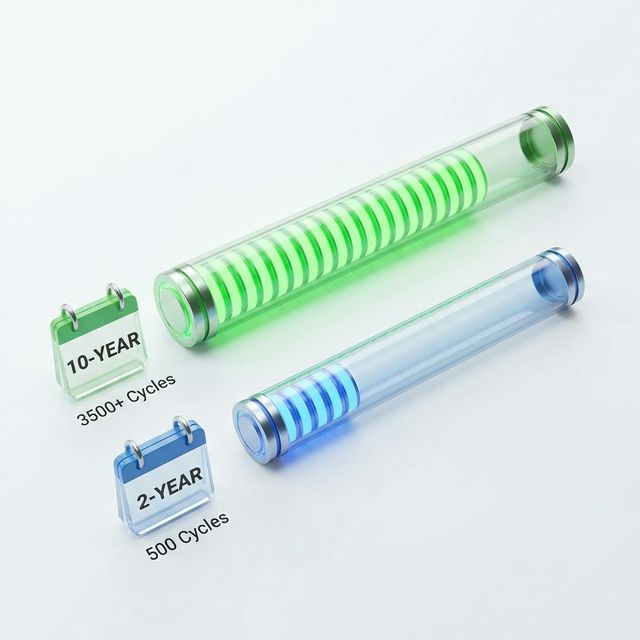
Warranty terms are a useful reality check. A 10-year warranty with a throughput limit tells you what the manufacturer expects; a 2-year warranty on a “5,000-cycle” pack tells you the claim is marketing, not a commitment.
Can LiFePO4 batteries be charged below freezing?
Generally no. Charging LFP below 0°C (32°F) can cause lithium plating, which permanently reduces capacity and can create a safety risk. Many BMS units block charging below freezing; some premium systems heat the cells first. Discharging in cold weather is usually allowed, but capacity is reduced.
If you need a power station in winter or a cold climate, check the operating temperature range in the manual, not just the marketing page. Look for:
- A minimum charging temperature of 0°C or higher, with a BMS that enforces it.
- A low-temperature charging cut-off and, if advertised, internal heating.
- A discharge range that covers your expected conditions.
- Storage guidance for freezing conditions.
Never bypass a BMS low-temperature lockout. If a station refuses to charge in the cold, that is a protection feature, not a fault. Let it warm up to a safe temperature first.
How much does LiFePO4 storage cost?
For portable power stations, LFP usually has a lower median cost per watt-hour than NMC/Li-ion in the current WhichWatts catalog. The exact figure varies by capacity, brand, inverter, and warranty, so use the live table on this page rather than a generic industry average.
The cell cost is not the product cost. A power station adds an inverter, MPPT solar charger, BMS, ports, display, enclosure, and warranty support. Two stations with the same LFP cells can have very different $/Wh because one has a 2,000W inverter and the other has a 500W inverter.
Use the live catalog medians as a benchmark, then compare specific models. A lower $/Wh is only meaningful if the product also meets your output, surge, solar input, and port requirements.
Which power stations use LiFePO4?
Most mid-range and premium portable power stations now use LiFePO4, including many EcoFlow DELTA and RIVER models, Bluetti AC and Elite series units, Jackery Explorer v2 models, and Anker SOLIX units. Check the individual product page: brands still sell NMC models in some sizes and regions.
Do not assume a brand means a chemistry. Manufacturers mix cell types across product lines and revise models without changing the name. The safest approach is to check the battery type on the product page or datasheet.
WhichWatts lists the battery chemistry on product pages and in the catalog filters. If a listing says LiFePO4, the source is the manufacturer specification or a verified retailer listing. If the chemistry is missing, treat it as unknown rather than assuming LFP.
Is LiFePO4 worth the extra cost?
For most buyers, yes. The longer cycle life and thermal stability usually outweigh the weight penalty, especially for home backup and frequent camping. If you need the lightest possible pack for occasional use, an NMC model can still be the better fit.
A simple way to decide:
- Daily or weekly use: LFP. The cycle life matters.
- Home backup: LFP. The pack may sit for long periods, and thermal stability is valuable.
- Backpacking or airline travel: compare weight carefully. NMC may be lighter, but check airline watt-hour limits.
- Tight budget, occasional use: a well-reviewed NMC or budget LFP model can work; do not pay for cycle life you will never use.
Whatever the chemistry, buy from a seller with a clear warranty and a product that has been certified for its market.
Bottom line
LiFePO4 is the best default chemistry for portable power stations and home backup in 2026. It lasts longer, is more thermally stable, and now typically costs less per watt-hour than NMC. Accept the extra weight and respect the cold-charging limits.
If weight is the deciding factor, NMC is the alternative. If upfront price is the deciding factor, a budget LFP station is usually a better long-term buy than a cheap lead-acid system.
Where to start shopping
The three lowest cost-per-watt-hour stations in the live US catalog. Affiliate links; the ranking is not paid.


Retailer links are affiliate links. WhichWatts may earn a commission; the shortlist is ranked by cost per watt-hour, not by commission.
Shop by brand
Direct links to manufacturer stores. These are affiliate links and we may earn a commission.
Compare before you buy
Browse every model · Cost per watt-hour chart · Best for home backup · Size a system for your appliances
Common questions
Is LiFePO4 the same as lithium-ion?
Yes. LiFePO4 is a type of lithium-ion battery. It is often compared with NMC/NCA because those are the other common lithium-ion chemistries in power stations.
How many cycles does a LiFePO4 battery last?
Most power station manufacturers rate LFP for 3,000–5,000 cycles to about 80% capacity. Actual life depends on depth of discharge, temperature, charge rate, and storage conditions.
Can LiFePO4 be charged below freezing?
Generally no. Charging below 0°C can cause lithium plating and permanent damage. Many BMS units block charging in the cold; some systems heat the cells first. Discharging in cold weather is usually allowed with reduced capacity.
Is LiFePO4 safer than NMC?
LFP is more thermally stable and generally has a lower fire risk than NMC under abuse. It is not risk-free: a certified pack, a functioning BMS, and proper use are still required.
Why is LiFePO4 heavier?
LFP cathodes store less energy per kilogram than NMC cathodes, so an LFP pack needs more mass for the same watt-hours. The trade-off buys longer cycle life and greater thermal stability.
Does LiFePO4 lose capacity over time?
Yes. Both cycling and calendar aging reduce capacity. Keeping the pack cool, avoiding prolonged storage at 100%, and respecting the charge temperature limits slows the loss.
Sources
- U.S. Department of Energy — Batteries — Lithium-ion chemistry and system basics.
- U.S. Energy Information Administration — Energy storage — How storage is used on the grid and how capacity is measured.
- IEC — Standards portal — IEC 62619 and related battery safety standards.
Related: Battery types explained · Lithium-ion battery guide · Battery capacity explained · Solid-state batteries: status and trade-offs · LiFePO4 vs NMC vs LTO · Browse LiFePO4 power stations
WhichWatts is independent and funded by affiliate commission. Figures come from manufacturer specifications and the live catalog; see our methodology. Corrections to hello@whichwatts.com.