Lithium-Ion Battery: How It Works, Types, Lifespan and Cost
Lithium-ion batteries move lithium ions between an anode and a cathode to store and release energy. The cathode chemistry determines the trade-offs: NMC and NCA offer high energy density, LFP offers long cycle life and thermal stability, and LTO offers extreme cycle life at low density. For portable power stations, LFP and NMC cover almost every product worth comparing.
By WhichWatts editorial team · Updated October 25, 2026
What is a lithium-ion battery?
A lithium-ion battery is a rechargeable battery that uses lithium ions as the charge carrier. Lithium ions move between a host anode and a host cathode through an electrolyte, while electrons flow through the external circuit to do work.
The name describes the mechanism, not the chemistry. The anode is usually graphite, the cathode is a lithium metal oxide or phosphate, and the electrolyte is a lithium salt in a solvent. The separator is a porous membrane that prevents direct contact between the electrodes.
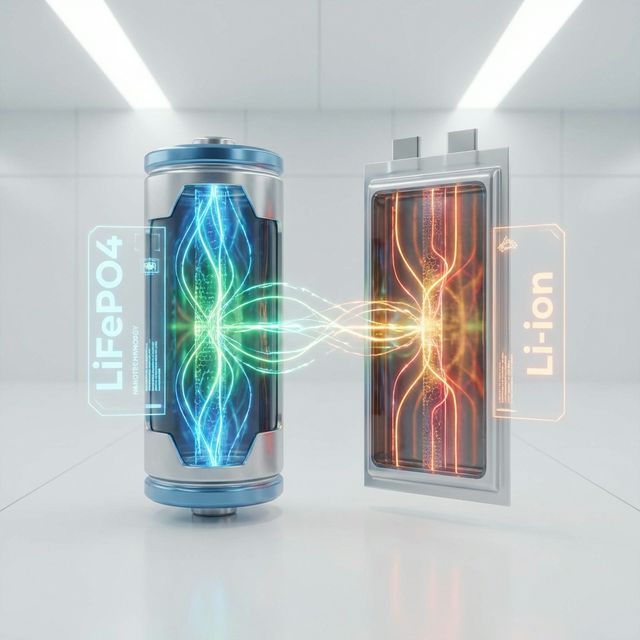
“Lithium-ion” is often used loosely to mean NMC/NCA, while LiFePO4 is treated as a separate category. Technically, LiFePO4 is also a lithium-ion chemistry. This matters when you compare specs: a page that says “lithium-ion vs LiFePO4” is usually comparing NMC/NCA with LFP.
How does a lithium-ion battery work?
On charge, an external voltage pushes lithium ions out of the cathode, through the electrolyte, and into the anode. On discharge, the ions move back to the cathode and the electrons power your devices. The process is reversible, but every cycle causes small irreversible changes.
The anode and cathode are intercalation hosts: they accept lithium ions into their crystal structure without dissolving. This is why the process is called “rocking-chair” storage. The electrolyte is an ion conductor but an electronic insulator, so electrons are forced through the external circuit.
Several degradation mechanisms limit life:
- Solid electrolyte interphase (SEI) growth: a passivation layer forms on the anode and slowly consumes lithium.
- Lithium plating: at low temperature or high charge rate, lithium metal plates on the anode instead of intercalating, permanently reducing capacity.
- Cathode cracking and transition-metal dissolution: repeated cycling and heat damage the cathode structure.
- Electrolyte oxidation: high voltage and high temperature accelerate side reactions.
A good BMS and thermal design slow these processes. A cheap pack that charges fast but runs hot will not deliver its rated cycle life.
What are the main lithium-ion chemistries?
The cathode chemistry defines the trade-offs. NMC and NCA offer high energy density; LFP offers long cycle life and thermal stability; LTO offers extreme cycle life and fast charging; LMO is an older, lower-cost chemistry. For power stations, LFP and NMC are the relevant choices.
| Chemistry | Typical cycle life | Energy density | Best fit |
|---|---|---|---|
| NMC (nickel manganese cobalt) | 500–1,000 | High | Compact power stations, EVs, tools |
| NCA (nickel cobalt aluminum) | 500–1,000 | High | EVs and high-energy packs |
| LFP (lithium iron phosphate) | 3,000–5,000 | Moderate | Daily cycling, home backup, safety |
| LTO (lithium titanate) | 10,000+ | Low | Fast charging, high-cycle applications |
| LMO (lithium manganese oxide) | 300–700 | Moderate | Older or low-cost devices |
“NCM” and “NMC” refer to the same nickel-manganese-cobalt family. The numbers in a name such as NMC 811 describe the ratio of nickel, manganese, and cobalt. Higher nickel usually means higher energy density and lower thermal stability.
How long does a lithium-ion battery last?
Cycle life is usually stated as the number of full charge-discharge cycles before the battery falls to a percentage of its original capacity, often 80%. NMC/NCA is typically rated for 500–1,000 cycles; LFP for 3,000–5,000. Calendar aging also reduces capacity even if the battery is rarely used.
A “cycle” is not always a full 0–100% run. Manufacturers often count equivalent full cycles: two 50% discharges count as one full cycle. The test temperature, charge rate, discharge rate, and end-of-life threshold all affect the number.
Calendar aging is separate. A lithium-ion battery stored at a high state of charge and high temperature loses capacity faster than one stored at around 50% in a cool, dry place. For a power station that sits unused for months, storage conditions can matter as much as cycle count.
Practical advice:
- Store at about 50–60% charge if the battery will sit for weeks.
- Avoid leaving it at 100% in a hot car or garage.
- Recharge to a healthy level every few months.
- Use the manufacturer’s charger and observe the temperature limits.
What accelerates lithium-ion degradation?
Heat, high state of charge, deep discharge, and fast charging are the main accelerators. A battery that is kept cool, cycled gently, and stored at a moderate charge will usually outlast one that is repeatedly run to empty and charged at maximum rate.
Heat is the single biggest factor. Chemical side reactions roughly double in rate for every 10°C rise in temperature within the operating range. That is why a power station left in direct sun or a hot vehicle ages faster.
High voltage at the cathode accelerates electrolyte oxidation. Keeping a battery at 100% for long periods is therefore worse than charging it to 80% and topping it up before use. Deep discharge is also stressful, especially for lead-acid but also for lithium if the BMS allows the pack to sit at a very low voltage.
Fast charging is a trade-off, not automatically harmful. A well-designed pack will taper the current as it approaches full and will manage temperature. The problem is fast charging at low temperature or with inadequate cooling.
Are lithium-ion batteries safe?
Yes, when the pack is well designed, certified, and used within its limits. Lithium-ion cells can enter thermal runaway if they are overcharged, overheated, short-circuited, or physically damaged, so the BMS, cell spacing, enclosure, and certification matter.
Look for a documented BMS and relevant certification. For portable power stations, UL 2743 is a common North American safety standard; IEC 62619 covers industrial lithium battery safety; UN 38.3 covers transport. Regional electrical approvals also apply.
Safety practices:
- Do not charge a lithium battery below 0°C unless the manufacturer explicitly supports it.
- Do not puncture, crush, or immerse the pack.
- Do not use a charger that exceeds the specified voltage or current.
- Keep the pack away from flammable materials while charging.
- If a pack swells, overheats, or smells unusual, stop using it and isolate it.
How much does lithium-ion storage cost?
Cost is usually compared per kilowatt-hour (kWh) or per watt-hour (Wh). For portable power stations, the live WhichWatts catalog shows a lower median cost per watt-hour for LiFePO4 than for NMC/Li-ion, but the gap varies by capacity, brand, and included electronics.
The battery cell is only part of the cost. A power station also includes an inverter, charge controller, BMS, ports, enclosure, display, and warranty. That is why cost per watt-hour for a complete station is higher than the raw cell cost published in battery-industry reports.
Use cost per watt-hour to shortlist comparable products, then check output, surge, solar input, weight, and warranty. A low $/Wh product with a weak inverter or a short warranty may not be the better value.
Lithium-ion vs lead-acid: which is better?
Lithium-ion is lighter, has more usable capacity, and lasts longer; lead-acid is cheaper upfront and simpler to recycle. For portable power, lithium-ion wins on weight and usable energy. For a stationary budget system with infrequent cycling, lead-acid can still make sense.
| Factor | Lithium-ion (LFP/NMC) | Lead-acid |
|---|---|---|
| Usable capacity | Often 80–100% of nameplate | About 50% for good life |
| Weight | Much lower per kWh | Much higher per kWh |
| Cycle life | 500–5,000+ depending on chemistry | 300–500 at 50% DoD |
| Upfront cost | Higher per kWh | Lower per kWh |
| Maintenance | Low | Watering and terminal care for flooded types |
| Cold performance | Charging limits below 0°C | Capacity drops in cold, but charging is less restricted |
The comparison is not close for camping or RV use: lead-acid’s weight and usable-capacity penalty usually outweigh its lower sticker price.
How do I choose a lithium-ion power station?
Start with the load and runtime you need, then choose LFP unless weight or compact size is the priority. Check the inverter’s continuous and surge output, solar input, ports, BMS features, warranty, and certification. Use cost per watt-hour only after those requirements are met.
A practical shortlist:
- Calculate your load: watts × hours for each device, plus a 20% buffer.
- Check surge: motors and compressors can draw two to three times their running wattage at startup.
- Choose chemistry: LFP for longevity and safety; NMC for lighter weight.
- Check recharge: AC input, solar input, and whether pass-through charging is supported.
- Check the BMS and warranty: a long warranty is only useful if the company honors it.
- Compare $/Wh: use the price comparison chart after the shortlist is set.
Bottom line
Lithium-ion is the right family for portable power and home backup. LFP is the default for most buyers because it lasts longer and is more thermally stable; NMC/NCA is the lighter option. The BMS, warranty, and system design matter as much as the chemistry name.
If you are comparing two similarly priced stations, choose the one with the better-documented battery, a real warranty, and the output and solar input your use case needs. Chemistry is the starting point, not the whole decision.
Where to start shopping
The three lowest cost-per-watt-hour stations in the live US catalog. Affiliate links; the ranking is not paid.


Retailer links are affiliate links. WhichWatts may earn a commission; the shortlist is ranked by cost per watt-hour, not by commission.
Shop by brand
Direct links to manufacturer stores. These are affiliate links and we may earn a commission.
Compare before you buy
Browse every model · Cost per watt-hour chart · Best for home backup · Size a system for your appliances
Common questions
Is lithium-ion the same as LiFePO4?
LiFePO4 is a type of lithium-ion battery. The term “lithium-ion” is often used for NMC/NCA chemistries, while LiFePO4 is called out separately because its cycle life, weight, and safety profile are different.
How long does a lithium-ion battery last?
NMC/NCA is typically rated for 500–1,000 cycles to 80% capacity; LFP for 3,000–5,000. Calendar aging also matters, so a battery stored hot or at full charge will lose capacity even if it is not cycled often.
Do lithium-ion batteries have a memory effect?
No meaningful memory effect. The old advice to fully discharge a battery before recharging comes from nickel-cadmium chemistry. Lithium-ion prefers partial cycles and should not be left at very low voltage for long periods.
Can I charge a lithium-ion battery to 100%?
Yes, within the manufacturer’s limits. For daily use, charging to about 80% and topping up before a trip can reduce calendar aging. Follow the product manual; some systems manage this automatically.
Is fast charging bad for lithium-ion batteries?
Not automatically. Heat and charging at low temperature are the bigger concerns. A well-designed pack tapers current near full and manages temperature. Use the manufacturer’s charger and avoid fast charging when the pack is very cold or hot.
What is a BMS?
A battery management system monitors cell voltage, current, and temperature, balances cells, and disconnects the pack if conditions are unsafe. It is a critical safety and longevity component, not an optional accessory.
Are lithium-ion batteries safe indoors?
A certified power station with no fuel and no exhaust is safe indoors under normal use. Follow the manual, keep it away from water and flammable materials, and do not charge or store it outside its temperature range.
Sources
- U.S. Department of Energy — Batteries — Lithium-ion chemistry and system basics.
- U.S. Energy Information Administration — Energy storage — How storage is used on the grid and how capacity is measured.
- IEC — Standards portal — IEC 62619 and related battery safety standards.
- UL Solutions — UL 2743 and product safety certification context.
Related: Battery types explained · LiFePO4 battery guide · Battery capacity explained · Solid-state batteries: status and trade-offs · Lithium vs lead-acid power stations · Compare power stations by cost per Wh
WhichWatts is independent and funded by affiliate commission. Figures come from manufacturer specifications and the live catalog; see our methodology. Corrections to hello@whichwatts.com.