Solar Battery Storage: How It Works, Sizing and Costs
Solar battery storage saves excess solar generation for use at night or during an outage. Size it from daily kWh and the loads you want to back up, not from panel wattage alone. Lithium systems typically round-trip 85–90% of the energy; LFP is the dominant chemistry for new home storage.
By WhichWatts editorial team · Updated October 25, 2026
How does solar battery storage work?
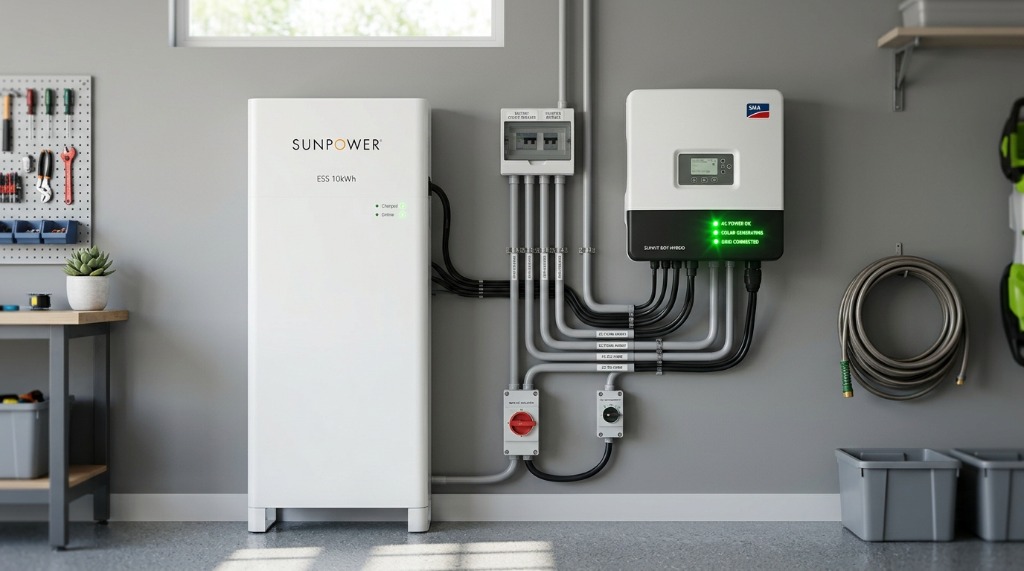
Solar panels produce DC electricity. A charge controller or hybrid inverter sends excess energy into a battery, and an inverter converts stored DC back to AC when the house needs it. The battery can also provide backup power if the system is designed for it.
A grid-tied solar system without a battery sends surplus generation to the grid and draws power back at night. Adding storage changes the energy flow: surplus solar charges the battery first, the house uses stored energy when solar is low, and any remaining surplus or deficit goes to or comes from the grid.
The main components are the panels, the inverter, the battery, and the controls that decide when to charge and discharge. In a backup-ready system there is also a transfer switch or a critical-load panel that disconnects the house from the grid and lets the inverter run selected circuits safely.
Storage does not create energy. It shifts energy in time. A battery can improve self-consumption, reduce peak-import charges, and carry a house through an outage, but it cannot make a solar array produce more than the roof and weather allow.
What is the difference between AC-coupled and DC-coupled storage?
AC-coupled storage adds a battery inverter to an existing solar inverter. DC-coupled storage connects the battery to the same DC bus as the panels through a hybrid inverter. DC coupling typically avoids one conversion; AC coupling is usually easier to retrofit.
| AC-coupled | DC-coupled | |
|---|---|---|
| Best for | Adding a battery to an existing solar system | A new system, or a full inverter replacement |
| Energy path | Panels → solar inverter → AC → battery inverter → battery | Panels → hybrid inverter → battery |
| Conversions | More conversion steps, so slightly lower efficiency | Fewer conversion steps |
| Equipment | Separate battery inverter | Hybrid inverter that manages both |
| Retrofit | Usually simpler | Often requires replacing the existing inverter |
| Backup | Possible if the battery inverter supports islanding | Possible if the hybrid inverter supports islanding |
The right choice depends on the existing equipment, the battery’s compatibility list, and whether the installer can commission a backup circuit. Do not choose a topology from a table alone. The inverter and battery have to be tested together and supported by the manufacturer.
How do I size a solar battery?
Start with daily energy use and the share you want to shift or back up. Divide by usable depth of discharge and round-trip efficiency, then add headroom for aging and unusual days. Panel wattage alone does not determine battery size.
A practical sizing sequence:
- Find daily consumption. Use a year of utility bills or, better, interval data. A household that uses 900 kWh per month averages about 30 kWh per day, but the daily figure varies with season and behaviour.
- Decide the job. For bill savings, estimate the solar surplus you can actually store. For backup, list the essential loads and the hours you need them. These are different calculations.
- Convert to delivered watt-hours. Add up watts × hours for the backed-up loads. For a fridge, use average draw rather than the compressor’s peak.
- Allow for usable capacity and efficiency. A lithium battery may be usable to about 90% depth of discharge, and a full round trip returns about 85–90% of the energy. Divide delivered watt-hours by roughly 0.9 × 0.88.
- Add headroom. A 20% buffer covers aging, cold weather, and loads you forgot. Do not plan to run the battery to empty every night.
Worked example, bill savings. A house uses 10 kWh per day and wants to shift half of it to stored solar. That is 5 kWh delivered. At 90% usable depth and 88% round-trip efficiency, the nominal battery needs to be about 5 ÷ (0.9 × 0.88) = 6.3 kWh. Round up to the next available size.
Worked example, backup. A fridge averaging 100 W over 24 hours uses about 2.4 kWh. A router at 10 W uses 0.24 kWh, lights at 30 W for five hours use 0.15 kWh, and phone and laptop charging adds about 0.13 kWh. That is roughly 2.9 kWh delivered. At the same efficiency assumptions plus 20% headroom, plan for about 4.4–4.6 kWh of nominal storage. A larger battery gives more margin; a smaller one may not last the outage.
These are estimates, not a design. A qualified installer should confirm the load calculation, the inverter’s backup rating, and the code requirements.
What drives the cost of solar battery storage?
Installed cost depends on battery capacity, inverter equipment, labour, permits, electrical-panel work, and whether the system is backup-ready. Portable power stations are priced per watt-hour; fixed storage is quoted as an installed system, so the two numbers are not directly comparable.
The battery is only one line item. A fixed storage quote usually includes the battery, an inverter or power conversion equipment, mounting, wiring, a transfer switch or critical-load panel, permits, inspection, commissioning, and labour. Retrofits can add panel upgrades or trenching. Those costs vary widely by market and by house.
Ask for an itemised quote that separates:
- battery capacity and usable capacity;
- inverter and backup equipment;
- electrical work and permits;
- commissioning and monitoring;
- warranty terms and labour coverage.
Compare systems on usable kWh, not nameplate kWh, and on the warranty’s capacity-retention threshold. A 10 kWh battery that is warrantied to 70% after ten years delivers less over its life than a 9 kWh battery warrantied to 80%. Also ask what happens at end of life: replacement, recycling, and removal are real costs.
Portable power stations are different. They are sold as a single unit with a published price and capacity, and the WhichWatts catalog can compare them on cost per watt-hour. That metric is useful inside the portable category. It is not a substitute for an installed-storage quote.
Should the battery be sized for backup or for self-consumption?
Most home batteries can do both, but the sizing is different. Self-consumption sizing follows the daily solar surplus; backup sizing follows the essential loads and the outage duration. A system sized only for bill savings may not cover an outage.
Self-consumption is about time-shifting. The battery charges when solar production exceeds the house load and discharges in the evening. The useful size is limited by the surplus and by how much of the evening load the battery can cover. Oversizing beyond the daily surplus wastes capital.
Backup is about reliability. The battery has to carry selected loads for the duration of an outage, and the inverter has to be able to disconnect from the grid and form a stable island. A backup system also needs a plan for recharging during a long outage: solar may be reduced by cloud, snow, or short winter days.
A system can be sized for both, but the backup requirement often sets the minimum. If the goal is to run a fridge, communications, and a few lights for two days, calculate that load first. Then check whether the same battery can absorb the solar surplus on a normal day.
Portable power station or fixed home battery?
A portable power station is plug-and-play, movable, and limited to what you can plug into it. A fixed home battery is wired into the electrical panel, can run larger loads for longer, and requires installation, permits, and a backup-ready inverter.
| Portable power station | Fixed home battery | |
|---|---|---|
| Installation | None; plug in appliances | Electrician, permits, inspection |
| Typical use | Camping, small backup, room-level loads | Whole-home or critical-load backup, solar self-consumption |
| Output | Usually a few kW; check surge | Several kW to whole-home, depending on inverter |
| Capacity | Portable units commonly 0.3–5 kWh; larger expandable systems exist | Commonly several kWh and up; expandable |
| Recharge | Mains, solar, vehicle DC | Solar, grid, or generator through the inverter |
| Movability | Yes | No |
| Best fit | Renters, apartments, short outages, travel | Homeowners planning a permanent system |
A portable station can be a sensible first step. It covers phones, lights, a router, and a fridge for a limited time, and it can move to a campsite or a relative’s house. It is not a substitute for a wired backup system if you need to run a furnace blower, a well pump, or a sump pump on a dedicated circuit.
How efficient is solar battery storage?
Lithium storage typically returns about 85–90% of the energy put into it over a full cycle. Inverter conversion, wiring, standby electronics, temperature, and depth of discharge explain the rest of the gap between nameplate and delivered energy.
Round-trip efficiency is the energy you get out divided by the energy you put in. A 90% figure means 10 kWh in returns about 9 kWh out. The loss appears as heat in the battery, the inverter, and the wiring.
Several other factors reduce delivered energy:
- Depth of discharge. Most lithium systems are usable to about 90–100% of nominal capacity, but a conservative reserve protects cycle life. Lead-acid is usually limited to about 50%.
- Temperature. Cold reduces available capacity and can block charging; heat accelerates aging.
- Standby load. Controls, monitoring, and inverters draw a small continuous load.
- Aging. Capacity fades gradually. A warranty may promise 70% or 80% retention after a stated number of years or cycles.
Use the manufacturer’s round-trip efficiency and warranty data for the exact model. If those figures are not published, treat the system as an unknown rather than assuming a best-case number.
What should I check before installing home storage?
Use a qualified installer, confirm the inverter and battery are listed for the application, and require a proper disconnect and overcurrent protection. For backup, insist on a transfer switch or critical-load panel; never backfeed a home circuit.
Fixed storage is electrical equipment. It needs a permit in most jurisdictions, an inspection, and an installer who follows the manufacturer’s instructions and local code. The quote should identify the battery model, inverter model, backup configuration, and who is responsible for commissioning and monitoring.
Ask these questions before signing:
- Is the inverter rated for backup and islanding, or only for grid-tied self-consumption?
- Which circuits will be backed up, and what is the surge load when they start together?
- Where will the battery be installed, and does the location meet the manufacturer’s temperature and clearance requirements?
- What happens if the battery is full and the grid is down? Can the solar inverter keep running?
- What are the warranty exclusions, and who performs service?
- Is the system listed for the local grid interconnection rules?
For a portable station, follow the manufacturer’s indoor/outdoor guidance. Do not run a fuel generator indoors or in a garage, and do not connect a portable station to a home circuit with a male-to-male cable. Carbon monoxide and backfeeding are both lethal risks.
Where to start shopping
The three lowest cost-per-watt-hour stations in the live US catalog. Affiliate links; the ranking is not paid.


Retailer links are affiliate links. WhichWatts may earn a commission; the shortlist is ranked by cost per watt-hour, not by commission.
Shop by brand
Direct links to manufacturer stores. These are affiliate links and we may earn a commission.
Compare before you buy
Browse every model · Cost per watt-hour chart · Best for home backup · Size a system for your appliances
Common questions
How many kWh of battery do I need for solar storage?
It depends on daily consumption, how much solar surplus you can store, and the loads you want to back up. A useful starting point is one day of essential load plus a 20% buffer, then check that the battery can also absorb the solar surplus you expect. There is no single correct kWh figure for every house.
Do I need solar panels to have a home battery?
No. A battery can charge from the grid and provide backup or peak-shaving. But if the goal is solar self-consumption, the battery is only useful when there is solar surplus to store. During a grid outage, a grid-charged battery will not recharge unless you have solar or another source.
Is AC-coupled or DC-coupled storage better?
DC coupling usually has fewer conversion steps and can be simpler in a new system. AC coupling is often easier to add to an existing solar installation. The better choice depends on your current inverter, the battery’s compatibility list, and whether you need backup. Have the installer confirm the equipment pairing.
Can a portable power station run my house during an outage?
It can run appliances you plug into it, such as a fridge, router, lights, and phone chargers. It cannot run a hardwired furnace, well pump, or whole-house panel without a proper transfer switch and a compatible inverter. Never connect it to a home circuit with a male-to-male cord.
How long do solar batteries last?
LiFePO4 home batteries commonly carry manufacturer-rated cycle lives in the thousands and warranties of about ten years, but the exact figure depends on depth of discharge, temperature, and usage. Ask for the capacity-retention threshold, not just the year count.
Will my solar battery work during a grid outage?
Only if the system is designed for backup. A grid-tied inverter normally shuts down when the grid is down to protect line workers. A backup-rated inverter with a transfer switch can form an island and run selected circuits. Confirm this in writing before buying.
Can I add a battery to my existing solar system later?
Often, but not always. The existing inverter may not support battery charging, or the battery may not be on its compatibility list. A retrofit may need an AC-coupled battery inverter or a replacement hybrid inverter. Check the equipment before assuming a simple add-on.
Sources
- U.S. Department of Energy — How solar works — Solar generation, inverters, and system basics.
- U.S. Energy Information Administration — Solar — How solar generation and capacity are measured.
- U.S. Energy Information Administration — Energy storage — Storage roles, capacity, and round-trip efficiency.
- U.S. Department of Energy — Batteries — Lithium-ion chemistry and battery system basics.
Related: Battery backup sizing · Battery capacity explained · Best power stations for home backup · Portable vs fixed home storage · Size your backup with the calculator
WhichWatts is independent and funded by affiliate commission. Figures come from manufacturer specifications and the live catalog; see our methodology. Corrections to hello@whichwatts.com.