Battery Backup: How to Size a System for Home Outages
A battery backup runs selected loads during an outage. Size it from the essential loads you need, multiplied by the hours you need them, plus a buffer for efficiency, surge, and aging. Portable stations are plug-and-play but limited; fixed systems need a transfer switch or critical-load panel and a qualified installer.
By WhichWatts editorial team · Updated October 25, 2026
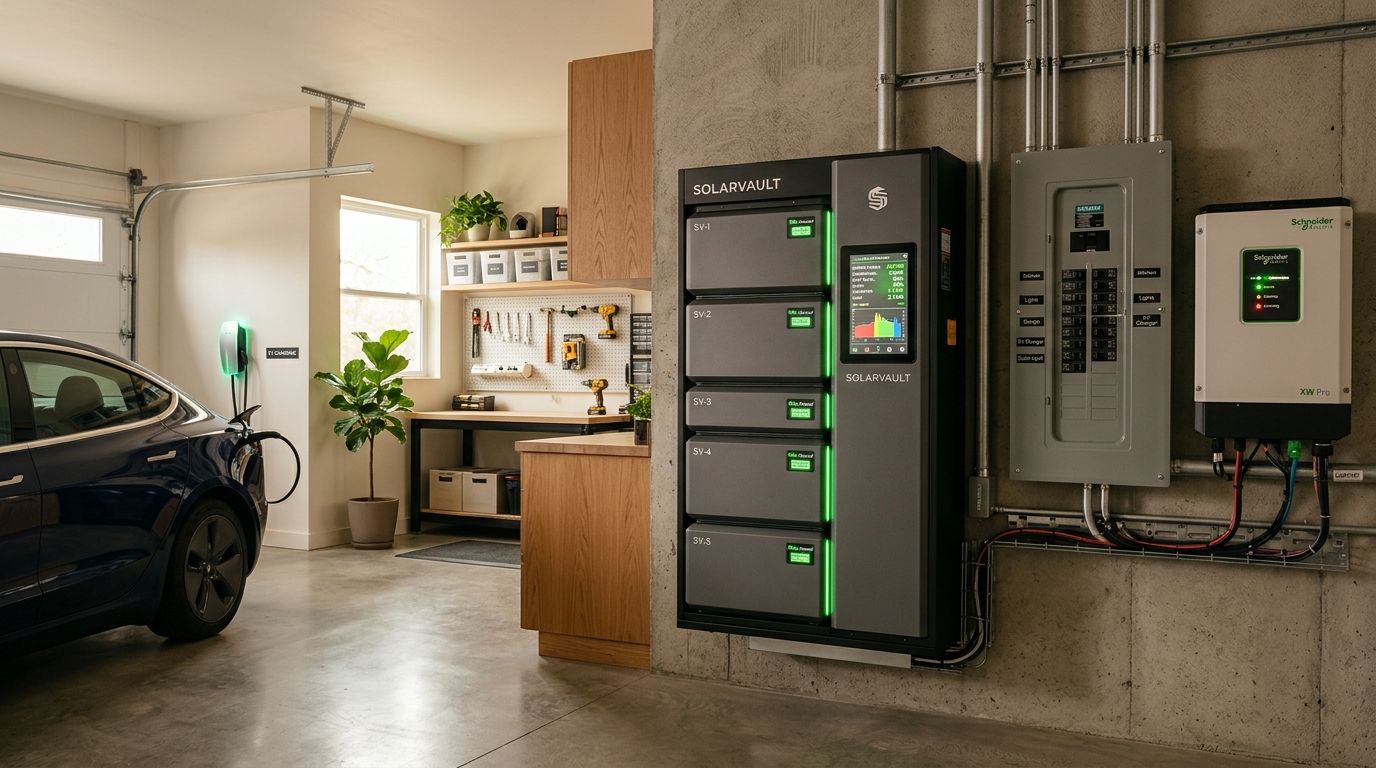
What counts as battery backup?
Battery backup is a stored-energy system that keeps selected electrical loads running when the grid fails. It can be a portable power station plugged into individual devices or a fixed battery wired to a critical-load panel.
The category covers three different products:
- A portable power station with AC outlets, USB ports, and often a 12V output. You plug devices into it directly. No installation, no panel work.
- A fixed home battery with a hybrid or backup inverter, wired to a transfer switch or a critical-load panel. It can run hardwired circuits and larger loads.
- A UPS (uninterruptible power supply) for a specific device, such as a computer or medical equipment. It switches over in milliseconds but usually holds only minutes of runtime.
The common thread is stored energy. The differences are capacity, output, transfer time, installation, and what happens when the battery is empty. A generator makes new electricity while fuel lasts; a battery only releases what was stored.
Portable power station or fixed home battery?
Portable stations need no installation and can move between rooms or vehicles. Fixed systems support larger loads and longer outages, but they require an electrician, permits, and a transfer switch or critical-load panel.
| Portable power station | Fixed home battery | |
|---|---|---|
| Installation | None | Electrician, permit, inspection |
| Loads | Appliances you plug in | Selected hardwired circuits or whole home |
| Capacity | Commonly 0.3–5 kWh; expandable systems exist | Several kWh and up |
| Output | Usually a few kW; check surge | Several kW to whole-home, depending on inverter |
| Runtime | Limited by a carryable battery | Longer; can be expanded |
| Recharge | Mains, solar, vehicle DC | Solar, grid, or generator through the inverter |
| Best fit | Renters, apartments, short outages, travel | Homeowners with a permanent backup plan |
A portable station is often the right first purchase. It covers communications, lights, device charging, and a fridge for a limited time, and it can move with you. It is not the right tool for a well pump, a furnace blower, or a sump pump on a dedicated circuit unless the unit is explicitly rated for that load and you have a safe connection method.
How do I size a battery backup?
Add the running watts of each essential load multiplied by the hours you need it, divide by usable depth of discharge and inverter efficiency, then add about 20% for surge, aging, and cold. Size for the outage you plan to survive, not for the whole house.
The formula:
Nominal watt-hours = (sum of watts × hours) ÷ (usable depth of discharge × inverter efficiency) × 1.2
Use the appliance nameplate for running watts, or a plug-in power meter for a real measurement. For cycling appliances, use average draw rather than the compressor’s peak. For a fridge, the annual kWh label divided by 365 gives a better daily estimate than the startup wattage.
Worked example. A fridge averages 100 W over 24 hours (2.4 kWh). A router draws 10 W continuously (0.24 kWh). Five LED lights draw 30 W total for five hours (0.15 kWh). Phone and laptop charging adds about 0.13 kWh. The delivered energy is about 2.9 kWh.
At 90% usable depth and 88% inverter efficiency, the nominal battery needs to be about 2.9 ÷ (0.9 × 0.88) = 3.7 kWh. Add 20% headroom and plan for roughly 4.4–4.5 kWh. If the outage may last two days, either double the battery or plan a recharge source.
Surge. A fridge may draw three to five times its running wattage for a second or two when the compressor starts. A sump pump or furnace blower can be similar. Check the station’s continuous and peak output, and avoid starting every large load at once.
Which loads should I back up?
Back up the loads that protect health, safety, food, and communication first: medical equipment, communications, lighting, refrigeration, and a way to charge devices. Add comfort and convenience loads only after the essentials fit.
| Load | Typical running watts | Startup surge | Notes |
|---|---|---|---|
| Refrigerator | 100–200 | 3–5× running | Use the annual kWh label for daily energy; keep the door closed |
| Router and modem | 5–15 | None | Continuous load; small but important |
| LED lights | 5–15 each | None | Use the actual bulb wattage |
| Phone and laptop | 10–65 | None | Charging is intermittent |
| CPAP | 30–60 | Low | Heated humidifier can add significantly; check the device |
| Sump pump | 300–800 | 2–3× running | Critical in wet basements; check surge |
| Furnace blower | 300–800 | High | A gas furnace still needs electricity for the blower and controls |
| Microwave | 700–1,200 | Low | High sustained load; short runtime |
| Space heater | 750–1,500 | Low | Large sustained load; usually a poor battery choice |
These are typical ranges, not specifications. Check the nameplate or manual for your exact appliance. Medical equipment deserves a separate plan: confirm the device’s power requirements, talk to the manufacturer or a medical professional, and do not rely on a single battery.
How long will a battery backup last?
Runtime is usable watt-hours divided by the load. A 1,000Wh station with 85% usable output runs a 100W load for about 8.5 hours. Cycling loads such as fridges last longer than their peak wattage suggests because the compressor is not always running.
The table below assumes 85% usable output and a steady load. It is an estimate, not a guarantee. Inverter overhead, temperature, battery age, and startup surges all reduce real runtime.
| Nominal capacity | 50 W | 100 W | 300 W | 500 W |
|---|---|---|---|---|
| 500 Wh | 8.5 h | 4.3 h | 1.4 h | 0.9 h |
| 1,000 Wh | 17.0 h | 8.5 h | 2.8 h | 1.7 h |
| 2,000 Wh | 34.0 h | 17.0 h | 5.7 h | 3.4 h |
For a duty-cycled appliance, multiply the runtime by the duty cycle. A fridge that runs 40% of the time draws its average, not its compressor peak, so a 1,000Wh station may keep it cold for much longer than the 100W row suggests. The only reliable way to know is to measure the appliance’s daily watt-hours.
Do not plan to discharge to 0%. Most lithium systems reserve a buffer, and deep discharges accelerate aging. Treat the table as an upper bound.
How will I recharge during a long outage?
Runtime is only half the plan. Mains, solar, vehicle DC, and generators each have limits, and a multi-day outage can outlast the battery. Decide how you will recharge before the grid fails.
A battery that runs the essentials for 24 hours is not a two-week solution unless it can be recharged. The options:
- Mains is unavailable during the outage that matters most.
- Solar depends on panel wattage, orientation, weather, and season. A 200W panel might produce roughly 0.8–1.2 kWh on a good day in summer and much less in winter or cloud. Recharge time is not just panel wattage divided by battery capacity.
- Vehicle DC can top up a portable station while the engine runs, but it is slow and uses fuel. Do not idle a vehicle in an enclosed space.
- A fuel generator can recharge a battery quickly, but it needs fuel, maintenance, and outdoor operation away from windows and doors. Carbon monoxide kills.
Calculate an ideal recharge time as battery watt-hours divided by charger watts, then add 20–40% for conversion losses and the charger’s tapering behaviour. A 1,000Wh battery with a 200W charger takes about five hours in theory and longer in practice.
What are the installation and safety rules?
Use portable stations only as the manufacturer instructs, and never backfeed a home circuit without a transfer switch. Fixed systems require a qualified installer, permits, and inspection. Fuel generators must run outdoors, away from windows and doors.
Portable stations. Keep them dry, ventilated, and within the manufacturer’s temperature range. Do not chain power strips into a rat’s nest of extension cords. Check the continuous and surge ratings before connecting a fridge, pump, or heater. Never use a male-to-male cord to connect a station to a wall outlet or panel; that is backfeeding and can electrocute a utility worker.
Fixed systems. A home battery needs a transfer switch or a critical-load panel so the house can disconnect from the grid before the inverter energizes the circuits. The installation needs a permit and inspection in most places, and the equipment must be listed for the application. Use a qualified installer who will commission the system and test the backup transition.
Generators. Never run a fuel generator indoors, in a garage, or near a window or door. Carbon monoxide is invisible and can build up quickly. Follow the manufacturer’s clearance and grounding instructions, and install battery-powered CO alarms.
Testing. Test the backup under load before you need it. Plug in the actual fridge or pump, confirm the surge starts, and note the runtime. Repeat the test occasionally and replace the battery when capacity falls below your needs.
Where to start shopping
The three lowest cost-per-watt-hour stations in the live US catalog. Affiliate links; the ranking is not paid.


Retailer links are affiliate links. WhichWatts may earn a commission; the shortlist is ranked by cost per watt-hour, not by commission.
Shop by brand
Direct links to manufacturer stores. These are affiliate links and we may earn a commission.
Compare before you buy
Browse every model · Cost per watt-hour chart · Best for home backup · Size a system for your appliances
Common questions
How many watt-hours do I need for 24 hours of backup?
Add up the watts of the loads you want to run and multiply by 24, then divide by usable efficiency and add 20%. A fridge, router, lights, and device charging can land around 3–5 kWh of nominal storage, but the exact number depends on the appliances and how often they cycle.
Can a portable power station run a refrigerator?
Yes, if the station’s continuous and surge ratings cover the fridge’s startup draw. A fridge may pull three to five times its running wattage for a second or two. Check the nameplate and the station’s peak rating, and measure the fridge’s daily kWh if you can.
Can I plug a battery backup into my house?
Only with a proper transfer switch or critical-load panel installed by a qualified electrician. A male-to-male cord between a station and a wall outlet is backfeeding, can damage equipment, and can electrocute a utility worker. Portable stations are for plugging appliances directly into the station.
How long does a home battery backup last?
It depends on capacity, load, and how deeply you discharge it. A lithium system may carry essentials for a day or more; a larger system can last longer. The battery’s calendar life and cycle life also matter. Ask for the warranty’s capacity-retention threshold, not just the year count.
What size battery backup do I need for medical equipment?
Check the device’s power requirements with the manufacturer and plan for the longest outage you reasonably expect. Do not rely on a single battery or a single recharge path. Medical needs are a safety-critical case; a backup plan should include an alternative power source and a place to go if the equipment cannot run.
Do I need a generator with a battery backup?
Not necessarily. A battery can carry essentials for a short outage without fuel or fumes. A generator becomes useful when the outage is long and you need to recharge the battery or run high-wattage loads. If you use one, run it outdoors and follow the carbon-monoxide guidance.
How often should I test my battery backup?
Test it under load before each storm season and periodically during the year, following the manufacturer’s guidance. Confirm the transfer works, the surge loads start, and the runtime still meets your plan. Replace or expand the battery before capacity falls below your essential-load requirement.
Sources
- U.S. Department of Energy — Batteries — Battery capacity, chemistry, and system basics.
- U.S. Energy Information Administration — Energy storage — How storage capacity and round-trip efficiency are measured.
- U.S. Department of Energy — How solar works — Solar recharge and inverter basics for outage planning.
Related: Solar battery storage · Battery capacity explained · Best power stations for home backup · Outage backup buying guide · Power station runtime guide · Size your backup with the calculator
WhichWatts is independent and funded by affiliate commission. Figures come from manufacturer specifications and the live catalog; see our methodology. Corrections to hello@whichwatts.com.