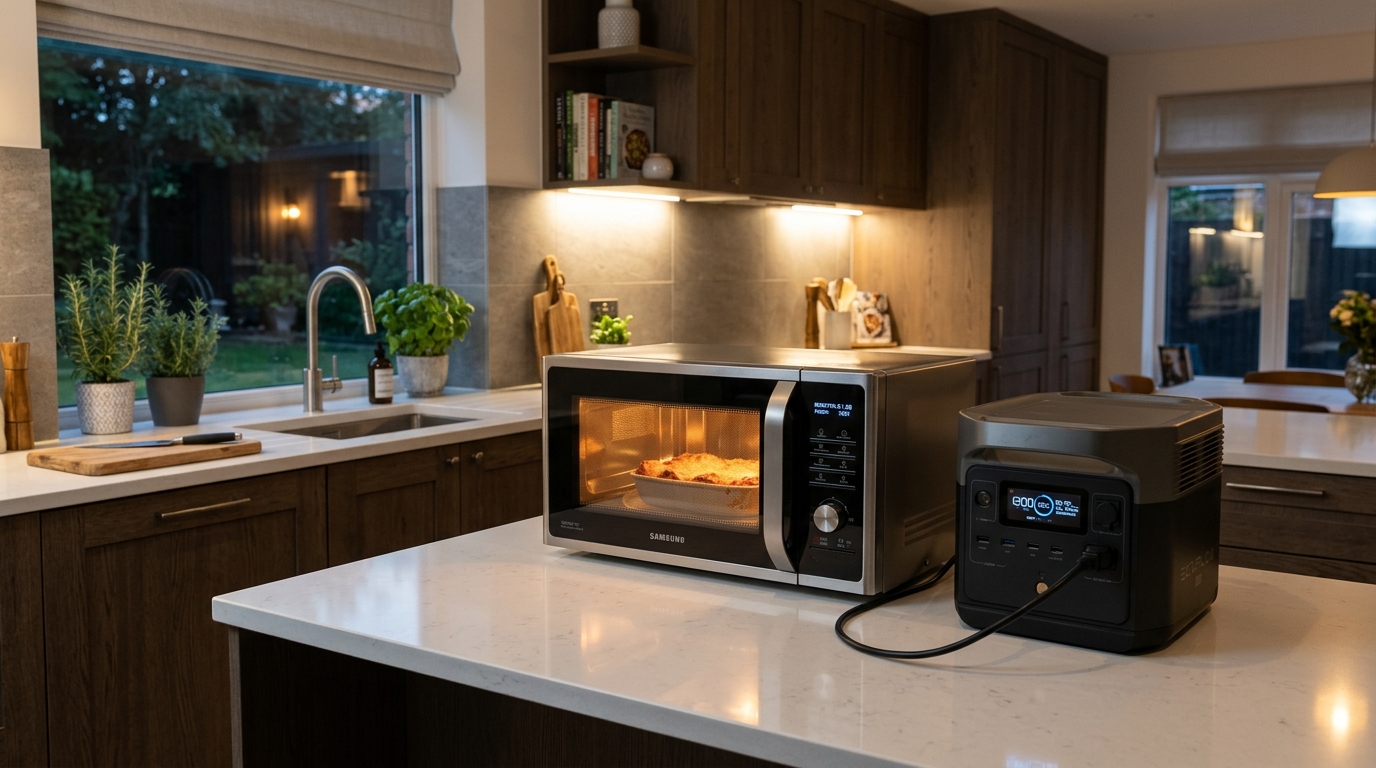
Direct answer: Yes, if the inverter covers the input wattage rather than the cooking wattage. An 800 W microwave draws roughly 1,250 W; a 1 kWh station delivers about seven five-minute reheats, a 2 kWh station about fifteen.
Editorial note: WhichWatts is an independent comparison site. Prices, availability, specifications, and retailer promotions change frequently. Check the live product table and retailer page before buying.
Can a Power Station Run a Microwave? Input Watts and Runtime
Microwaves are one of the most misunderstood loads in backup-power planning, because the number on the front is not the number the inverter sees. A "900 W" microwave can draw 1,050 W, and a "1,000 W" model can pull 1,580 W. Size a station from the cooking wattage and it will trip the first time you press start.
This guide explains the difference, gives the runtime maths, and lists the station classes that reliably run a domestic microwave.
The short answer
Yes — a modern 1 kWh station with a 1,800 W inverter will run an 800 W microwave, because the real draw is about 1,250 W. A five-minute reheat uses roughly 0.1 kWh, so a 1 kWh station manages about seven of them. Larger 1,200 W output microwaves can draw 1,400–1,700 W and need a 2,000 W+ continuous inverter.
Cooking watts vs input watts
Microwave labels quote output power: the microwave energy delivered to the food, measured to IEC 60705. The appliance also runs a transformer, magnetron cooling fan, turntable motor, light and controls, and the conversion is not lossless. Input power is typically 20–50% higher than output.
| Rated cooking output | Typical input draw | Five-minute use |
|---|---|---|
| 700 W | 1,000–1,200 W | 0.08–0.10 kWh |
| 800 W | 1,150–1,300 W | 0.10–0.11 kWh |
| 900 W | 1,050–1,450 W | 0.09–0.12 kWh |
| 1,000 W | 1,400–1,580 W | 0.12–0.13 kWh |
| 1,200 W | 1,400–1,700 W | 0.12–0.14 kWh |
The ranges are wide because designs differ. A survey of 203 countertop models found the average 1,000 W microwave drew 1,402.7 W; manufacturer rating plates show a GE 900 W at 1,050 W, a GE 1,000 W at 1,580 W, and a Panasonic 1,200 W at 1,400 W. The only reliable figure is the rated input on your own rating plate, usually on the back or inside the door.
How long will a power station run a microwave?
Using 1,400 W input and a five-minute reheat (117 Wh), with the usual 0.765 usable factor:
| Station size | Usable energy | Five-minute reheats | Ten-minute cooks |
|---|---|---|---|
| 500 Wh | 383 Wh | 3 | 1 |
| 1,000 Wh | 765 Wh | 6–7 | 3 |
| 2,000 Wh | 1,530 Wh | 13 | 6 |
| 3,600 Wh | 2,754 Wh | 23 | 11 |
| 5,000 Wh | 3,825 Wh | 32 | 16 |
Microwave energy is modest because the runs are short. The binding constraint is almost always the inverter, not the battery.
What the inverter has to survive
- Continuous input watts. Add the microwave's rated input to anything else running. A 1,400 W microwave plus a 1,500 W kettle is 2,900 W.
- Startup inrush. Transformer-based microwaves can pull a brief spike well above running watts. Inverter-type microwaves are gentler. If the station trips only at the moment you press start, inrush is the likely cause.
- Pure sine wave. Magnetron control boards and inverter models expect a clean waveform; modified sine wave can cause erratic heating or noise.
- Voltage and plug. A 120 V microwave needs a 120 V station; a 230 V model needs 230 V. Adapters do not convert voltage.
- Ventilation. Do not stack the station against the microwave's vents; both need airflow.
Which power stations run a microwave?
| Station | Capacity / continuous output | Microwave it suits |
|---|---|---|
| Anker SOLIX C1000 | 1,056 Wh / 1,800 W | 800 W output (≈1,250 W input) |
| EcoFlow DELTA 2 Max | 2,048 Wh / 2,400 W | Up to 1,000 W output, plus lights |
| Bluetti AC200L | 2,048 Wh / 2,400 W | 1,000 W output with headroom |
| EcoFlow DELTA Pro 3 | 4,096 Wh / 3,600 W | 1,200 W output; long outages |
| Anker SOLIX F3800 | 3,840 Wh / 6,000 W | Large or over-range microwaves |
A 500 Wh station is the wrong tool: its inverter is usually 300–600 W, well below any microwave's input.
Using a microwave efficiently on battery
- Reheat in shorter bursts. Two three-minute bursts use the same energy as one six-minute run but keep the average load lower.
- Avoid combining with the kettle. Boil water on gas or before the microwave, not simultaneously.
- Use the rating plate, not the badge. The input figure is the one that decides whether the station trips.
- Defrost overnight in the fridge. It costs the battery nothing.
FAQ
Is microwave wattage the same as power draw?
No. The advertised 700–1,200 W is cooking output. The wall draw is typically 20–50% higher — about 1,250 W for an 800 W microwave and up to 1,580 W for a 1,000 W model.
Can a 1 kWh station run a microwave?
Yes for an 800 W microwave: about 1,250 W input fits inside a 1,800 W inverter, and the battery delivers roughly seven five-minute reheats.
Can I run a microwave and kettle at once?
Only on a station with enough continuous output for both — around 2,700–3,000 W for a 1,400 W microwave plus a 1,500 W kettle. On smaller units, run them one at a time.
Does a microwave need a pure sine wave inverter?
It is strongly preferred. Modified sine wave can upset inverter-type microwaves and control boards, and may cause the station's protection to trip.
Why does my microwave trip the station at startup?
Transformer inrush can briefly exceed the inverter's surge rating. Try a lower power setting, start the microwave before other loads, or use a station with a higher surge rating.
Amazon price checks: countertop microwaves · portable power stations. As an Amazon Associate, WhichWatts earns from qualifying purchases.
Sources
- EcoCostSavings: microwave input vs output across 203 models
- Bluetti: microwave amps and rating-plate examples
- EU JRC: Ecodesign review of cooking appliances (IEC 60705)
- US Department of Energy: estimating appliance energy use